

In the U.S., most businesses pay $500 to $5,000 a month for SEO, and a realistic small-business retainer lands between $1,500 and $3,000 a month. Hourly billing averages around $111 an hour, though actual cost depends heavily on scope. The immediate next step: ask any provider under consideration for a scope-matched proposal and a 6 to 12 month roadmap before you sign anything.
TL;DR:
- Most U.S. businesses pay between $500 and $5,000 monthly for SEO, with the average around $2,917, depending on scope and industry competitiveness.
- Local SEO campaigns typically cost about $1,557 per month, whereas national campaigns can reach roughly $3,474, due to wider keyword and content demands.
- The most common pricing models are monthly retainers, hourly billing, and per-project fees, each suited to different business needs and scope.
- Effective SEO requires a proper scope, including technical audits, content planning, and realistic timelines of six to twelve months to see measurable results.
- Vetting a provider’s success metrics, transparency on scope, and experience is more important than choosing based solely on cost or quick promises.
Table of Contents
- What SEO costs across the United States right now
- How retainers, hourly billing, and project fees actually work
- Matching your budget to your business size and scope
- Why two quotes for the same site can look so different
- What to expect month by month
- Turning your SEO budget into a measurable return
- How to evaluate an SEO proposal before you sign
- How one Orlando agency structures its SEO plans
- What the pricing data actually tells you to prioritize
- Getting a quote that matches your actual budget
- Where these benchmarks came from
- Sources
- FAQ
What SEO costs across the United States right now
The clearest number to anchor your budget on comes from a 2026 survey of U.S. providers: SEO costs an average of $2,917 per month, with 63% of businesses spending between $500 and $5,000 monthly. That range is wide on purpose. A single-location service business and a multi-state e-commerce brand both fall under “SEO,” but they need very different amounts of work.
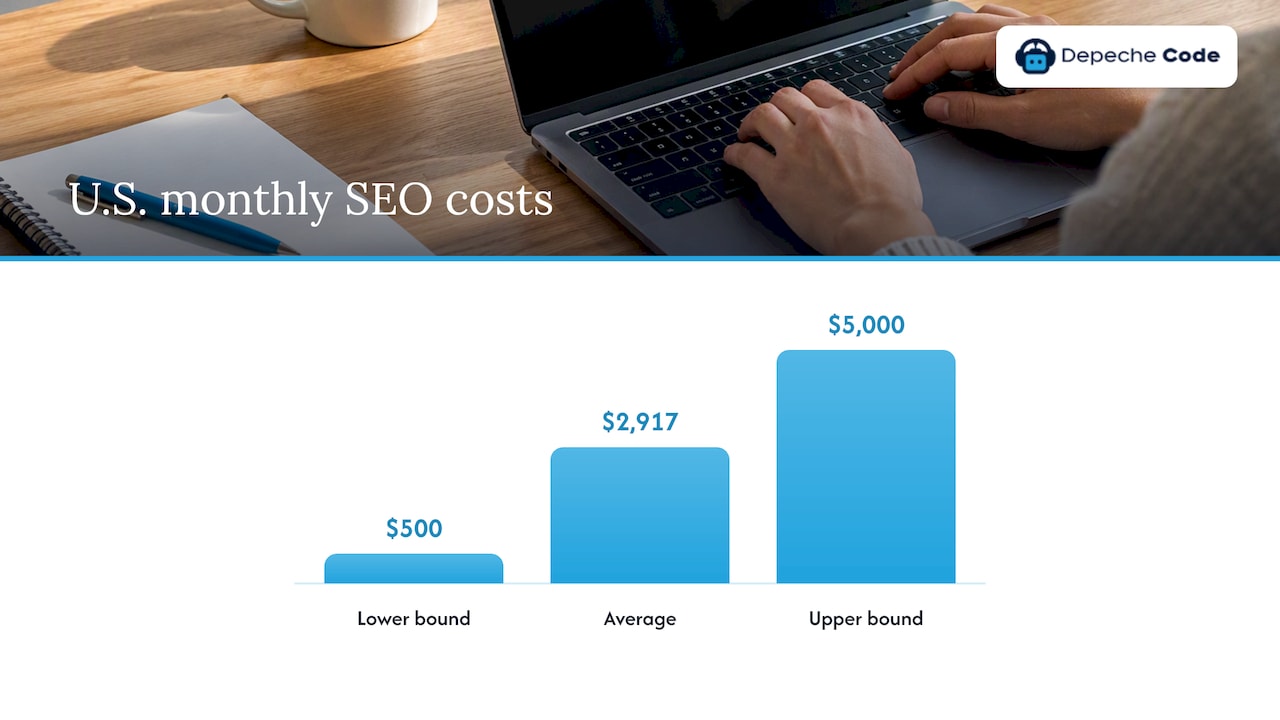
The $2,917 average monthly spend among U.S. providers reflects a mix of freelancers, agencies, and consultants, so a quote near the bottom of the range isn’t automatically a red flag, and one near the top isn’t automatically overpriced; it depends on what’s being delivered. GoodFirms’ 2026 pricing survey breaks this down further by provider type and campaign scope, which is useful context before you start comparing quotes.
A few numbers worth holding onto when you’re reading proposals:
- Monthly retainers cluster between $500 and $5,000, with the heaviest concentration in the lower-to-middle part of that band.
- Hourly rates generally fall between $75 and $150 per hour, averaging near $111 an hour.
- Per-project fees, used for one-time audits, migrations, or technical overhauls, typically run from $1,000 to $5,000 or more depending on the site’s size and condition.
- Local campaigns cost less than national ones: local SEO averages around $1,557 a month versus roughly $3,474 a month for national campaigns, since national work usually means more keywords, more content, and more competitive link targets.
These figures are survey averages, not fixed rates, and they vary by industry. A competitive field like legal services or financial services tends to cost more than a local home-services business, because the keywords are harder to rank for and the content requirements are heavier. If a quote looks unusually low for a competitive niche, ask what’s being cut to hit that number: content volume, link-building hours, or technical work are the usual places corners get trimmed.
Provider type matters too. Freelancers tend to price lower than agencies or consultants, mostly because they carry less overhead and often specialize in a narrower set of tasks. Agencies and consultants typically bring a broader team (strategists, writers, technical specialists) which shows up in the monthly rate. Neither model is inherently better: a freelancer can be the right call for a single-location business with a simple site, while a multi-location or e-commerce brand usually needs the bench strength an agency provides.
How retainers, hourly billing, and project fees actually work
Most SEO work is sold under one of four pricing structures, and each one fits a different kind of business.
- Monthly retainers are the dominant model because SEO is ongoing work: content needs refreshing, rankings need monitoring, and competitors keep moving. A retainer gives you continuity and a defined scope of monthly deliverables, usually a set number of content pieces, technical checks, and link-building activities. This suits businesses that want steady, compounding progress rather than a one-time fix.
- Hourly billing shows up most often for smaller, well-defined tasks: a technical audit, a one-time site migration review, or ongoing consulting where the scope changes month to month. The risk is scope creep. Without a cap on hours, a project that was supposed to take ten hours can quietly become thirty.
- Per-project pricing fits discrete, finite work: a site migration, a Core Web Vitals cleanup, or a one-time competitive audit. You know the total cost upfront, but this model doesn’t cover ongoing optimization, so it’s a poor fit if your real goal is sustained ranking growth.
- Productized packages bundle a fixed set of deliverables (a certain number of blog posts, a defined number of backlinks, a monthly reporting call) into a flat monthly price. These work well for small businesses that want predictable costs and don’t have the bandwidth to negotiate custom scopes every quarter.
None of these models is universally “better.” A retainer makes sense when you’re committed to SEO as a long-term channel. Hourly or per-project billing makes sense when you have a narrow, specific problem to solve. The mistake many business owners make is signing a broad retainer when what they actually needed was a focused technical fix.
Matching your budget to your business size and scope
Benchmark numbers only help if you know which segment you fall into. Business size and campaign scope (local versus national) are the two biggest levers.
- Startups and micro-businesses often start smaller, sometimes handling basic on-page fixes themselves before bringing in outside help, and should expect limited scope (a handful of pages, a narrow keyword set) rather than a full campaign.
- Small businesses usually budget a moderate monthly amount to cover ongoing content, basic technical maintenance, local citation work, and reporting, enough to build steady visibility.
- Mid-market and enterprise businesses usually budget well above small-business norms, since they need larger content teams, more aggressive link-building, and technical work across far more pages and, often, multiple domains or subdomains.
- Local campaigns cost less than national ones because the keyword set is narrower and the competition is geographically bounded. A national campaign has to compete for terms against businesses across the entire country, which pushes up both content and link-building requirements, and explains most of the jump from the roughly $1,557 local average to the $3,474 national average.
The practical takeaway: don’t buy a national-scope retainer if you only serve one metro area, and don’t expect a local-scope budget to move the needle on nationally competitive keywords. Matching scope to actual business need is the single biggest lever for avoiding wasted spend.
Why two quotes for the same site can look so different
If you’ve gotten quotes ranging from $800 to $4,500 a month for what feels like the same job, the gap usually comes down to a handful of variables.
- Industry competitiveness: ranking for “personal injury lawyer” costs more in time and content than ranking for a niche local service with little competition.
- Technical SEO needs: a site with crawl errors, slow load times, or a messy URL structure requires developer hours that a clean site doesn’t.
- Content production volume: a plan built around four long-form articles a month costs more than one built around a single blog post, and quality expectations (original research, expert review) add further cost.
- Link-building intensity and risk profile: earning links from relevant, editorially placed sources takes more time and skill than cheap directory submissions, which carry little ranking value and some risk.
- Number of locations or product lines: a business with ten locations needs ten sets of local pages, citations, and often separate landing page content, which multiplies the work.
- Provider experience and staffing model: a senior strategist’s time costs more than a junior associate’s, and agencies with specialized roles (technical SEO, content, outreach) typically price higher than a generalist freelancer.
Pro Tip: When a link-building line item looks cheap, ask what the links actually are. Low-cost outreach often means low-value directory or guest-post placements that won’t move competitive keywords, while quality link building weighs domain relevance and editorial placement over sheer volume.
What to expect month by month
SEO is not a channel that produces overnight results, and any proposal promising fast ranking jumps across competitive terms deserves scrutiny.
- Months 0 to 1: expect a technical audit, a content and keyword roadmap, and the first round of quick technical fixes (broken links, missing metadata, indexing issues).
- Months 2 to 6: this is when on-page updates roll out, initial content goes live, and you typically start seeing early movement in organic traffic and rankings for lower-competition terms.
- Months 6 to 12 and beyond: link-building and authority growth compound, and this is usually when measurable revenue impact becomes visible, particularly for competitive keywords.
Search Engine Land’s guidance on SEO timelines confirms this general arc: most businesses see measurable results within 3 to 6 months, while competitive industries or larger sites often need 6 to 12 months before the gains become significant. If a provider’s proposed timeline looks dramatically faster than this, especially in a competitive niche, ask what’s driving that confidence. A credible vendor can show you early deliverables, like completed technical fixes and a content calendar, well before rankings move.
Turning your SEO budget into a measurable return
Before you commit to a monthly number, it helps to work backward from what a new customer is actually worth to your business.
Start by assigning a dollar value to a lead or a sale. If your average sale is $500 and about one in ten leads converts, each lead is worth roughly $50. From there, you can estimate how many leads a given traffic increase needs to generate before the campaign pays for itself. A practical ROI approach tracks total investment (agency fees, tools, content costs) against the revenue generated from organic traffic over a 6 to 12 month window, which matches the timeline most SEO campaigns need to show results.
The basic formula: ROI equals (revenue from organic traffic minus total SEO spend), divided by total SEO spend. As a worked example: say a business spends $2,000 a month on SEO, or $24,000 over a year, and that campaign generates 100 new leads at $50 each by month twelve, or $5,000 in revenue. That’s a negative return in year one, which is normal for competitive niches still building authority. The number to watch is the trend: if leads attributable to organic traffic are climbing month over month, the investment is working even if it hasn’t broken even yet.
| Tool | What it tracks | Cost |
|---|---|---|
| Google Analytics 4 | Traffic sources, conversions, user behavior | Free |
| Google Search Console | Keyword rankings, click-through rate, indexing issues | Free |
Beyond these free tools, many providers add paid rank-tracking or content tools to their workflow, and those costs should appear in your monthly total rather than as a surprise add-on later. When you’re comparing a $1,800 quote to a $2,400 quote, check whether tool costs, content production, or reporting are bundled into the higher number.
How to evaluate an SEO proposal before you sign
Price alone tells you very little. What matters more is whether the deliverables and reporting match what you’re paying for.
A credible SEO proposal should include:
- A technical audit covering site speed, crawlability, and indexing issues.
- A content plan with a defined volume and cadence, not just a vague promise to “publish regularly.”
- A reporting cadence (monthly, at minimum) showing traffic, rankings, and conversions, not just rankings alone.
- Clear KPIs tied to business outcomes (leads, sales, calls) rather than vanity metrics like “keywords ranked.”
Before signing, ask the provider:
- Who specifically will work on the account, and what’s their experience with businesses your size?
- What tools do you use for tracking and reporting, and will I have direct access to the dashboards?
- How do you define and measure success for this campaign?
- Can you share examples of past results with businesses in a similar industry or size?
- What’s the minimum contract length, and what happens if I want to cancel?
- How many pages or locations does this proposal actually cover?
- What’s included in link-building, and how do you vet link quality?
- How often will we talk, and who do I contact if something feels off-track?
- What happens to the content and work product if I leave: do I keep ownership?
- How do you handle algorithm updates that affect rankings outside your control?
Watch for a few contractual red flags. Guaranteed rankings are a warning sign since no legitimate provider controls Google’s algorithm closely enough to promise a specific position. Vague deliverables (“ongoing optimization,” “regular content”) without specifics on volume or scope make it impossible to know what you’re paying for. And no defined reporting cadence means you won’t know whether the work is happening at all until months have passed.
How one Orlando agency structures its SEO plans
Looking at how an actual in-market provider organizes its offerings can make these benchmarks concrete. A full-service digital agency based in Orlando structures its SEO work around a few plan types rather than a single flat retainer, which maps reasonably well to the budget bands covered above.
- Local SEO plans target businesses competing in a defined service area, which aligns with the lower end of the local-campaign averages discussed earlier.
- Combo SEO plans blend local and organic (national-style) work for businesses that serve a home region but also want broader visibility.
- Organic SEO plans focus on national-scope keyword competition, suited to businesses without a single physical service radius.
One agency also folds AI-assisted tools into parts of its workflow, which helps reduce the manual hours typically spent on tasks like technical audits and reporting; using Google and ChatGPT Traffic on Autopilot can further streamline these processes for agencies. That shift can change the price-to-value math on a proposal: fewer billable hours spent on repetitive tasks can mean more of the budget goes toward content and link-building, the parts of SEO that most directly move rankings.
Full plan details and pricing structures are listed on the agency’s plan overview, which is a useful reference point when comparing any quote against what a local, in-market provider actually offers for the money.
What the pricing data actually tells you to prioritize
The biggest misconception in SEO budgeting isn’t about price, it’s about sequencing. Business owners often ask “what should SEO cost” when the better question is “what does my site need before spending anything.” A technical audit costing a few hundred dollars can reveal that a $3,000-a-month content retainer would be wasted on a site with indexing errors blocking half its pages from Google entirely.

Conventional advice treats the monthly retainer number as the whole decision. It isn’t. Two businesses paying the exact same $2,000 a month can get wildly different results depending on whether that money goes toward strategic technical fixes and well-researched content, or toward generic blog posts and low-value link placements. The number on the invoice says almost nothing about the quality of the work behind it.
If you take one thing from this guide, prioritize the vetting questions over the price comparison. A provider who can clearly explain their reporting cadence, link-building standards, and realistic timeline is a better bet than the cheapest or the most expensive quote on your desk.
— Donovan Wells – Founder and CEO
Getting a quote that matches your actual budget
Some providers offer SEO plans built around different scopes: Local SEO/AEO Plans for businesses competing in a defined service area, Combo SEO/AEO Plans for those blending local and broader visibility, and Organic SEO/AEO Plans for national-scope keyword competition.

Rather than trying to fit your business into a generic retainer, Depeche Code scopes proposals around what your site actually needs, whether that’s a technical cleanup, a content build-out, or a full local-to-national transition.
- Review the Search Engine Optimization services page to see how plan types map to campaign scope.
- Request a scoped quote that reflects your specific location count and keyword competitiveness, not a one-size-fits-all number.
- Confirm whether local or national scope fits your business before committing to a retainer size.
Visit the full services overview to compare SEO alongside related services like hosting and content support, and get a proposal matched to your actual budget and goals.
Where these benchmarks came from
The pricing figures in this guide come primarily from GoodFirms’ 2026 SEO pricing survey, which breaks down U.S. monthly, hourly, and project-based averages across freelancers, agencies, and consultants. Timeline expectations are drawn from Search Engine Land’s guide to SEO results timelines, and the ROI framework references a practical guide to measuring SEO success.
- Treat survey averages as a starting range, not a quote you should expect to match exactly.
- Always check whether a benchmark reflects local or national scope before comparing it to your own situation.
Sources
- SEO Pricing in the USA (2026): What Agencies, Freelancers & Consultants Actually Charge
- How long does SEO take to work? SEO timeline & results explained
FAQ
How much does SEO cost in the USA?
Most U.S. businesses spend $500 to $5,000 a month on SEO, with an average around $2,917 a month across providers. Hourly billing typically runs $75 to $150 an hour, and per-project work for audits or migrations usually costs $1,000 to $5,000 or more.
How much should I expect to pay for SEO?
A realistic small-business retainer falls between $1,500 and $3,000 a month, covering ongoing content, basic technical maintenance, and monthly reporting. Local campaigns tend to cost less than national ones, averaging around $1,557 versus $3,474 a month, since national work requires a broader keyword and content footprint.
What is the 80/20 rule in SEO?
In SEO, a common principle is that a small share of pages, keywords, or fixes tend to drive most of the measurable results, so prioritizing high-impact technical and content work usually outperforms spreading effort evenly. Definitions vary by source, so treat it as a prioritization principle rather than a fixed formula.
Why is SEO so expensive?
SEO costs reflect the time required for technical fixes, content research and writing, and relevant link-building, none of which can be meaningfully rushed without hurting results. Costs climb further with industry competitiveness, the number of business locations, and whether the campaign targets local or national visibility.
Should I hire an in-house SEO team or an agency?
An in-house hire makes sense for businesses with enough ongoing work to justify a full-time salary and benefits, while an agency or freelancer typically costs less upfront and brings a broader skill set across technical, content, and link-building work. Many small and mid-size businesses choose an outside provider first and consider in-house staffing only once SEO becomes a primary growth channel.