

Expect to pay anywhere from a low monthly SaaS starter fee to mid-five-figure monthly bills once you move into enterprise usage, and the gap between those two numbers almost always comes down to one thing: how your model or token consumption scales with traffic. Before you request a quote, estimate your expected monthly message volume. That single number predicts your bill better than any feature list.
TL;DR:
- Most high-volume chatbot costs are driven by token or resolution-based charges, which scale with traffic and can reach thousands of dollars monthly.
- Token prices often include additional fees for caching, Uplift charges, regional compliance, or priority modes that complicate cost estimation.
- Running a chatbot on flat-rate tiers offers predictability but may limit usage, while usage-based models are more cost-effective at low volumes but variable at scale.
- Proper cost estimation requires considering setup, knowledge base creation, integration, ongoing maintenance, and monitoring expenses beyond just subscription fees.
- Asking vendors for detailed overage definitions, cache support, uplift charges, and separate setup costs helps avoid surprise invoices.
Table of Contents
- How AI chatbot pricing models actually work
- Model and token pricing: reading the fine print in vendor tables
- Cost components your budget needs to include
- Realistic pricing bands by deployment type
- How to estimate your actual monthly bill
- Questions to ask vendors before you sign
- What managed chatbot projects typically involve
- Managed agency or DIY API: which path fits your business
- Depeche Code’s AI chatbot plans and how to get a quote
- FAQ
- Sources
How AI chatbot pricing models actually work
Every chatbot price tag hides one of four billing architectures, and knowing which one you’re looking at changes how you should read the quote.
Flat-rate tiers charge a fixed monthly fee for a bundle of features and a usage cap. Per-resolution or per-interaction pricing charges you each time the bot completes a conversation or resolves a query. Token-based API pricing charges by the unit of text the underlying language model processes, measured per million tokens. Per-seat licensing charges for each human agent or admin who manages the bot, common in hybrid human-plus-AI support tools.
Token pricing carries a wrinkle that catches most buyers off guard: prompt caching. When a conversation reuses the same system instructions or knowledge base context across multiple turns, providers let you cache that content instead of reprocessing it every time. Anthropic prices cache writes and cache hits at different multipliers than standard input tokens, and whether your vendor passes those savings to you or pockets them changes your real cost.
- Flat-rate tiers trade flexibility for predictability: you know your bill before the month starts.
- Per-resolution pricing scales with outcomes but can spike during seasonal traffic.
- Token-based pricing is the most transparent model and the easiest to misjudge at scale.
- Per-seat licensing suits teams that need human oversight layered on top of automation.
A vendor’s advertised base price almost never reflects what high-volume customers pay. A $49 monthly starter plan assumes a message cap; once your traffic crosses it, the token or resolution charges underneath start doing the real work on your invoice.
Model and token pricing: reading the fine print in vendor tables
If your chatbot runs on a third-party language model, your bill is really two bills stacked together: the platform fee and the model’s own token rate. Vendor pricing tables list separate charges for input tokens, cached input tokens, cache writes, and output tokens, usually quoted per one million tokens. Output tokens almost always cost more than input tokens because generating text is computationally heavier than reading it.
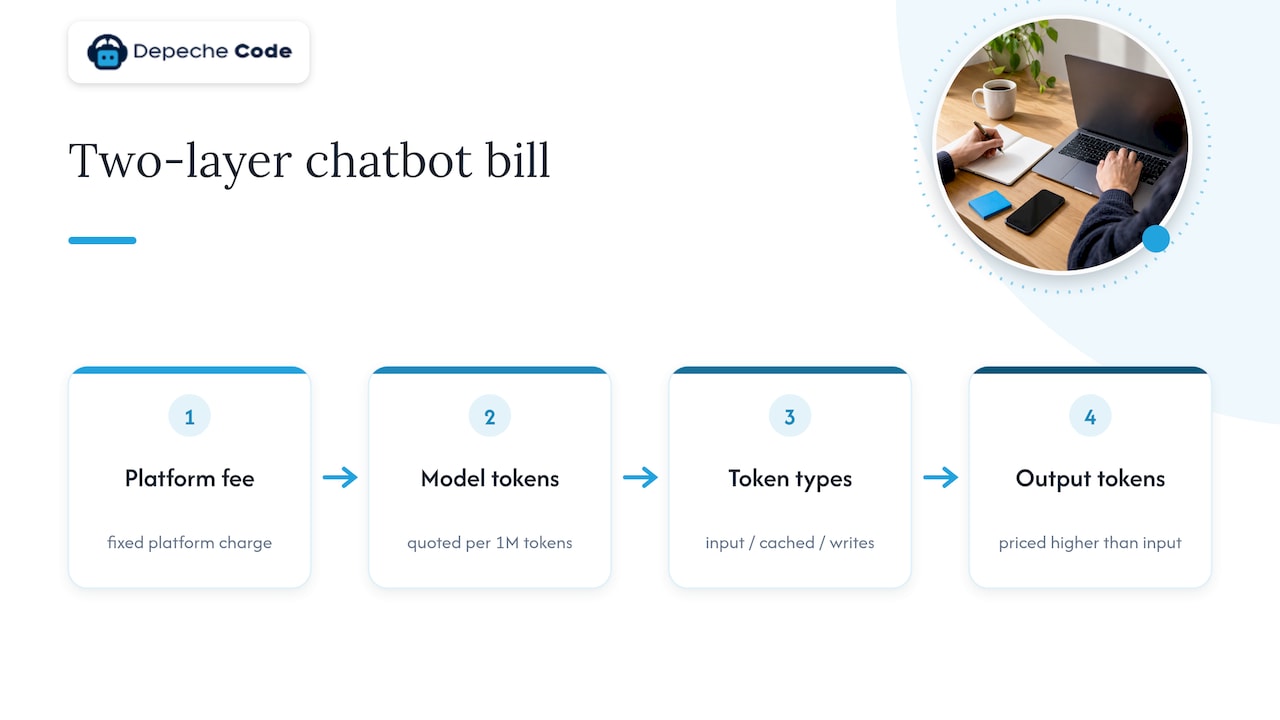
Watch for uplifts layered on top of the base rate. OpenAI’s pricing documentation notes additional charges for FedRAMP compliance and regional data-residency processing, and separately prices a “Fast” or priority mode for lower-latency responses. Google Cloud’s Gemini Agent Platform currently lists introductory per-1M token pricing for its Flash models, with a published end date for that promotional window before standard rates take over, a reminder that the number you see today may not hold next quarter.
A fraction of a cent per token sounds trivial until volume multiplies it. A model priced at a few dollars per million output tokens can still produce a monthly bill in the hundreds or thousands once a chatbot handles tens of thousands of conversations, because vendor pricing tables apply that rate to every token generated, not just the ones a human notices.
Two providers charging rates that look nearly identical per token can still produce meaningfully different invoices once you factor in caching discounts, uplift charges, and whether output tends to run long or short for your use case. Read the full table, not just the headline rate, before you compare vendors.
Cost components your budget needs to include
Most chatbot budgets fail because they price the subscription and forget everything around it. Split your planning into one-time setup costs and recurring operating costs.
- Discovery and scoping: defining use cases, conversation flows, and escalation rules before any build starts.
- Knowledge base creation: writing, structuring, and uploading the content the bot draws answers from.
- Integration work: connecting the bot to your website, CRM, help desk, or booking system.
- UI and design work: matching the chat widget to your site’s look and interaction patterns.
- Custom connectors: building links to niche internal tools that don’t have off-the-shelf integrations.
- Testing and QA: running real conversation scenarios before launch to catch gaps in the knowledge base.
Recurring costs stack on top: the platform subscription itself, ongoing token or API usage, hosting and storage for logs and conversation history, monitoring and analytics, maintenance as your products or policies change, support contracts, and any service-level agreement fees tied to uptime guarantees.
Custom development earns its higher upfront cost when your use case involves proprietary data, complex multi-step workflows, or integrations no off-the-shelf platform supports well. For a straightforward customer-service deflection bot answering FAQs and routing tickets, a SaaS subscription with predictable monthly fees almost always beats a custom build on cost and time to launch.
Pro Tip: Ask every vendor to quote your knowledge base setup and integration work as a separate line item, not folded into the subscription, so you can compare the recurring cost in isolation.
Realistic pricing bands by deployment type
Mapping your project to a deployment type narrows your estimate faster than reading another feature comparison.
- SaaS starter tiers typically bundle a chat widget, a limited monthly message or resolution cap, basic analytics, and email support, aimed at small businesses answering routine questions.
- Mid-tier SaaS plans add higher usage caps, multilingual support, CRM integrations, and priority support, suited to growing teams fielding steady support volume.
- API-driven, usage-based deployments charge close to the raw model rate plus a platform markup; costs stay low at low volume and climb directly with your token consumption.
- Custom enterprise builds involve a one-time development project, often followed by ongoing hosting, model usage, and maintenance retainers billed separately from the build itself.
Industry coverage from TechTarget notes that the market splits along familiar lines: free or low-cost tiers for individuals, business and team seats with moderate monthly fees, and custom enterprise pricing that mixes seat-based and usage-based billing depending on the vendor. That pattern holds whether you’re comparing general-purpose assistants or support-specific bots.
API-driven setups reward businesses with light, predictable traffic and punish businesses that scale fast without renegotiating rates. A low-volume deployment answering a few hundred queries a month might cost barely more than the platform’s base fee. The same architecture handling tens of thousands of queries can quietly cross into enterprise SaaS territory on token charges alone, even though nothing about the contract changed.
Custom enterprise projects front-load cost into the build, then settle into a lower, more predictable recurring spend, since the knowledge base, integrations, and conversation design are already paid for. The trade-off is a larger check written before the bot ever answers a single customer message.
How to estimate your actual monthly bill
You don’t need a finance team to build a defensible estimate. Three inputs get you most of the way there.
- Estimate your sessions per month and the average number of messages per session, since this sets your baseline volume.
- Convert messages to tokens using a rough average per message, then apply the model’s per-1M token rate from the vendor’s published pricing table, factoring in any caching discount or regional uplift that applies to your setup.
- Add the fixed costs: the platform subscription, hosting, integration maintenance, and support, since token charges are only one line on the invoice.
A small business handling roughly 2,000 conversations a month, each averaging a few hundred tokens of input and output combined, will land its token spend in the low tens of dollars once mapped against published per-1M token rates; the platform subscription fee typically outweighs the token cost at that volume. A high-volume deployment handling tens of thousands of conversations a month shifts that balance, since token charges scale linearly with usage while the subscription fee stays flat, often making usage the larger line item well before the business reaches enterprise scale.
Run this calculation before signing anything. A vendor’s sales deck shows you the base price. Your own math shows you the bill you’ll actually get three months in in, once real traffic replaces the demo numbers.
Questions to ask vendors before you sign
A clean-looking quote can still hide costs that surface after your first full billing cycle. Ask directly, in writing, before you commit.
- How exactly is an “overage” defined, and what’s the per-unit rate once I cross my plan’s cap?
- Is billing based on tokens, resolutions, or seats, and can I see a sample invoice at my expected volume?
- Does the platform support prompt caching, and do I receive the discount or does the vendor keep the margin?
- Are there uplifts for data residency, compliance certifications, or faster response modes that aren’t in the base rate?
- What analytics and rate controls do I get to monitor usage and cap spend before it runs away?
Vague overage language, integration fees quoted without a defined scope, and per-seat charges with no stated ceiling are the three contract terms most likely to turn a reasonable quote into a surprising invoice. If your traffic is steady and predictable, a flat-rate tier protects your budget better than usage-based billing. If your traffic is low and unlikely to spike, usage-based pricing probably costs you less over a year.
What managed chatbot projects typically involve
Across chatbot integrations, the scopes that come up most often include connecting the bot to an existing CRM or booking system, building a knowledge base from a client’s existing support documentation, and setting up analytics so the business owner can see deflection rates without digging through logs. Budget conversations tend to center on the same question this guide walks through: whether the client’s expected volume justifies a flat-rate plan or a usage-based one.
The agency’s chatbot offering is built around a cost-first lens, treating the pricing model as the first design decision rather than an afterthought bolted on after launch. Businesses considering a managed build should expect the conversation to start with volume and use case, not with a feature list.
Managed agency or DIY API: which path fits your business
If your team has engineering time to spare and your use case is simple, a DIY API integration keeps costs close to the raw token rate and gives you full control over the build. Most business owners don’t have that spare engineering time, and a half-finished chatbot integration costs more in lost support efficiency than the subscription ever would.
A managed path trades some of that control for a working bot on a known timeline and a single point of accountability when something breaks. If you’d rather hand off the scoping, knowledge base work, and integration to a team that does it daily, that’s the path worth exploring with Depeche Code.
— Donovan Wells – Founder and CEO
Depeche Code’s AI chatbot plans and how to get a quote
Chatbot packages are built for business owners who want the cost-first thinking in this guide handled for them instead of pieced together from vendor tables. Entry-level integrations cover basic needs, with additional capacity and deeper integrations available for businesses scaling past the basics, and comprehensive options for higher-volume deployments. Each tier bundles discovery, knowledge base setup, integration, and ongoing hosting and maintenance, so you’re not stitching together separate vendors for each piece.
A one-time setup and integration fee applies on top of the monthly plan, covering the discovery and build work this guide outlines above. If you want a real number instead of another estimate, request a free discovery call through the AI chatbot services page or browse the full range of digital services Depeche Code offers alongside chatbot integration.
FAQ
How much does a chatbot cost?
Costs range from a low monthly fee for a basic SaaS starter plan to mid-five-figure monthly spend for high-volume enterprise deployments, driven mainly by token or resolution-based usage charges. The platform subscription usually stays flat while usage charges scale directly with your conversation volume, so your actual cost depends more on traffic than on the plan you pick.
Which AI chatbot is the cheapest?
The cheapest option depends on your volume rather than a single vendor, since token-based API pricing can cost very little at low volume but overtake a flat-rate plan once traffic grows. Industry coverage notes that free or low-cost tiers exist for individuals, while business-grade plans carry higher, usage-dependent pricing.
Can I buy my own AI bot?
Yes, you can build a chatbot directly on a model provider’s API, paying only the published token rates with no platform markup. This route demands in-house development time for integration, knowledge base setup, and ongoing maintenance that a managed plan would otherwise handle.
What chatbot does Elon Musk use?
This question refers to a specific company or product rather than a pricing model, and it falls outside what this pricing guide covers. For budgeting purposes, the pricing principles here (subscription tiers, token costs, and caching) apply broadly across the major chatbot platforms regardless of which company built them.
Sources
- Pricing | OpenAI API
- Pricing | Anthropic (Claude)
- Agent Platform Pricing | Google Cloud
- The best AI chatbots for 2026: Compare features and costs | TechTarget