

International SEO is the practice of optimizing a website so the right country or language version shows up in each market’s search results, and it starts with three decisions: which countries to target, which URL structure to build on, and how to implement hreflang with a correct x-default fallback. The rest of the work, covering content, technical setup, and measurement, builds on those three choices.
TL;DR:
- Ensuring hreflang tags are reciprocal and include self-references is crucial; a single missing reciprocal can invalidate the entire international setup.
- Subfolder URL structures are usually the most cost-effective and easiest to maintain for most businesses, especially those without large regional teams.
- Prioritizing markets based on actual demand, existing traffic, and competition helps avoid building unnecessary or low-impact multilingual sites.
- Automatic IP-based redirects are risky because they can block search engines from indexing localized versions and may lead to penalties.
- Localized content must go beyond translation, considering tone, currency, legal disclosures, and cultural references; a native reviewer enhances accuracy and relevance.
Table of Contents
- International SEO basics: what it is and when you need it
- How to research and prioritize target markets
- Choosing URL and domain structure for global pages
- Hreflang: the rules that actually prevent duplicate content problems
- Content localization: why translation alone falls short
- Technical foundations: hosting, redirects, and crawlability
- International keyword research and mapping by market
- Measuring international SEO: Search Console, analytics, and KPIs
- Common international SEO mistakes and a launch checklist
- How we approach international SEO for B2B clients
- Why fundamentals beat tooling in international SEO
- Where Depeche Code fits into your international SEO plan
- FAQ
- Sources
International SEO basics: what it is and when you need it
International SEO means structuring, tagging, and localizing a website so search engines understand which page serves which country or language, and so searchers land on the version meant for them. The goal is not simply translation. It is matching intent, currency, legal requirements, and cultural context to each audience while keeping technical signals clean enough that Google and other search engines can tell your pages apart without guessing.
Two strategies get confused constantly, and they solve different problems:
- Multilingual SEO targets different languages, often within one country or region (French and German pages for Switzerland, for example).
- Multinational SEO targets different countries, which may share a language but need separate pages for currency, shipping, regulation, or cultural tone (US English versus UK English).
- Many businesses need both at once, which is why the URL and hreflang decisions in the next two sections matter so much.
International SEO makes sense once you have evidence of demand outside your home market: traffic from other countries already converting at a reasonable rate, repeated requests for shipping or service in a new region, or a product that translates cleanly across borders. It rarely makes sense as a defensive move or because a competitor expanded first. Google’s own guidance on managing multi-regional sites is direct about this: crawlers will not infer your target markets on their own, so the signals have to be explicit from day one.
Skipping straight to execution before this framing step is the most common reason international SEO projects stall. Teams build five language versions of a site, then discover none of them were prioritized against real demand.
How to research and prioritize target markets
Before touching a line of code, build a short list of candidate countries or languages and score them against real signals rather than gut feeling. Search demand, existing (even if small) organic traffic from the region, conversion behavior from that traffic, and the strength of local competitors all factor in.
- Pull existing traffic and conversion data by country from your current analytics to see where demand already exists without any dedicated effort.
- Check local search volume for your core terms in each candidate market using a keyword tool set to that country and language, not just a global aggregate.
- Assess local competition by running a handful of target queries through that country’s search engine and noting who ranks and how established they look.
- Confirm platform fit, since search behavior is not uniform worldwide. In China, for instance, discovery and transactions often run through “super apps” like WeChat rather than a conventional search engine, which changes the entire channel strategy for that market.
- Score and rank markets using a simple formula: demand plus existing traction minus competition intensity minus localization cost. Markets with high demand, some existing traction, and moderate competition should sit at the top.
- Roll out in phases, starting with one to three priority markets rather than attempting global coverage at once. A staged path such as selecting priority markets first, then building URL structure and hreflang for just those, then localizing top-converting pages, and only then expanding, keeps the scope manageable, a sequence consistent with Backlinko’s international SEO guidance.
Pro Tip: Treat each new market as its own mini-launch with its own success metric, not as a line item added to an existing roadmap.
Device access patterns are worth factoring into this scoring too. Global data on internet access by device shows how reliant some markets are on mobile-first browsing, which should influence both page design and the urgency of mobile performance work in that market.
Choosing URL and domain structure for global pages
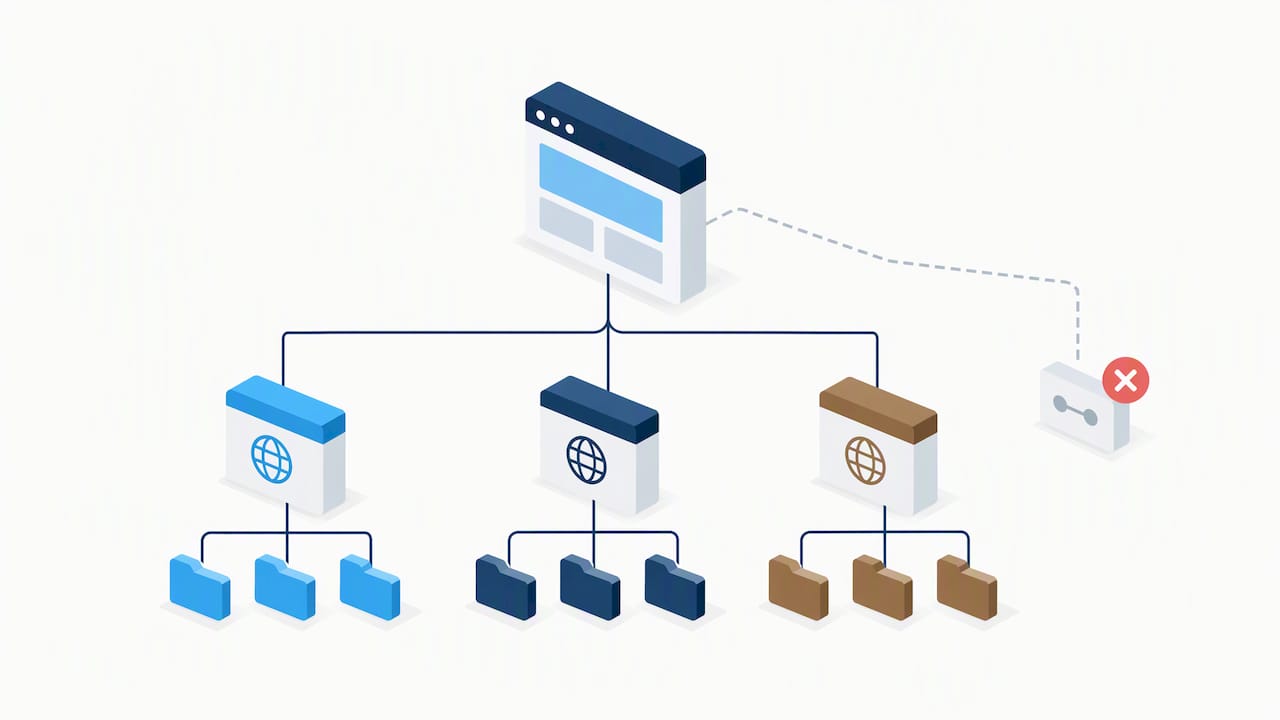
Your URL architecture is the foundation everything else sits on, and it is far harder to change later than to get right at launch. There are three common patterns.
- ccTLDs (example.de, example.fr) send the strongest country signal and build local trust fastest, but they require separate hosting, separate link-building, and separate domain authority for every single market, which gets expensive quickly.
- Subfolders (example.com/de/, example.com/fr/) keep all authority consolidated under one domain, inherit existing domain strength, and are the cheapest to maintain operationally.
- Subdomains (de.example.com, fr.example.com) sit in between: easier to separate technically or hand to a regional team, but Google tends to treat them as semi-independent, so they do not benefit from the root domain’s authority as directly as subfolders do.
For most businesses, especially those without the budget to run fully independent regional operations, subfolders are the sensible default: they consolidate SEO authority, keep maintenance centralized, and still support full locale targeting through hreflang and country targeting settings. ccTLDs make sense mainly for large enterprises with the resources to run each country as a near-separate business, or where a country-code domain carries unusually strong local trust, as in some regulated or government-adjacent sectors.
Whatever you choose, avoid URL parameters (example.com?lang=de) as your primary localization method. They are harder for search engines to treat as distinct, canonical signals get muddy, and they rarely support hreflang cleanly. Google’s own documentation on localized versions assumes a clear, locale-specific URL for each version, not a parameter appended to one shared page.
Hreflang: the rules that actually prevent duplicate content problems
Hreflang is an annotation that tells search engines which page is the right one to show for a given language and, optionally, a given region, and it is the single most misimplemented part of international SEO. Get the rules wrong and you risk duplicate content confusion, the wrong page ranking in the wrong country, or pages that silently drop out of the index.
The syntax itself is a language code from ISO 639-1, optionally paired with a region code from ISO 3166-1 Alpha 2, such as en-us, en-gb, or fr-ca. Google Search Central’s hreflang documentation lays out three non-negotiable rules:
- Every page must be self-referencing, meaning it includes an hreflang tag pointing to itself, not only to its alternates.
- Tags must be reciprocal: if page A points to page B, page B must point back to page A, or Google can ignore the annotation entirely.
- Include an x-default tag to specify a fallback page for visitors whose language or region does not match any of your listed variants.
There are three places to implement hreflang, and the right choice depends on site size and content type:
- HTML link tags in the page head work well for small to mid-sized sites where every page can carry its own tag set directly in the markup.
- HTTP headers are useful for non-HTML content such as PDFs, where you cannot insert a link tag into the document itself.
- XML sitemap entries scale better for very large sites, since updating one sitemap file is more manageable than editing link tags across thousands of pages individually, a point Hreflang makes directly for large-scale setups, though all three methods still require the same strict reciprocity to work.
Once implemented, validate the setup rather than assuming it works. Crawl the site with a tool that reports hreflang errors, check that every tag resolves to a live 200-status page rather than a redirect or 404, and confirm reciprocity on a sample of page pairs by hand. Our own breakdown of sitemap hreflang implementation walks through exactly this kind of reciprocal tagging and x-default setup for service-based sites.
Pro Tip: A single missing reciprocal tag can quietly invalidate hreflang for an entire cluster of pages, so spot-check pairs after every content update, not just at launch.
Content localization: why translation alone falls short
Translating a page word for word keeps the sentences intact but often loses the thing that made the original convert: the intent behind the words. Industry guidance on international SEO is explicit that search intent itself shifts by market, meaning the same product can be searched, framed, and compared differently from one country to the next, which a literal translation does nothing to fix.
Localization goes further than language. It adjusts tone (formal in Germany, more casual in Australia), units of measurement, currency display, legal disclosures, and even the imagery and examples used, since a reference that lands naturally in one culture can fall flat or confuse in another.
A practical localization checklist covers:
- Metadata and title tags rewritten for how people actually search in that language, not machine-translated from the source market.
- Alt text and image descriptions adapted to match localized content, since accessibility and SEO value both depend on accuracy here.
- Currency, units, and date formats converted to local conventions, not just displayed with a different symbol.
- Local references and examples swapped in where the original used a domestic case study, statistic, or cultural reference that will not resonate elsewhere.
- Calls to action and legal text reviewed separately, since compliance language and persuasive phrasing both need native judgment, not a direct translation.
The workflow that supports this well usually involves an in-country reviewer, not just a translator, someone who can flag when a phrase is technically correct but culturally off. Pairing that reviewer with a style guide and reusable content templates keeps tone consistent across pages without requiring a full rewrite every time. This same intent-first mindset extends to professional service verticals too. A law firm SEO resource from LawSmiths illustrates how even specialized industries need market-specific framing rather than generic translated copy, a pattern that holds across most B2B service categories once you cross a border.
Technical foundations: hosting, redirects, and crawlability
The infrastructure behind your localized pages matters as much as the content itself. A page that loads slowly or routes visitors incorrectly undermines everything else you have built.
A content delivery network (CDN) that serves assets from locations near your target markets reduces load times meaningfully for international visitors, and server or hosting location becomes more relevant the further your audience sits from your primary data center. For a business running a handful of regional subfolders, a well-configured CDN usually solves this without needing separate hosting per country.
One of the riskiest habits in international SEO is the automatic IP-based redirect, where a server detects a visitor’s location and force-routes them to a different language or country version. Google’s spam policies guidance warns directly against this practice, since automatic redirects that change content for users and crawlers can look like cloaking and have triggered manual actions or indexing problems. Google’s own community guidance on managing international websites recommends the safer alternative: a visible, non-blocking language or country selector that lets visitors choose, rather than a server-side redirect that can trap crawlers on one version and hide the rest from the index entirely.
Canonical tags need careful handling across international versions too. Each localized page should canonicalize to itself, never to a “master” version in another language, since doing so tells search engines to ignore the localized version altogether. Combine that with clean hreflang, and you get the crawlability outcome you actually want: every locale indexed, discoverable, and correctly matched to its audience.
- Use a CDN with edge locations near your priority markets rather than relying on one central server.
- Never force a redirect based on detected IP location; offer a selector instead.
- Self-canonicalize every localized page and pair it with reciprocal hreflang.
International keyword research and mapping by market
Keyword research has to restart from scratch for every language and country, not just run through a translation of your home-market list. The same product can be searched using completely different terms, phrasing, and even informal slang depending on the market.
- Start with native-language seed terms, gathered by asking native speakers or local team members how they would actually search, rather than translating your existing list.
- Pull data from local search engines and keyword tools set to that country, since global keyword volume aggregates can hide how a term actually performs in one specific market.
- Map each localized keyword set to a specific page, so every market has its own dedicated target rather than sharing a page optimized for a different locale’s terms.
- Check for keyword cannibalization across similar-language variants, since en-US and en-GB pages targeting near-identical terms can compete against each other in search results if hreflang and targeting are not configured precisely.
- Treat same-language, different-country pairs as distinct markets anyway, adjusting spelling, terminology, and even product names (what is called one thing in the US market may have a different common name in the UK or Australia) rather than assuming shared language means shared keywords.
This process takes longer than a single global keyword list, but it is what prevents a page from ranking for the wrong country’s version of a search term, or worse, not ranking at all because it was optimized around phrasing nobody in that market actually types.
Measuring international SEO: Search Console, analytics, and KPIs
Monitoring needs to happen at the locale level, not just in aggregate, because a healthy global total can hide a market that is quietly failing. Set up Search Console properties for each major subfolder, subdomain, or domain, or use the country and page filters within one property if your structure supports it, so you can isolate performance by locale rather than guessing from blended data.
The metrics worth tracking regularly include:
- Impressions and clicks by country, to spot a market that is not even appearing in relevant searches.
- Click-through rate by locale, which flags when metadata or titles are not resonating with that market’s search phrasing.
- Conversion rate by locale, tracked separately since localized versions should be measured as close to independent products, a framing Search Engine Land’s international SEO guide recommends explicitly rather than folding them into one global conversion number.
- Indexing status per locale, checked periodically to confirm pages are not being dropped or merged incorrectly.
When something breaks, the troubleshooting path is usually short. A locale missing from search results often traces back to a missing or non-reciprocal hreflang tag, which a crawl audit will surface quickly. Duplicate content warnings across markets usually mean canonical tags are pointing to the wrong version, or an IP redirect is interfering with crawler access to one of the pages. A sudden drop in one country’s traffic after a site update is worth checking against recent hreflang or sitemap changes before assuming it is a ranking penalty.
Common international SEO mistakes and a launch checklist
Most international SEO failures trace back to a handful of repeatable mistakes, and most of them are preventable with a short audit before launch.
- Inconsistent URL structure, where some locales live in subfolders and others on separate domains with no clear logic, confusing both users and crawlers.
- Non-reciprocal hreflang tags, which Google can ignore outright, silently undoing the entire localization signal.
- Automatic IP-based redirects, which risk manual action and prevent crawlers from accessing alternate versions.
- Untranslated or machine-translated metadata, leaving title tags and descriptions that do not match how people search locally.
- No locale-level Search Console setup, which hides problems in individual markets behind healthy-looking global numbers.
| Checklist item | What to verify | Common failure |
|---|---|---|
| URL consistency | Every locale follows the same structure pattern | Mixed ccTLDs and subfolders with no clear rule |
| Hreflang reciprocity | Tags point both ways and include self-reference | One-directional tags Google ignores |
| No IP redirects | Visitors can choose their version manually | Forced redirects block crawler access |
| Localized metadata | Titles and descriptions written for local search terms | Metadata is a direct machine translation |
| Search Console setup | Each locale is visible and filterable separately | One blended property hides locale problems |
In the first 90 days after launch, watch for a locale that never gains impressions at all, which usually points to an indexing or hreflang issue rather than a ranking one, and watch conversion rate by locale closely, since a page that ranks but does not convert often signals a localization gap rather than a technical one.
How we approach international SEO for B2B clients
Our process for international and multilingual projects starts with the same market prioritization work covered above: reviewing existing traffic, scoring candidate markets, and agreeing on which one to two locales come first. From there we move into technical setup, building the URL structure and hreflang annotations before any content work begins, since retrofitting hreflang onto an already-live multi-market site is far more error-prone than building it in from the start.
Localization work runs in parallel with a native-language reviewer pass on top of any translation, covering metadata, currency, and cultural references rather than relying on a literal translation alone. Measurement is set up from day one with locale-level Search Console properties, so a client can see which market is gaining traction before committing budget to the next one.
International SEO is a maintained program rather than a one-time project, requiring budget for translation or in-country review, a technical setup phase for URL structure and hreflang, and ongoing monitoring time once new locales go live.
Why fundamentals beat tooling in international SEO
The part of international SEO that gets the least attention is usually the part that breaks the most: hreflang reciprocity and avoiding automatic redirects. Most guidance online spends disproportionate space on keyword tools and comparatively little on these two technical rules, even though a single non-reciprocal tag or a careless IP redirect can undo months of localization work without anyone noticing until traffic quietly drops in one market.
My honest read, after seeing how these projects actually unfold, is that teams overinvest in translation polish before they have confirmed the technical foundation even works. A beautifully localized page that Google cannot correctly match to its market is wasted effort. Get the URL structure, hreflang, and redirect behavior right first, prove one market is indexing and converting correctly, and only then scale the content and translation work outward. Fundamentals first, polish second, in that order, every time.
— Donovan Wells – Founder and CEO
Where Depeche Code fits into your international SEO plan
Running international SEO well means handling technical hreflang setup, hosting decisions, localization workflows, and ongoing measurement at the same time, which is a lot to coordinate on top of a regular marketing workload. We handle technical implementation of URL structure and hreflang, WordPress hosting and maintenance built to support multi-locale sites without the automatic-redirect pitfalls covered above, and ongoing SEO monitoring once new markets go live.
A typical engagement starts with a discovery call to review your current traffic and candidate markets, followed by a roadmap covering URL structure, hreflang, and a phased content rollout, with deliverables handed over at each stage rather than held back until the end. If you are weighing which markets to prioritize or how to structure a multi-locale site correctly from the start, our services page covers the full range of SEO and technical work we take on, and it is the right place to start the conversation.
FAQ
How do I get started with international SEO?
Start by confirming demand in a candidate market using existing traffic data, then choose a URL structure, usually subfolders for most businesses, and implement reciprocal hreflang tags with a self-referencing entry and an x-default fallback. Localize your highest-converting pages before expanding further, and set up locale-level tracking in Search Console so you can measure each market independently.
What is the 80/20 rule as it applies to SEO?
In SEO, it is effective to focus most effort on the small number of pages, keywords, or technical fixes that drive the majority of your results, rather than spreading effort evenly. In an international context, that often means prioritizing hreflang accuracy and your top-converting pages in one or two markets before attempting broad multi-country coverage.
Do I need a separate domain for every country?
No. Subfolders under one domain are the common default because they consolidate authority and are cheaper to maintain, while ccTLDs are reserved mainly for larger operations that can support fully separate regional domains. The right choice depends on your resources, not just on which option looks most official locally.
What happens if my hreflang tags are not reciprocal?
Google can ignore non-reciprocal hreflang annotations entirely, which means the localization signal you intended simply does not take effect. This is one of the most common causes of the wrong country version appearing in search results, so reciprocal tagging deserves a dedicated check after every site update.
Can automatic language redirects hurt my rankings?
Yes. Automatic IP-based redirects that change the content shown to users and crawlers can be treated as a spam signal and have led to manual actions or indexing problems, according to Google’s own guidance. A visible language or country selector that lets visitors choose manually is the safer alternative.