

You likely aren’t alone: Instagram’s median engagement rate has fallen platform-wide, dropping from roughly 7.3% in 2024 to about 5.4% in 2025. Before changing anything, check your reach, watch time, saves and shares, and confirm your account is eligible for recommendations in Settings. Likes and follower-based rates tell you far less than they used to.
TL;DR:
- Instagram’s median engagement rate has decreased by about 26%, from 7.3% in 2024 to 5.4% in 2025, across all account sizes and formats.
- Reels reach more users but tend to generate lower engagement per view, especially when spreading to non-followers, while original content outperforms recycled or watermarked posts.
- Variations in ranking signals across Feed, Reels, and Stories demand distinct strategies focused on watch time, shares, saves, and private interactions like DMs instead of likes.
- Diagnosing a decline involves checking account eligibility, early engagement metrics, content originality, and comparing broad trends with niche accounts before implementing fixes.
- Recovery requires a structured approach over 30 to 90 days, emphasizing shifting to view and share-based metrics, testing content hooks, maintaining posting consistency, and avoiding drastic content eliminations or mass volume.
Table of Contents
- What the data says: 2025-2026 benchmarks and what to expect
- Why it’s happening: algorithm shifts, format priorities, and audience behavior
- How to diagnose your drop: a prioritized audit sequence
- Tactical recovery playbook: what to do over the next 30 to 90 days
- Audit checklist and handoff items
- When to call in help: an agency’s role in recovery
- Get a prioritized audit and recovery plan for your account
- FAQ
- Sources
What the data says: 2025-2026 benchmarks and what to expect
The decline shows up across independent panels, not just isolated accounts. Buffer’s pooled analysis of 52 million posts found Instagram’s median engagement rate fell to about 5.4% in 2025, down from around 7.3% the year before, a decline of roughly 26%.
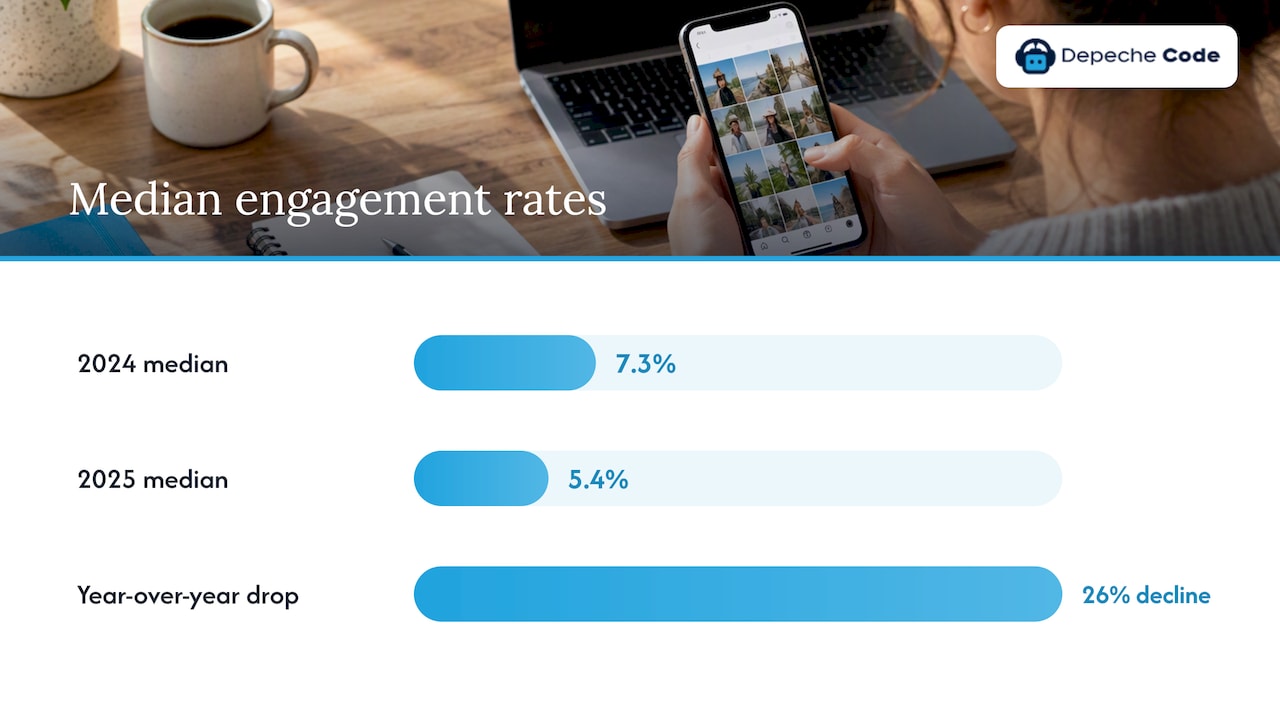
That figure is a median, not an average, which matters because a handful of viral outliers can mask how most accounts are actually performing. Smaller accounts often show stronger engagement rates relative to size, since ranking systems weigh recent engagement quality over raw follower count.
Industry reporting consistently shows the same direction: engagement per post is down, even as accounts post more often. Posting volume alone has not reversed the trend in the panels Buffer and similar trackers follow.
- Median engagement rate dropped from about 7.3% to 5.4% year over year.
- Carousels tend to earn more engagement per impression through saves and slower interactions.
- Reels still carry the broadest reach, just at a lower engagement rate per view.
- Smaller accounts can still outperform larger ones on a percentage basis.
Why it’s happening: algorithm shifts, format priorities, and audience behavior
Instagram runs separate ranking systems for Feed, Reels and Stories, and each one rewards different signals. Hootsuite’s 2026 algorithm explainer notes that original, made-for-Instagram content gets prioritized, while watch time, shares and saves now carry more weight than follower count.
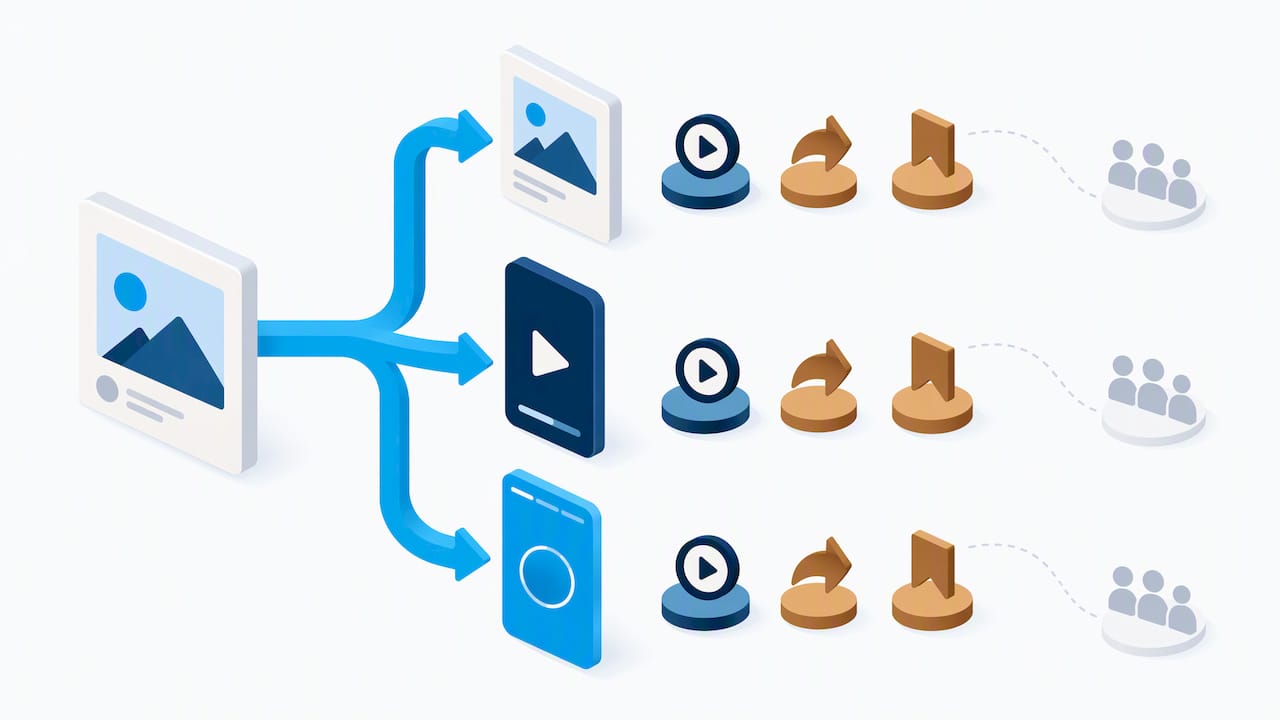
Reels get pushed for reach, which spreads a post to more non-followers, but that often dilutes engagement rate per impression since a chunk of new viewers never interact. Originality enforcement adds another layer: recycled clips, watermarked reposts and aggregator content get down-ranked, which explains sudden reach losses for accounts that lean on repurposed material.
Meanwhile, attention is fragmenting into private channels. Saves, direct messages and shares are rising as public likes and comments decline, a shift practitioners increasingly treat as a feature of how people use the platform now, not a bug in the algorithm.
- Feed, Reels and Stories each use distinct ranking signals.
- Reels maximize reach but often show lower per-impression engagement.
- Original content outperforms recycled or watermarked reposts.
- Private interactions like DMs and saves are growing relative to public likes.
- More creators competing for the same attention adds to the squeeze.
How to diagnose your drop: a prioritized audit sequence
Before assuming something is broken, run through a short sequence that separates a platform-wide shift from an account-specific problem.
- Open Settings and check Account Status to confirm you’re eligible for recommendations and not under a temporary restriction.
- Pull reach, views or watch time, saves, shares and early engagement velocity from the first 30 to 60 minutes after posting.
- Run a simple A/B test: post a Reel and a carousel on similar topics and compare performance side by side.
- Review your recent cadence and content origin: are you posting mostly original work, or leaning on repurposed clips?
- Check whether other accounts in your niche are seeing the same drop; if reach is down broadly, treat it as platform-wide and reset your benchmarks instead of chasing a fix that doesn’t exist.
Hootsuite’s explainer points out that early watch time and share velocity in the first 30 to 60 minutes often gate how far a post travels afterward, so that window deserves close attention before you judge a post a failure.
Pro Tip: Screenshot your reach, saves and watch-time numbers weekly so you have a real baseline instead of relying on memory when something changes.
Tactical recovery playbook: what to do over the next 30 to 90 days
Recovery is a sequence, not a single fix. Work through these in order and measure after each change before stacking another one.
- Re-baseline your reporting first: swap likes-per-follower for views, reach, watch time, saves and sends as your core metrics.
- Rebuild your content mix: Reels for discovery, carousels for deeper engagement, Stories for relationship-building with existing followers.
- Test your hooks: try three different openers on similar content and compare watch-time retention in the first three seconds.
- Push community actions: reply to comments quickly, add explicit calls to save or share, and encourage DMs tied to a measurable outcome like a link click or booking.
- Protect your cadence: post consistently rather than in bursts, since gaps followed by a flood of posts tend to trigger cold-start penalties.
A few things to avoid while you’re testing:
- Don’t delete historical posts in a panic. Older content still contributes to profile-level signals.
- Don’t buy engagement or follow the “like for like” cycle. Purchased activity rarely survives Instagram’s originality checks and can suppress reach further.
- Don’t flood your feed with volume to chase the algorithm. Industry panels show higher posting frequency alone didn’t reverse the decline.
Pro Tip: Run experiments in small cohorts: change one variable (hook, format, posting time) per week so you can actually tell what moved the number.
Audit checklist and handoff items
Whether you run this yourself or hand it to a team, a focused audit covers account health, content originality and a short testing plan.
- Confirm Account Status eligibility and check your repost ratio for watermarked or recycled content.
- Test three creative fixes: a new hook format, a Reel-to-carousel swap, and an explicit save or share prompt in your caption.
- Set milestones at 30, 60 and 90 days so progress is measurable rather than assumed.
| Milestone | What to measure | Target signal |
|---|---|---|
| Day 30 | Reach, watch time, save rate | Early stabilization versus prior baseline |
| Day 60 | Shares, sends, comment response time | Upward movement in private signals |
| Day 90 | Views, reach, save and share trend | Sustained recovery versus platform-wide norm |
When to call in help: an agency’s role in recovery
Most accounts can recover with consistent testing inside 30 to 45 days. If reach stays flat after that window despite following an audit, the gap is usually creative production, measurement design, or knowing when paid amplification makes sense, areas where a dedicated team can move faster than a solo creator juggling everything else.
— Donovan Wells – Founder and CEO
Get a prioritized audit and recovery plan for your account
We run social accounts through an audit and re-baselining process: checking account eligibility, originality, and metrics predictive of recovery, then building a prioritized fix list.
- One-time audit plus a prioritized set of fixes tailored to your account’s data.
- Measurement re-baselined to views, reach, saves and shares instead of outdated like-based benchmarks.
- Ongoing management available for teams that want this handled consistently rather than squeezed in between other work.
If you’d rather have a team run this for you, our social media management services cover the audit, content mix and reporting rebuild from day one.
FAQ
What is the 5-3-1 rule on Instagram?
The 5-3-1 rule is a posting framework some creators use to balance content types each week: roughly five pieces of curated or repurposed content, three original posts, and one piece of interactive or promotional content. It’s a loose guideline rather than an Instagram-stated rule, so treat it as a starting structure to adapt based on your own engagement data.
Is Instagram losing users in 2026?
Instagram hasn’t published user-loss figures for 2026, so that claim isn’t publicly confirmed. What industry tracking does show is a decline in engagement rate per post, which is a separate measure from total active users.
Why am I suddenly getting no engagement on Instagram?
A sudden drop usually points to one of three things: a platform-wide shift affecting many accounts, an account eligibility issue visible in your Account Status, or a format and originality problem like relying on repurposed content. Check your Account Status in Settings first, then compare your reach trend against others in your niche before assuming it’s just you.
Why is my engagement so low on Instagram today?
Low engagement today is often tied to early watch-time and interaction velocity in the first 30 to 60 minutes after posting, since that window influences how widely a post gets distributed. It can also reflect the broader platform trend where median engagement rates have fallen across many accounts rather than a problem unique to your content.
Sources
- Is Your Instagram Engagement Down? You’re Not Alone. Here’s Why It’s Happening
- Instagram algorithm tips for 2026: Everything you need to know