

E-E-A-T stands for Experience, Expertise, Authoritativeness, and Trustworthiness, and Google’s own guidance treats trust as the component that matters most. The immediate priority for any content team is making clear who wrote a page and backing it with verifiable evidence: bylines, credentials, citations, and visible proof the site can be trusted. AI-assisted content faces the identical bar.
TL;DR:
- For health, finance, legal, and safety pages, route drafts through qualified expert review and cite professionals or academic journals rather than general commentary.
- Google’s human quality raters assess sample pages to calibrate ranking systems; their feedback does not directly change an individual page’s search position.
- When publishing with AI, identify who is accountable, explain how automation and human review shaped the content, and state why it serves readers.
- Prioritize ownership and accountability across the site before treating bylines or author schema as isolated checklist items; reputation depends on consistency and outside corroboration.
Table of Contents
- Breaking down experience, expertise, authoritativeness, and trust
- Why E-E-A-T matters now: quality raters, YMYL, and AI search
- Tactical playbook: page- and site-level steps that demonstrate E-E-A-T
- Measuring and monitoring E-E-A-T over time
- AI-assisted content: following Who, How, Why
- A practitioner’s checklist
- The part most teams get backward
- How we help you put E-E-A-T into practice
- FAQ
- Sources
Breaking down experience, expertise, authoritativeness, and trust
Each letter in E-E-A-T describes a different kind of proof, and pages rarely fail or succeed on just one of them. Google’s guidance frames these as a package: a page with strong expertise but no trust signals still reads as low quality, and a page can’t fake experience it never had.
Experience means the creator has actually done, used, or lived the thing they’re writing about. A product review written by someone who bought and used the item reads differently than one assembled from spec sheets. On a page, this shows up as first-person detail: a specific failure mode, a photo from actual use, a number pulled from a real project rather than a press release.
Expertise is formal or demonstrated knowledge of the subject. For a tax article, that might be a CPA byline. For a coding tutorial, it might be a working repository the author maintains. Expertise does not require a degree in every case, but it requires evidence the writer knows the terrain better than an average searcher.
Authoritativeness is what other sources say about the creator or the site, not what the site says about itself. A journalist citing a page, a university linking to it, or an industry publication naming the author as a source all build authoritativeness in ways self-promotion can’t replicate.
Trustworthiness covers accuracy, transparency, and safety, and Google explicitly calls it the most load-bearing of the four because an untrustworthy page is considered low quality regardless of how experienced or expert the author seems. Trust shows up as correct contact information, clear editorial policies, secure checkout, and content that doesn’t mislead even when every other signal checks out.
Concrete additions that move the needle on a typical page include:
- A named byline linking to an author bio with relevant credentials or work history.
- Inline citations to primary sources, government data, or peer-reviewed research instead of vague references.
- A specific case detail or data point that only someone with direct experience would include.
- A visible last-updated date paired with a note on what changed and why.
- A link to press coverage, partnerships, or third-party mentions that corroborate the site’s standing.
Page-level signals and site-level signals reinforce each other. A strong byline on one article means little if the site has no author pages, no contact information, and no history of being cited elsewhere; the components work as a system, not a checklist to clear in isolation.
Why E-E-A-T matters now: quality raters, YMYL, and AI search
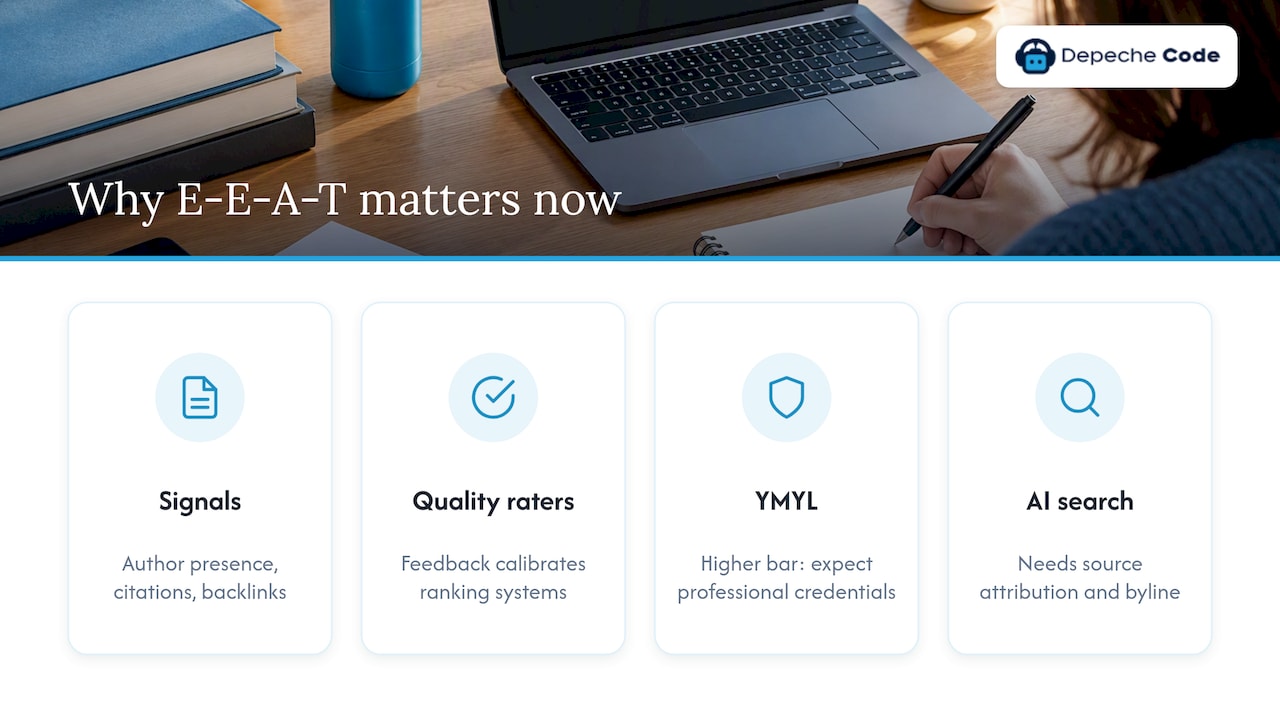
E-E-A-T isn’t a single ranking factor you can toggle. It’s operationalized through many measurable signals, author presence, citation patterns, backlinks, and site trust metrics, that collectively shape how automated ranking systems treat a page.
Quality raters play a specific, often misunderstood role here. Human raters apply the Search Quality Rater Guidelines to sample pages and produce feedback, but that feedback calibrates Google’s ranking systems rather than directly changing any individual page’s position. Think of raters as the mechanism Google uses to check whether an algorithm update is rewarding the right kind of content, not as a jury voting on your page.
For YMYL topics (health, finance, legal, safety) the bar is deliberately higher. Google gives these pages extra weight toward strong E-E-A-T, often expecting professional credentials or peer-reviewed sourcing rather than general web commentary. A blog post about meal prepping can lean on personal experience; a page about drug interactions needs a clinician’s input or a citation to a medical authority.
AI-powered search features raise the stakes further. Search generative AI surfaces create a direct incentive to carry clear source attribution and visible author identity, because these features pull from sources they can verify as trustworthy. A page with no byline and no citations is far less likely to be surfaced or cited in an AI-generated summary than one that documents its own provenance.
Tactical playbook: page- and site-level steps that demonstrate E-E-A-T
This is the checklist version: concrete moves, roughly ordered by effort versus payoff, that a content or SEO team can start this quarter.
- Add real bylines to every piece of substantive content, linking each author’s name to a bio page with credentials, published work, or professional affiliations.
- Build out author pages that list expertise areas, social or professional profiles, and a short history of the author’s work on the topic.
- Cite primary sources directly in the sentence making the claim, not just in a reference list at the bottom, and prefer government data, academic research, or named industry reports over aggregator blogs.
- Add structured data for authors, articles, and reviews so search engines can parse who wrote what and when, which also supports schema markup for local business pages that need author and review attribution.
- Secure the site and surface contact information, including a physical address or support channel, since trust signals include basic technical hygiene as described in Google Search Essentials.
- Create an editorial checklist that requires fact-checking, source verification, and a named reviewer before publication, and keep a visible changelog on pages that get updated.
- Document AI use with a Who/How/Why disclosure whenever generative tools assist drafting, naming who is accountable, how the content was produced, and why it was created, mirroring the framing Google’s own guidance recommends.
- Pursue earned mentions, press coverage, podcast guest spots, or partnerships, and link to them from an “as featured in” section or author bio, since site-wide reputation signals carry weight beyond any single page.
- Audit internal linking so authoritative, well-sourced pages link to newer or thinner content, passing editorial credibility across the site rather than isolating it.
- Review technical hygiene quarterly: broken links, outdated author bios, expired certifications, and stale statistics all erode trust signals that took months to build.
A practical governance habit worth adopting: require an author bio on all long-form content, mandate a source check for every factual claim, and keep an editorial log documenting review and verification steps. That kind of traceability is exactly what separates a page that merely claims expertise from one that can prove it.
Pro Tip: Treat your author bio pages as living documents: update them every time a writer publishes new credentialed work, not just when someone joins or leaves.
For teams building this out from scratch, a practical SEO checklist can help sequence these tactics alongside other ranking fundamentals, and reviewing site trust practices is a useful companion step when contact information, policies, or security need an overhaul.
Measuring and monitoring E-E-A-T over time
E-E-A-T doesn’t show up as a single metric in any dashboard, so tracking it means watching a cluster of proxies rather than one number.
Useful signals to track on a recurring basis:
- Branded search volume over time, since growing recognition often correlates with authoritativeness building offsite.
- Referral traffic and citations from authoritative domains, which indicate other trusted sites see your content as worth linking to.
- Impressions and click-through changes for informational queries in Search Console, especially after publishing bylined, well-sourced updates.
- Engagement metrics like time on page and return visits, which often shift when experience-based detail replaces generic filler.
- Byline and schema presence across the site, checked as part of a recurring technical audit rather than a one-time fix.
Search generative AI control in Search Console lets site owners choose whether their content is eligible for inclusion in AI-generated features; excluding a page removes it from AI Overviews without affecting its normal search listing. Reviewing this setting alongside standard performance reports gives a clearer picture of whether trust-building work is actually translating into AI-era visibility, a theme covered in more depth in our look at 2026 SEO trends.
AI-assisted content: following Who, How, Why
Google has stated plainly that AI-assisted or AI-generated content is judged by the same E-E-A-T criteria as content written entirely by a person, and automation itself isn’t penalized unless it’s used primarily to manipulate rankings.
What that means in practice:
- Disclose who is accountable for the content, even when a tool helped draft it.
- Document how the content was produced, including which steps involved automation and which involved human review.
- State why the content exists and what problem it solves for the reader, not just that it was easy to generate at scale.
- Route anything touching health, finance, legal, or safety topics through an additional expert review before publication, regardless of how the draft was produced.
For teams building AI into their editorial pipeline, a deeper breakdown of AI content’s SEO implications is worth reviewing alongside Google’s own guidance, since the technical mechanics of how AI tools assist publishing are evolving faster than most editorial policies.
Pro Tip: Keep the Who/How/Why disclosure as a visible note on the page itself, not buried in a terms-of-service document nobody reads.
A practitioner’s checklist
When we audit website content, we start by assigning a clear owner to every page, someone accountable for accuracy, not just a name in a footer. From there, we apply a consistent byline template across the site, verify every factual claim against a primary source, and check that structured data actually matches what’s published.
A short version worth copying: name the owner, cite the source, date the update, and make sure a stranger could verify every claim in five minutes. That last test catches more weak pages than any algorithm explanation.
— Donovan Wells – Founder and CEO
The part most teams get backward
Most E-E-A-T advice treats it as a content-writing problem: add a bio, cite a source, done. The research and Google’s own framing point somewhere else: trust is the dominant factor, and trust is built at the site level over time through consistency, not fixed on a single page in an afternoon.
The overrated move is chasing author schema and bylines as a checkbox exercise while leaving the rest of the site untouched, no clear ownership, no editorial history, no corroborating mentions elsewhere. That gets you the appearance of E-E-A-T without the substance quality raters and algorithms are calibrated to detect.
What actually works is treating every page as part of a reputation system: the author’s credentials matter less in isolation than whether the same author shows up consistently, cited elsewhere, maintaining a real track record. If you can only fix one thing first, fix ownership and accountability across your whole site before polishing individual pages. The rest compounds from there.
How we help you put E-E-A-T into practice
Turning this playbook into a working site often means touching more than content: hosting stability, structured data, author pages, and a technical foundation that doesn’t undercut the trust signals you’re building. We handle that end to end, from search engine optimization built around authoritative content and citation-worthy pages to website design and redesign that gives bylines, credentials, and reviews a proper home.
Our relevant services include various SEO plans built around authoritative, well-sourced content, WordPress hosting and maintenance to support technical trust signals, and AI chatbot integration with disclosure practices for responsible use of automation.
If you want a clear-eyed look at where your site stands today, our full services overview is the place to start, and requesting a consultation is the fastest way to turn this checklist into a working audit.
This article is general information, not a substitute for advice from a qualified doctor. Consult a qualified healthcare professional about your own circumstances before acting on anything here.
FAQ
What does E-E-A-T stand for in SEO?
E-E-A-T stands for Experience, Expertise, Authoritativeness, and Trustworthiness, the four components Google uses to describe what makes content reliable and helpful. Trustworthiness is treated as the most important of the four, since an untrustworthy page is considered low quality even when the other three are strong.
What are the E-E-A-T principles of Google?
The principles ask content creators to show direct experience with a topic, demonstrated expertise, recognition from other authoritative sources, and verifiable trustworthiness through accuracy and transparency. Google frames these through a Who/How/Why lens, encouraging creators to document who made the content, how it was produced, and why it exists.
What are the four types of SEO?
SEO work is commonly split into on-page SEO (content and page elements), technical SEO (crawlability, speed, structured data), off-page SEO (backlinks and reputation), and local SEO (location-based visibility). Google Search Essentials covers the technical and content fundamentals that underpin all four categories.
Is SEO dead now with AI?
SEO isn’t dead, but it has shifted toward signals that are harder to fake: verifiable authorship, citations, and site-wide trust. Google has confirmed AI-assisted content is evaluated by the same E-E-A-T criteria as human-written content, so the work has moved from keyword tactics toward documented expertise and provable trust.
How do I audit existing content for E-E-A-T compliance?
Start by checking every page for a named byline, a working author bio, and citations to primary or authoritative sources rather than secondhand summaries. Then review site-wide signals: contact information, security, structured data validity, and whether the site has earned mentions from other credible publications, since Search Essentials and industry guidance on E-E-A-T tactics both frame these as the baseline checks.
Sources
- Creating helpful, reliable, people-first content | Google Search Central
- Search generative AI control – Search Console Help
- Google Search Essentials | Google Search Central
- Google E-E-A-T for SEO | Search Engine Land