

Choose a digital agency by matching it to 2 or 3 measurable business outcomes, not the lowest bid. Write a short brief covering scope, timeline, and budget range, then open a Request for Information to a focused pool of several agencies before narrowing to a smaller group for full proposals. Evidence and team transparency predict long-term performance far better than price alone.
TL;DR:
- Choosing a digital agency should be based on measurable business outcomes like leads or revenue, not just price or shiny case studies.
- An effective search process includes an initial RFI to screen candidates, a detailed RFP for finalists, and in-depth reference and team checks.
- Evaluate proposals by real evidence and strategic fit, ensuring scope, team seniority, and measurement tools are clearly outlined and aligned with your goals.
- Always meet the actual delivery team, confirm ownership of assets and data, and ask for a clear exit strategy before signing any contract.
- Be wary of agencies refusing transparency, shifting scope, or promising guaranteed results, and prioritize those with proven metrics and open communication.
Table of Contents
- How Do You Choose a Digital Agency?
- How Do You Build a Shortlist of Digital Agencies?
- What Should You Look for When Evaluating Proposals?
- What Questions Should You Ask the Delivery Team?
- Red Flags and Green Flags to Watch For
- Scorecard and Sample Questions You Can Use Right Now
- What Proof Should a Credible Agency Actually Show You?
- A Founder’s Take on Where Agency Searches Go Wrong
- Ready to Put This Checklist to Work?
- Sources
- FAQ
How Do You Choose a Digital Agency?
Picking the right partner starts with clarity, not comparison shopping. Before you look at a single portfolio, decide what “success” actually means in numbers: more qualified leads, a higher conversion rate, faster page load times, or measurable revenue growth. That single decision reshapes everything downstream, from which agencies you invite to bid to how you score their proposals.
Most companies skip this step and default to comparing hourly rates or flashy case studies. That’s backwards. The ANA/4A’s agency search guidance frames selection as a two-way fit assessment: you supply a clear brief, and a serious agency should be asking you hard questions about budget, internal capacity, and what “done well” looks like. If they’re not asking, that’s information too.
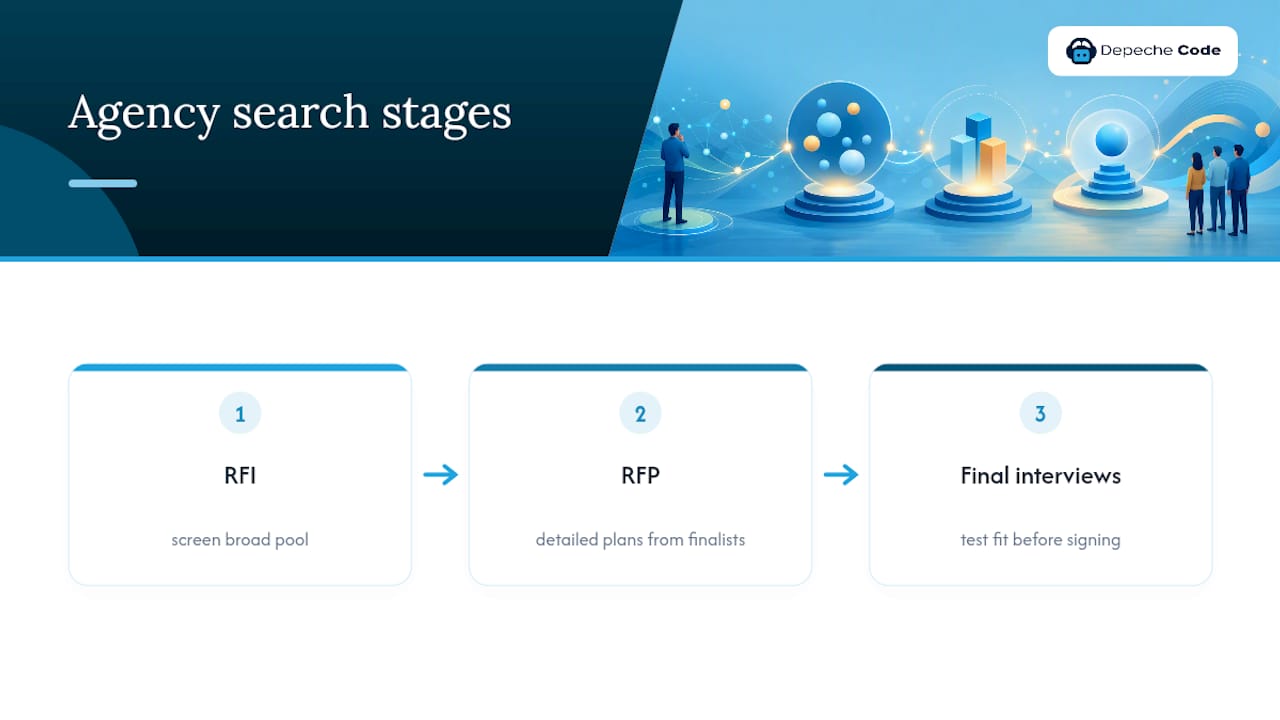
The standard industry term for this process is a marketing agency search or agency review, and it typically runs through three formal stages: a Request for Information (RFI) to screen a broad pool, a Request for Proposal (RFP) to get detailed plans from finalists, and a final round of interviews before you sign. Skipping the RFI and jumping straight to five sales pitches is the single most common reason companies end up with a partner who looks great in a slide deck and underperforms in month four.
Step 1: Define Goals, Scope, Timeline, and Budget
Translate whatever business problem you’re solving into SMART KPIs before you contact anyone. “Grow our online presence” is not a goal an agency can price accurately.
Next, list the specific services you need. Do you need a full website rebuild, ongoing SEO, paid media, content production, a chatbot, or a mobile app? If you need three or more of these working in sync, you likely need a full-service or hybrid partner rather than five disconnected specialists. Understanding the different agency operating models before you write your brief saves you from inviting the wrong type of vendor entirely.
Budget disclosure matters more than most decision-makers expect. Sharing at least a range, even a wide one, improves the quality and realism of the proposals you get back, because agencies can scope work to match rather than guessing and either overbuilding or underselling.
Finally, get your own house in order:
- Designate one internal owner who can make decisions without a committee vote at every step.
- Prepare access to analytics, CMS logins, and brand assets before the search even starts.
- Set internal approval SLAs (48 hours, 5 business days) so the agency isn’t waiting on you and blaming delays on scope creep later.
Pro Tip: Write your brief once and reuse it verbatim for every agency in your RFI. If the brief changes between conversations, you can’t compare the proposals that come back.
How Do You Build a Shortlist of Digital Agencies?
Source candidates from referrals, industry associations, or vetted review platforms rather than cold outreach lists, which tend to produce mismatched proposals and wasted evaluation time. Existing vendors, especially ones you already trust for adjacent work, are often an underused source of solid referrals.
Once you have a pool, the process the ANA/4A’s Guidelines for Agency Search recommends looks like this:
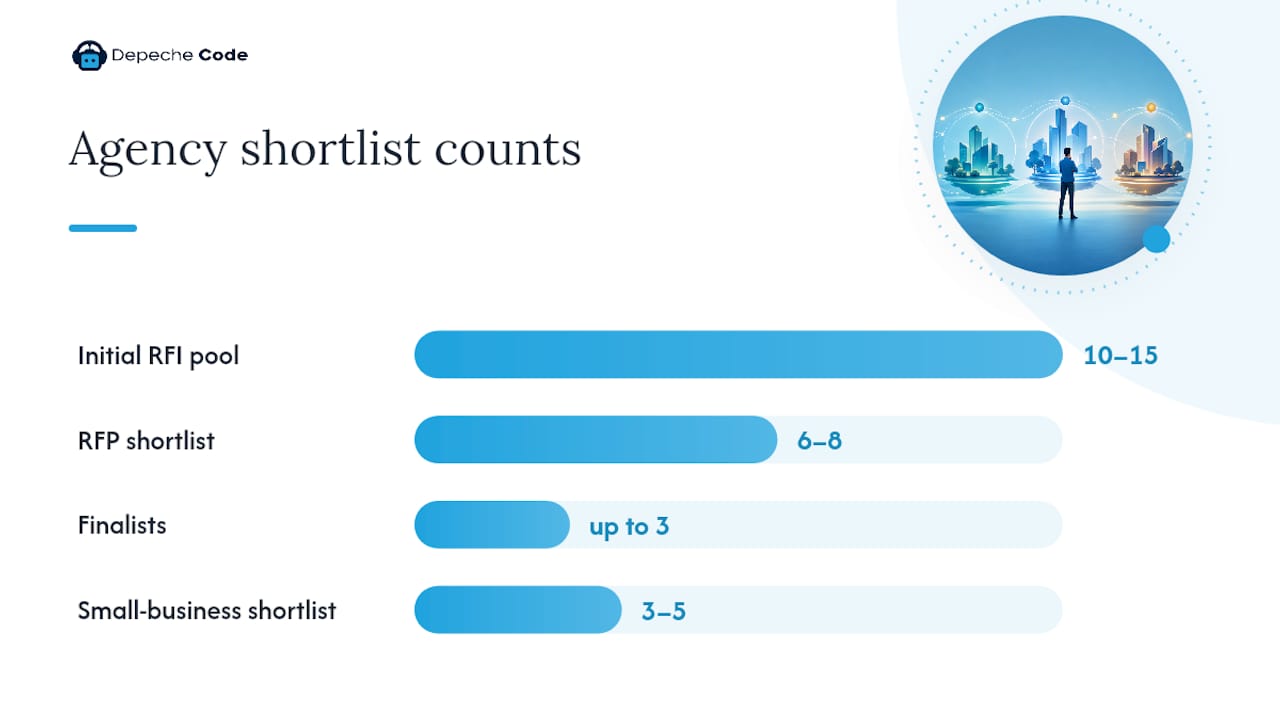
- Send an RFI to 10 to 15 agencies. Ask for an org chart, a conflict-of-interest check (are they already working with a direct competitor?), two or three relevant case studies, and typical contract terms.
- Narrow to 6 to 8 for the RFP stage. Send the exact same brief and evaluation questions to every one of them, so the proposals that come back are structurally comparable, not apples to oranges.
- Advance up to 3 finalists to live presentations and reference calls before making a decision.
Smaller businesses without a procurement team can compress this into a leaner 3 to 5 finalist shortlist and skip the formal RFI stage, as long as every candidate still receives the same brief. What you’re protecting against either way is the trap of comparing a polished pitch deck from Agency A against a rough estimate from Agency B, because you asked them different questions.
What Should You Look for When Evaluating Proposals?
Score proposals against business outcomes first, then channel expertise. The Backlinko guide to choosing a marketing agency makes a point worth repeating: agencies that lead with vanity metrics like impressions or “engagement” over qualified leads or revenue are often optimizing for a metric that’s easy to hit, not one that matters to you.
Weigh proposals across these axes:
- Strategic fit with the KPIs from your brief, not a generic template pitch.
- Relevant case studies with real evidence, not just logos.
- A proposed roadmap with milestones you can actually check against.
- Team composition and seniority, not just the agency’s overall headcount.
- A stated measurement approach, including which tools and reporting cadence.
- Transparency around asset and data ownership.
- Commercial terms: what’s included, what’s billed separately, what’s excluded entirely.
When you read a case study, ask what the baseline was before the agency started, what specifically they changed, over what timeframe, and how they measured the result. A case study missing any of those four elements is a testimonial dressed up as evidence, not proof of repeatable skill.
Price comparison is where most buyers get fooled. It’s usually missing something.** The ANA/4A’s cost of the pitch analysis found that under-scoped bids typically strip out senior staff hours, technology or media costs, and revision allowances, then reintroduce them later as change orders once you’re locked in. Compare hours, seniority mix, and what’s genuinely bundled before you compare the bottom-line number.
What Questions Should You Ask the Delivery Team?
Ask to meet the people who will actually do the work, not just the account executives who ran the pitch. This single step catches more mismatches than any other part of the process.
- Request names, roles, seniority level, and expected weekly time allocation for each person on your account.
- Ask directly whether any part of the work will be subcontracted, and to whom.
- Request to see an example of their standard client reporting, with real KPIs, not a mockup built for the sales deck.
- Call two or three reference clients and ask specifically about scope changes, communication speed, and whether timelines held up.
- Confirm the escalation path: who do you call when something breaks on a weekend?
The ANA blog on agency search best practices notes that a credible agency will walk you through discovery, strategy, execution, quality assurance, reporting, and optimization as distinct stages, each with a named owner. Vague answers here are a preview of vague accountability later.
Before signing anything, confirm asset ownership in writing: who holds the domain registrar login, hosting account, CMS admin access, analytics property, ad accounts, and backups. Grant only the access an agency actually needs to do the job, and test that you can export your own data before real work begins.
Pro Tip: Ask every finalist the same blunt question: “If we ended this contract in 90 days, could we walk away with full control of our website and data today?” Their answer, and how quickly they give it, tells you more than their pitch deck.
Red Flags and Green Flags to Watch For
A short mental checklist saves you from a bad six-month contract. Watch for these warning signs during your final calls:
- Refusal to name or introduce the actual delivery team before you sign.
- Vague, shifting scope that changes each time you ask for specifics.
- Guarantees of specific rankings, follower counts, or “guaranteed leads.” No legitimate SEO or marketing agency can promise a specific ranking or result, and treating this as a settled fact rather than a red flag is a mistake.
- No measurable case studies, only client logos and adjectives.
- Reluctance to give even a rough budget range before quoting a fixed price.
On the other side, these signals correlate with agencies that tend to perform well over time:
- Evidence-first discovery calls where they ask about your data before pitching a solution.
- Clear, scheduled reporting with real numbers, not a monthly PDF of screenshots.
- Willingness to staff senior people on your account, not just juniors after the deal closes.
- Openness to a pilot project rather than insisting on a 12-month contract upfront.
Before signing, push for a 30-day exit clause, explicit deliverable ownership in the contract, and clearly defined change-order terms so scope creep doesn’t quietly become your new invoice.
Scorecard and Sample Questions You Can Use Right Now
Turning gut feeling into a number keeps the final decision from becoming a popularity contest in your boardroom. Score each finalist 1 to 5 on the categories below, then multiply by the suggested weight.
Useful items for your RFI: ask each agency for an org chart, two relevant case studies with baseline data, and a sample report. For your interview round, ask “who specifically will work on this account” and “what happens if the assigned lead leaves the company.” A gap of more than 15 points between your top two finalists usually signals a real difference in fit, not just a scoring quirk, so don’t overthink close calls between agencies bunched at the top.
What Proof Should a Credible Agency Actually Show You?
Ask any finalist to back its claims with specifics: named case studies with real metrics, a delivery team you can identify by name and role, written asset ownership terms, and a clear maintenance and support structure once the initial project wraps.
A credible agency is built around exactly those proofs. The agency positions itself around transparent ownership of every deliverable, technical performance measured through tools like Google PageSpeed, and integrated services spanning website design and redesign, SEO, and AI chatbot deployment. Whatever agency you evaluate, ask to see reporting dashboards live, not in a screenshot, and confirm in writing that references can speak to comparable projects, not just enthusiasm.
A Founder’s Take on Where Agency Searches Go Wrong
The three mistakes I see most often: no defined KPI before the search starts, no single internal owner accountable for the decision, and a final choice made on price alone because nobody built a real scorecard. All three are avoidable with a week of upfront work.
My honest recommendation: run a small, KPI-bound pilot before signing anything long-term. It de-risks the decision for both sides. And always verify the delivery team and confirm you retain access to your own assets before kickoff, not after.
— Donovan Wells – Founder and CEO
Ready to Put This Checklist to Work?
Depechecode is the alternative to a slow, guesswork-driven agency search: instead of juggling five disconnected vendors for your website, SEO, and chatbot, you get one accountable team, transparent ownership of everything they build, and pricing that’s published rather than hidden behind a sales call.
Run the checklist above against our full services lineup, covering website design and redesign, SEO, WordPress hosting and maintenance, AI chatbots, mobile app development, and social media management. If you want to test the fit before committing long-term, our AI chatbot plans start at $49 a month for the Starter tier, a low-risk way to see how we handle delivery, reporting, and communication before a bigger engagement. Request a discovery audit or a scoped 90-day pilot tied to the KPIs you defined in Step 1, and see how the proposal compares against everyone else on your shortlist.
Sources
FAQ
How Much Does a Digital Agency Cost?
Costs vary widely by scope, seniority, and included services, so there’s no single flat rate across the industry. Depechecode publishes some of its own pricing, including AI chatbot plans that start at $49 a month with a $299 one-time setup fee, while custom project work like website builds or SEO plans is quoted after a discovery conversation.
What Is the 3-3-3 Rule for Marketing?
Definitions of the “3-3-3 rule” vary across marketing sources, and it’s not a standardized framework covered by the agency search guidance in this article. Rather than guess at a canonical version, treat any specific rule name an agency pitches you as something to verify directly with them and ask for the source.
What Does a Digital Agency Do?
A digital agency handles services like website design, SEO, paid media, content, social media management, and increasingly AI chatbot integration and app development, usually under one contract. The value of using one partner instead of freelancers is coordination: your SEO strategy, your website, and your ad campaigns are built to work together rather than compete for the same budget.
Who Are the Big Six Digital Marketing Agencies?
The “big six” typically refers to the large holding-company networks that dominate global enterprise advertising and media buying, not the boutique or mid-size agencies most small and mid-market businesses actually hire. For most business decision-makers, the more useful comparison isn’t against holding-company giants but against right-sized agencies offering transparent website, SEO, and marketing services matched to your actual budget and goals.