

Chatbots capture, qualify, and route leads automatically, cutting response time from hours to seconds and lifting qualified-lead flow when they’re wired into a CRM and a scoring workflow. That’s the whole job in one sentence. Everything else is execution detail.
Here’s what that looks like in practice:
- Primary jobs: capture contact details, qualify against your ideal customer profile, then route or book a meeting without a human touching the first interaction.
- Top operational benefit: speed-to-lead. A bot replies in seconds, and the Lead Response Management study tradition of research this space cites has long shown that minutes matter enormously in conversion odds.
- Typical impact: higher form-to-lead capture and better lead-to-opportunity rates once qualification logic replaces a static contact form.
HubSpot reports its SalesBot deflected over 80% of chats while doubling qualified-lead conversion in the channels it measured. That’s not a fluke. It’s what happens when a chatbot is built as a qualification engine instead of a glorified popup.
Key Takeaways
Chatbots generate pipeline only when qualification scoring and CRM handoff are built in from the start, not bolted on after launch.
| Point | Details |
|---|---|
| Speed-to-lead is the core value | Bots reply in seconds, and HubSpot measured doubled qualified-lead conversion after adding an AI selling assistant. |
| Sequencing drives capture | Ask open questions first, then closed ones, and request an email only after delivering value. |
| Screening saves SDR time | Automated qualification filters out the 60 to 70% of inbound leads that don’t meet basic criteria. |
| Choose the right chatbot type | Rule-based fits simple capture; generative or hybrid fits complex B2B qualification. |
| Depechecode implements end to end | Depechecode designs qualification rubrics, builds flows, and maps CRM integrations as a full implementation partner rather than a template vendor. |
Table of Contents
- What Is the Role of Chatbots in Lead Generation Across the Funnel?
- How Do Chatbots Generate Leads Behind the Scenes?
- Rule-Based, Generative, or Hybrid: Which Chatbot Type Fits?
- What Features Actually Make a Lead Chatbot Work?
- Where Chatbots Move the Needle Most
- How Do You Actually Implement One?
- Which Vendors Specialize in What?
- How Depechecode Approaches Chatbot Implementation
- Why Chatbots Belong in Sales Ops, Not Just Marketing
- Get Your Lead-Generation Chatbot Built the Right Way
- Sources
- FAQ
What Is the Role of Chatbots in Lead Generation Across the Funnel?
A lead-generation chatbot is software that holds a live, structured conversation with a website visitor to collect contact information, assess fit, and hand that visitor to sales or nurture, on the spot. That’s different from a contact form, which just stores whatever a visitor types with no back-and-forth. It’s also different from a support bot, which exists to answer questions and close tickets, not to move someone toward a sale.
The role splits into four jobs:
- Capture — the first touch, replacing or supplementing forms with a conversation that asks one question at a time.
- Qualify — in-chat scoring based on budget, authority, need, and timeline signals gathered during the exchange.
- Route — pushing qualified contacts into a CRM record, a calendar slot, or a specific sales rep’s queue.
- Nurture — re-engaging visitors who aren’t ready yet, often across chat, WhatsApp, or email follow-up sequences.
Picture the flow as a funnel diagram: a visitor lands on a page, a chat window opens at the right trigger point, the conversation branches based on answers, a score gets assigned, and the lead routes to booking, nurture, or the trash pile. Deployment channel matters too. Website chat works for general inbound traffic. Landing-page bots tied to paid campaigns qualify harder because that traffic is more expensive. In-app bots catch users mid-onboarding. WhatsApp fits markets where mobile messaging is the default communication channel and conversations need to continue across days.
How Do Chatbots Generate Leads Behind the Scenes?
A lead-generation chatbot is built from a handful of moving parts, and most of the ones that fail are missing at least one. The entry trigger decides when the chat opens: exit intent, time-on-page, a click on “get pricing,” or scroll depth. The conversational engine runs the actual dialogue, either scripted (rule-based) or powered by natural language processing that can handle open-ended answers. Qualification logic scores responses against a rubric. Integrations push that data into a CRM, a calendar, and an analytics dashboard. A notification system alerts a rep the moment a hot lead appears.
Here’s roughly how a well-built exchange reads:
Bot: “What are you hoping to fix with a new website: speed, design, or lead capture?”
Visitor: “Lead capture, mostly. Our contact form barely converts.”
Bot: “Got it. How many leads are you generating monthly right now?”
Visitor: “Maybe 15.”
Bot: “That’s a common bottleneck. Want to grab 15 minutes with a strategist this week?”
Notice the sequence: open question first, a closed follow-up to gather a hard number, then the ask, placed only after some value has been delivered. That ordering is deliberate. Hyperleap’s playbook on chatbot flows recommends exactly this pattern because asking for an email before establishing relevance tanks completion rates.
On the integration side, structured data (name, email, company size, stated need, score) should land directly in CRM fields, not buried in a free-text note. Attach the full transcript as an activity log so reps have context. For notification, Slack or email alerts paired with a direct calendar link work better than a generic “new lead” ping with no next step.
Before launch, run this checklist:
- Confirm the entry trigger fires on the pages with actual buying intent.
- Verify qualification questions map cleanly to a scoring framework.
- Set a score threshold that separates “book now” from “nurture.”
- Test the routing action end-to-end, from chat to CRM to calendar invite.
Oscom.ai found that 60 to 70% of inbound leads fail basic qualification criteria. Automated screening at this stage is what actually frees an SDR team’s time for the leads worth calling.
Rule-Based, Generative, or Hybrid: Which Chatbot Type Fits?
Not every business needs a generative AI chatbot, and pretending otherwise wastes budget. Rule-based bots follow scripted decision trees. NLP bots classify intent and retrieve pre-written answers. Generative bots, often built with retrieval-augmented generation (RAG), can hold open-ended conversations grounded in your own content. Hybrid systems blend a scripted backbone with generative fallback for anything outside the script.
- Rule-based: cheap, predictable, easy to maintain, but breaks the moment a visitor asks something outside the flow.
- NLP (classifier + retrieval): better at understanding intent, still limited to canned responses.
- Generative (RAG-enabled): handles loosely worded, complex B2B questions without breaking, but costs more to build and needs ongoing oversight.
- Hybrid: scripted for qualification steps, generative for open conversation, the most common pattern in production today.
Simple lead capture on a landing page rarely needs generative AI. Complex B2B qualification, where prospects ask nuanced questions about pricing tiers or integrations, benefits from it. HubSpot’s own SalesBot evolution reflects this: they moved from rigid scripts toward retrieval-augmented generation specifically because rule-based flows kept breaking on real buyer language. Start rule-based if your qualification questions are static. Invest in generative capability early if your sales cycle involves nuanced, high-consideration conversations.
What Features Actually Make a Lead Chatbot Work?
A chatbot that “looks good” and a chatbot that generates pipeline are two different products. The features that matter fall into two tiers.
Must-haves for any rollout:
- Progressive profiling (asking for information gradually, not all at once)
- Intent classification to route conversations correctly
- In-chat lead scoring tied to a defined rubric
- Calendar booking built into the conversation, not a separate step
- CRM field mapping so data lands where reps actually look
- Context-preserving handoff so a human rep sees the full conversation history
Nice-to-haves that can wait:
- Advanced analytics dashboards beyond basic conversion tracking
- Multi-language or WhatsApp support for international markets
- Customizable templates for different campaigns
- Consent and privacy controls beyond baseline compliance
On the AI side, generative grounding through retrieval matters because it keeps answers tied to your actual product information instead of hallucinated claims, using structured reference data the way a knowledge base grounds facts for retrieval systems. Every generative deployment needs a scripted fallback, too, so a confused conversation doesn’t spiral into something embarrassing on a public-facing page. And don’t skip consent: cookie and tracking rules under frameworks like the IAB’s TCF affect what data you’re legally allowed to store from a chat interaction, which matters more than most marketing teams assume during scoping.
Where Chatbots Move the Needle Most
Not every page deserves a chatbot. Deploy where intent is already high and the cost of a slow response is real.
- Pricing pages: qualification bot that books a demo directly, capturing visitors at peak buying intent.
- Paid-traffic landing pages: capture bots that justify ad spend by converting a higher share of expensive clicks.
- Product pages: bots that answer objections in real time and nudge toward an upsell or trial.
- In-app onboarding: bots that catch confused new users before they churn.
- WhatsApp follow-up: ideal for high-touch markets where conversations span days and include documents.
NoForm AI’s data on conversational qualification shows conversion into leads climbing meaningfully when static forms are replaced with progressive profiling and value-first sequencing. Prioritize pricing pages and paid-ad landing pages first. Those are the traffic segments where a slow or clunky experience costs you the most money per lost visitor.
How Do You Actually Implement One?
This is where most projects go sideways: treating the bot as a design exercise instead of a sales-ops build. Here’s the sequence that works.
- Define your ICP and qualification rubric before writing a single conversation flow. If sales and marketing don’t agree on what “qualified” means, the bot will score leads nobody wants to call.
- Map handoff rules: which score triggers immediate outreach, which goes to nurture, which gets discarded.
- Build the conversation flows, following the open-question-then-buttons pattern before asking for an email.
- Test in a staged environment with real internal users trying to break it.
- Integrate with CRM, calendar, and analytics so no lead sits in a chat log unseen.
- Train and tune any generative components against your actual product FAQs and objections.
- Turn on monitoring and alerts so a rep knows within minutes when a hot lead appears.
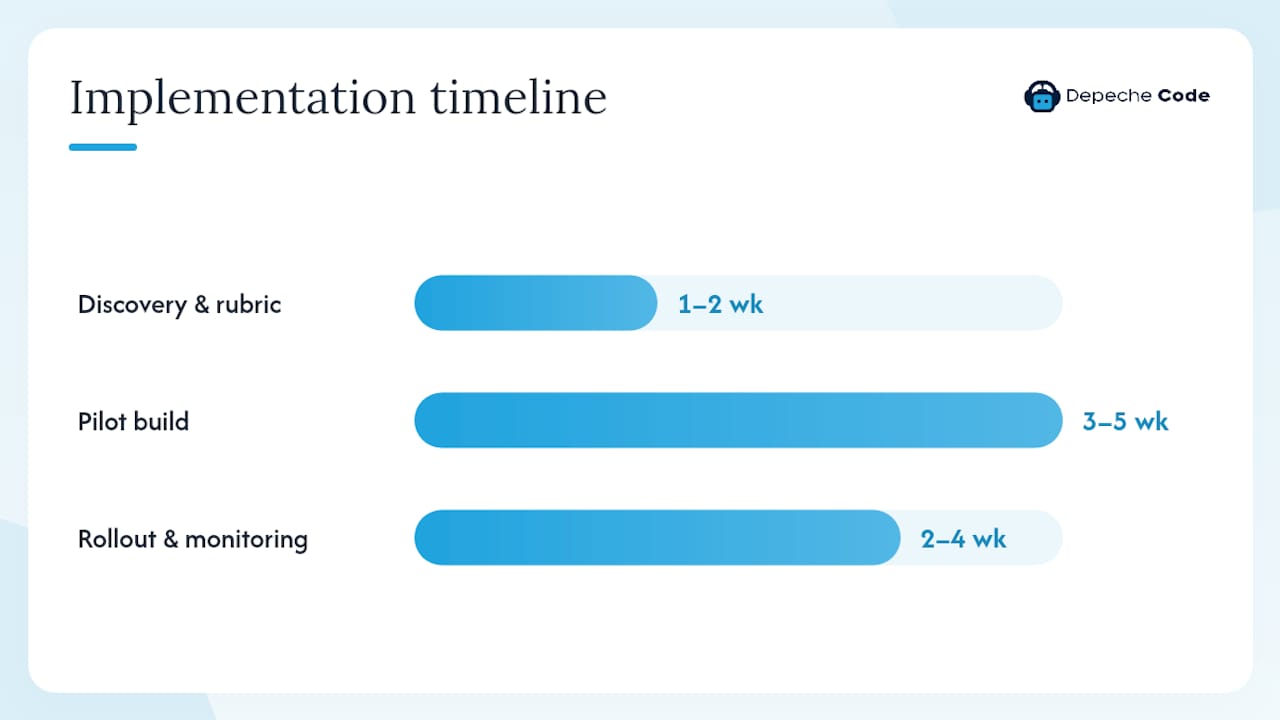
A realistic timeline: discovery and rubric design run one to two weeks, a pilot build takes three to five weeks depending on integration complexity, and production rollout with monitoring typically follows within another two to four weeks. Maintenance and tuning continue indefinitely, since buyer language and product offerings both shift.
Track these KPIs from day one:
- Response time (target: under one minute for the first reply)
- Capture rate (visitors who start a conversation vs. total visitors)
- Qualified-lead conversion rate
- Speed-to-contact for hot leads
- Pipeline velocity change compared to your pre-chatbot baseline
Pro Tip: Have the bot generate a two-to-three sentence lead summary alongside the score in its first sales notification. Reps who open a Slack alert that reads “Series B fintech, 15 leads/month, wants demo this week, score 92” respond faster than reps who get a bare CRM link with no context.
Run A/B tests on the opening message, the timing of the email ask, the order of qualification questions, and your score thresholds. Give each test at least two to three weeks to gather enough conversations for a real read, then iterate. Hyperleap’s research is blunt about the most common failure mode here: teams build a bot that behaves like a form wearing a chat bubble, with no scoring and no immediate handoff, and then wonder why it doesn’t generate pipeline.
Which Vendors Specialize in What?
The market has enough range that matching vendor to use case matters more than picking a “best” one.
Salesforce built its chatbot capability (Agentforce and related tools) around deep CRM integration, which makes it a natural fit for enterprise sales teams that already live inside Salesforce and need chat data to flow directly into existing pipelines without custom connectors.
Tidio leans toward small and mid-sized businesses that want a fast setup with pre-built templates, combining live chat and bot automation without much technical lift.
Drift (now part of Salesloft) built its reputation as a conversational sales assistant, oriented toward B2B teams that want chat tied tightly to buyer intent signals and account-based marketing plays.
Landbot specializes in a drag-and-drop flow builder that appeals to marketing teams who want to design and adjust conversation logic themselves without engineering support.
For businesses that don’t want to manage vendor selection, flow design, and CRM mapping in-house, working with an implementation partner like Depechecode often gets a production-ready bot live faster than piecing together a DIY vendor stack.
How Depechecode Approaches Chatbot Implementation
Depechecode’s implementation work follows the same sequence outlined above, applied to real client environments where the chatbot has to plug into existing CRM and website infrastructure without breaking either one.
The typical engagement runs through:
- Discovery: mapping the client’s actual ICP and current lead flow bottlenecks.
- Qualification rubric design: defining what “sales-ready” means in scoring terms before writing conversation logic.
- Flow build and CRM mapping: building the conversation and connecting structured fields to the client’s existing system.
- Pilot and scale: launching on high-intent pages first, then expanding once the flow proves out.
Procurement teams evaluating any implementation partner, Depechecode included, should ask pointed questions before signing:
- What’s the SLA for lead delivery time after a chat conversation ends?
- Who owns the conversation data and transcripts?
- What does the maintenance and tuning window look like after launch?
- What’s the escalation path when the bot misroutes a hot lead?
A chatbot project succeeds or fails on the handoff, not the widget. The conversation design matters, but the CRM mapping and routing logic are what actually turn a chat into a sale.
Why Chatbots Belong in Sales Ops, Not Just Marketing
Most marketing teams treat a chatbot like a website feature: pick a vendor, drop in a script, call it done. That’s backward. A lead-generation chatbot is a sales operations tool wearing a marketing costume, and treating it otherwise is why so many implementations stall at “nice widget, no pipeline.”

Get sales, marketing, and ops in the same room before writing a single conversation flow. Sales needs to agree on the scoring rubric. Ops needs to own the CRM mapping. Marketing needs to own the messaging. Without that alignment, you get a bot that captures leads nobody follows up on, which is worse than no bot at all.
Run a small pilot on one high-intent page. Measure only two things: speed-to-lead and qualified-lead conversion. Everything else is noise until those two numbers move.
Get Your Lead-Generation Chatbot Built the Right Way
Depechecode builds chatbot systems the way this article describes them: as sales-ops infrastructure, not decorative widgets. If you’ve been comparing vendors like Salesforce, Tidio, Drift, or Landbot and finding that none of them come with the flow design, CRM mapping, and rubric work needed to actually make the thing convert, that’s the gap Depechecode fills.
The scope covers discovery and ICP mapping, prototype conversation flows, CRM and calendar integration, production rollout, and ongoing monitoring so the bot keeps improving after launch instead of going stale. For teams that want a chatbot woven into a broader growth plan rather than a standalone tool, the AI Chat Bot Growth service scopes out strategy, build, and tuning together. If small-business intake and routing tools are also on your radar, RingPort’s AI receptionist handles a complementary piece of that puzzle for call-based lead capture.
Ready to see what a properly built qualification flow looks like for your traffic? Reach out to Depechecode’s team through the website design and development page and ask for a chatbot scoping call as part of the conversation.
Sources
- AI Lead Qualification for Chatbots: Strategies That Convert
- Lead Gen Chatbot Playbook 2026: Flows & CRM Handoff
FAQ
What Is the Main Role of Chatbots in Lead Generation?
Chatbots capture visitor information, qualify it against defined criteria in real time, and route qualified contacts to sales or nurture sequences, cutting response time compared to static forms.
Why Do Chatbots Qualify Leads Better Than Forms?
Chatbots ask one question at a time using progressive profiling, which lowers cognitive load and raises completion rates compared to a long static form asking for everything up front.
What Types of Chatbots Work Best for B2B Lead Generation?
Hybrid systems, combining a scripted qualification backbone with generative AI for open-ended questions, handle most B2B use cases better than pure rule-based or pure generative bots alone.
How Long Does It Take to Implement a Lead-Generation Chatbot?
Discovery and rubric design typically take one to two weeks, a pilot build another three to five weeks, with production rollout following two to four weeks after that.
Can Depechecode Help Build a Custom Lead-Generation Chatbot?
Yes. Depechecode handles discovery, qualification rubric design, conversation flow building, CRM integration, and ongoing tuning as part of its chatbot implementation services.