

TL;DR:
- Rebranding in redesign involves fundamentally reshaping a brand’s identity to guide website updates and strategic positioning. It ensures visual, messaging, and structural changes align with business goals, creating a more effective digital presence. Integrating rebranding with redesign improves market positioning, customer perception, and long-term performance.
Rebranding in redesign is the process of fundamentally reshaping a brand’s identity to inform and drive every decision in a website overhaul, from color palettes to messaging to user experience. The role of rebranding in redesign goes far beyond swapping a logo. It redefines market positioning, customer perception, and the entire visual system that your website communicates. Business leaders who treat redesign as a purely cosmetic exercise miss the deeper strategic opportunity. When rebranding and redesign work together, the result is a website that does not just look different. It performs differently.
How does rebranding differ from redesign?
Redesign and rebranding are related but distinct disciplines. Confusing them leads to projects that look refreshed but fail to move the needle on business outcomes.

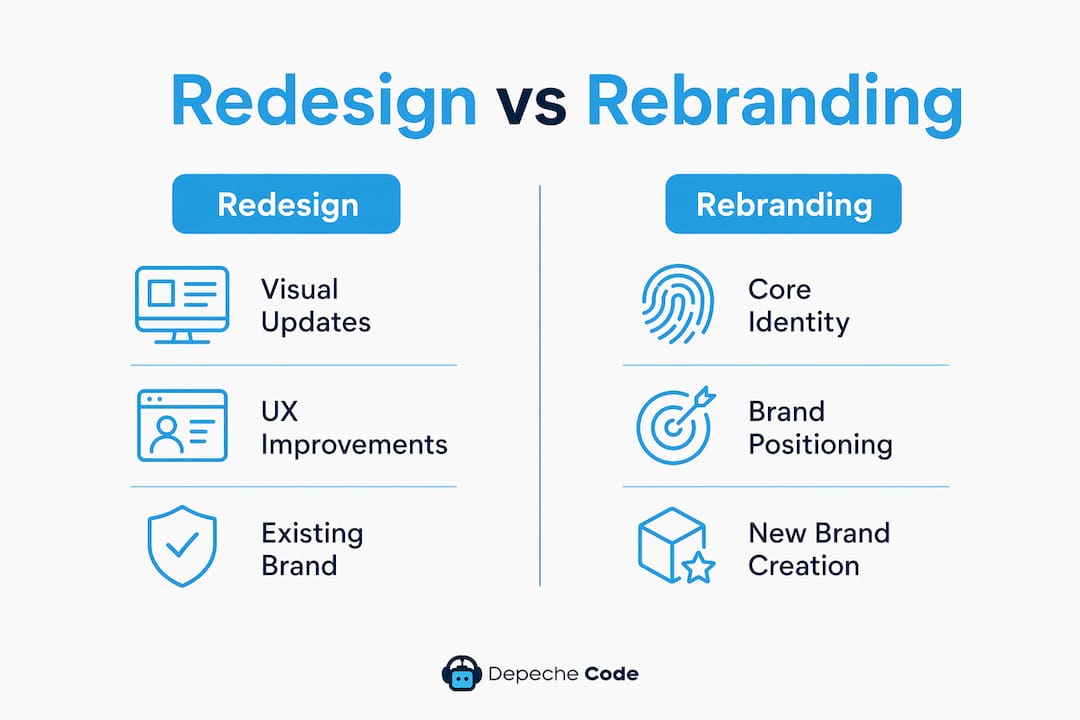
A redesign updates the visual presentation and user experience of an existing brand. It improves navigation, refreshes layouts, updates typography, and modernizes the look of a site. The brand’s core identity stays the same. A redesign is the right move when your brand positioning is solid but your digital presence feels dated.
Rebranding goes deeper. A rebrand involves rethinking a brand’s core proposition and visual system, then carrying those changes through every touchpoint. It means revisiting your mission, your audience, your voice, and your market position. The visual changes follow from that strategic shift, not the other way around.
Here is a practical comparison:
| Aspect | Redesign | Rebranding |
|---|---|---|
| Scope | Visual and UX updates | Full identity and positioning shift |
| Triggers | Outdated look, poor UX | New market, audience shift, reputation change |
| Core identity | Unchanged | Redefined |
| Visual changes | Yes | Yes, but driven by new strategy |
| Messaging | Refined | Rewritten from the ground up |
| Timeline | Shorter | Longer, more cross-functional |
The key takeaway: redesign serves the existing brand. Rebranding creates a new one, and the redesign then expresses it.
Why is the role of rebranding critical in a website redesign?
Rebranding gives a redesign its direction. Without it, design decisions become subjective debates about color preferences rather than strategic choices tied to business goals.
When rebranding precedes or runs alongside a redesign, every visual and structural choice has a reason. Integrating rebranding into redesign enables expanded market appeal, refined messaging, and a visual identity that responds to where the business is going, not where it has been. That alignment is what separates websites that convert from websites that simply exist.
The strategic benefits are concrete:
- Market repositioning. A rebrand signals to customers and competitors that your business has evolved. The redesigned website becomes the proof point.
- Customer perception alignment. Your site’s tone, imagery, and structure now match the brand promise you are making in every other channel.
- Competitive differentiation. Rebranding often involves modifying logo elements, typography, and colors to improve clarity and relevance to new market positions. That specificity sets you apart.
- UX decisions grounded in strategy. Navigation structure, calls to action, and content hierarchy all reflect the new brand’s priorities, not legacy assumptions.
- Consistency across touchpoints. A redesign informed by rebranding produces a site that matches your social media, sales materials, and in-person brand experience.
Pro Tip: Before you brief a design team, run a brand audit. Most brands fix visible UI problems but miss the underlying architecture issues causing users to drop off. A brand and usability audit reveals both.
Starting with a brand and usability audit before redesign reveals the true points of friction and directs efforts where they matter most. Skipping this step is the single most common reason redesign projects underdeliver.
What are effective strategies to integrate rebranding into redesign projects?
The most effective integration happens when rebranding strategy is locked before design work begins. Teams that start designing while brand strategy is still in flux waste time and produce inconsistent results.
Set KPIs before the first wireframe
Redesigns without predefined KPIs risk failure because their impact cannot be measured. Set commercial metrics upfront: conversion rate, average session duration, bounce rate, and Net Promoter Score. These numbers give the team a shared definition of success and prevent subjective debates from derailing the project.
Pro Tip: Split your KPIs into two categories: commercial (conversion rate, revenue per visitor) and perception-based (NPS, brand recall surveys). Both matter, and neither alone tells the full story.
Build a cross-functional team from day one
Rebranding touches marketing, design, development, and often sales. When these teams work in silos, the website ends up with a new visual identity but old messaging, or a new brand voice but an outdated information architecture. Assign a project lead with authority to make decisions across all three functions.
For B2B companies in particular, choosing a web design agency that understands brand strategy, not just visual execution, makes a measurable difference in outcomes. The agency should ask about your positioning before they ask about your color preferences.
Create a communication plan for every touchpoint
Effective communication across digital and offline touchpoints is the backbone of brand coherence after a rebrand. Map every place your brand appears: website, email templates, social profiles, sales decks, and physical materials. Assign ownership for updating each one and set a launch sequence so nothing goes live out of sync.
Key checkpoints to build into your workflow:
- Brand strategy sign-off before any design begins
- Messaging framework approval before copywriting starts
- Design system review at 50% completion to catch drift early
- Stakeholder alignment session before the final build phase
- Soft launch with analytics tracking active from day one
Reviewing your website branding strategies at each checkpoint keeps the project on track and prevents last-minute scope changes that blow timelines.
How to measure the impact of rebranding on redesign outcomes?
Measurement is where most rebranding and redesign projects fall short. Teams celebrate the launch and move on without capturing the data that proves whether the investment worked.
The most direct measure is conversion rate. Italic’s checkout redesign, which aligned the checkout experience with the brand’s identity, produced a 31% lift in conversion rates and a 19% decrease in cart abandonment. That result came from treating the checkout not as a transaction utility but as a brand touchpoint. The lesson applies to every page of a redesigned site.
“Redesigns without measurement are like journeys without maps.” Setting KPIs before design begins is not optional. It is the only way to know whether the rebrand delivered what the business needed.
Commercial KPIs capture the financial impact. Perception metrics capture the brand impact. Customer satisfaction and NPS complement conversion data to give a complete picture of redesign success. A site that converts well but scores poorly on brand perception has a problem that will surface in churn rates six months later.
| Metric type | Examples | What it measures |
|---|---|---|
| Commercial KPIs | Conversion rate, revenue per visitor | Direct business impact |
| Engagement metrics | Session duration, pages per visit | Content and UX effectiveness |
| Perception metrics | NPS, brand recall surveys | Brand identity alignment |
| Retention signals | Return visitor rate, churn rate | Long-term brand loyalty |
Measure before the redesign launches, not after. Baseline data is the only way to prove causation rather than correlation. Set up analytics tracking, run a pre-launch NPS survey, and document your current conversion benchmarks. Then measure again at 30, 60, and 90 days post-launch.
For teams focused on sustained traffic growth after a redesign, pairing the new site with a structured SEO plan protects and builds on the visibility gains the redesign creates.
Key Takeaways
Rebranding drives redesign success when it precedes design decisions, aligns cross-functional teams, and is measured against predefined KPIs from day one.
| Point | Details |
|---|---|
| Rebranding precedes design | Lock brand strategy before briefing any design work to avoid costly revisions. |
| Audit before you build | A brand and usability audit reveals architectural issues that visual redesigns alone cannot fix. |
| KPIs are non-negotiable | Set commercial and perception metrics before the first wireframe to define success clearly. |
| Measure pre and post launch | Baseline data is the only way to prove the redesign delivered measurable business impact. |
| Cross-functional alignment | Marketing, design, and development must work from the same brand strategy document throughout. |
What most teams get wrong about rebranding and redesign
Most projects I have seen treat rebranding as a deliverable rather than a process. The team agrees on a new logo, picks updated colors, and hands a brand guide to the design team. Then the redesign begins. That sequence looks logical on paper, but it produces websites that feel inconsistent because the strategy never fully informed the structure.
The brands that get this right do something different. They spend more time on the brand strategy phase than on the visual phase. They ask hard questions: Who are we losing to, and why? What do our best customers say about us that we are not saying about ourselves? What does our current site communicate that we no longer want to be true? Those answers shape everything from the homepage headline to the navigation labels.
The other mistake I see constantly is partial rebranding. A company updates its visual identity but leaves the messaging unchanged, or rewrites the copy but keeps the old visual system. Partial rebranding produces a site that feels off without anyone being able to say exactly why. Customers sense the inconsistency even when they cannot name it. A solid B2B brand strategy treats identity and messaging as inseparable, and the redesign reflects both completely.
The measurement gap is the third failure point. Teams that do not set KPIs before launch have no way to defend the investment or learn from the results. The Italic checkout example is instructive precisely because the team measured everything. They knew their baseline cart abandonment rate. They knew their target. They built the redesign around closing that gap. That is the standard every project should hold itself to.
— Donovan
Depechecode builds redesigns that reflect your brand strategy
A website redesign without a clear brand strategy behind it is an expensive cosmetic update. Depechecode, based in Orlando, builds brand-aligned websites that connect your positioning, messaging, and visual identity into a single, high-performing digital presence.

Every project starts with understanding where your brand is going, not just what your current site looks like. Depechecode’s team covers website design and development, SEO, and ongoing maintenance, so the gains from your redesign compound over time rather than fade. If you are planning a redesign and want it grounded in real brand strategy, request a consultation with Depechecode today.
FAQ
What is the role of rebranding in a website redesign?
Rebranding defines the strategic direction that a redesign must express. It reshapes brand identity, positioning, and messaging so that every design decision serves a clear business purpose.
How does rebranding affect design choices?
Rebranding directly determines color palettes, typography, tone of voice, and information architecture. Design choices that conflict with the new brand strategy undermine the entire project.
Why should you redesign your website after rebranding?
A redesigned website is the primary proof point of a rebrand. Without it, the new brand identity exists only in documents while customers still experience the old one.
What KPIs should you track after a rebranding redesign?
Track conversion rate, Net Promoter Score, session duration, and return visitor rate. Combining commercial and perception metrics gives a complete picture of whether the rebrand delivered results.
How long does a rebranding and redesign project take?
Timeline varies by scope, but projects that include full rebranding typically run longer than pure redesigns because the strategy phase must be completed before design begins. Rushing the strategy phase is the leading cause of project failure.