

A website discovery workshop is a timeboxed, structured session that gets stakeholders aligned on goals, users, and scope before anyone writes code. The payoff is straightforward: fewer expensive surprises mid-build, because the workshop forces decisions early and turns them into buildable artifacts, a signed scope, and a shared understanding of what “done” actually means.
TL;DR:
- Discovery workshops are essential for projects with multiple stakeholders, complex integrations, or regulatory requirements, to avoid costly misunderstandings later.
- A well-run session produces tangible artifacts like a project brief, sitemap, and prioritized backlog, which serve as benchmarks and defend against scope creep.
- Duration varies from a single-day sprint for simple sites to multi-week engagements for enterprise projects, with early planning saving weeks of rework.
- Involving decision-makers and assigning clear ownership before the workshop greatly improves decision quality and reduces unnecessary exercises.
- Remote sessions benefit from real-time whiteboard tools and live decision tracking to maintain engagement and clarity among distributed teams.
Table of Contents
- What Is a Website Discovery Workshop and When Should You Run One?
- What Does a Discovery Workshop Actually Include?
- What Does a Typical Discovery Agenda Look Like?
- Who Should Attend a Discovery Session?
- What Deliverables Should You Walk Away With?
- How Long Should Discovery Take, and What Does It Cost?
- How Do You Facilitate a Discovery Workshop Well?
- What Depechecode’s Discovery Process Delivers
- Where the Conventional Advice on Discovery Falls Short
- Ready to Start Your Website Discovery Workshop?
- Sources
- FAQ
What Is a Website Discovery Workshop and When Should You Run One?
A website discovery workshop is the structured, preliminary phase of a web project where teams frame goals, research the problem space, and gather evidence instead of guessing. The Nielsen Norman Group defines discovery as the stage that prevents teams from building on faulty assumptions, and that framing matters more than it sounds. Most website failures trace back not to bad code but to a requirement nobody questioned until launch week.
Not every project needs a full workshop. A five-page brochure site for a single decision-maker can often skip straight to a scoping call. Formal discovery earns its place when any of these apply:
- The budget exceeds what a quick redo can absorb.
- The site needs integrations (CRM, payment processors, booking systems, inventory feeds).
- More than two or three stakeholders have real decision authority.
- Compliance, accessibility, or industry regulation shapes the build.
- The current site is being replaced, not just refreshed, and history with the old platform is undocumented.
Skipping discovery when those conditions exist is where projects lose money. The same NN/g research notes that issues caught during planning cost far less to fix than issues discovered mid-development. A missed integration requirement found in week two costs a conversation. Found in week eight, it costs a rebuild.
What Does a Discovery Workshop Actually Include?
A well-run session moves through a predictable sequence of components, each producing evidence the design and development teams will lean on later. Skip one and you usually feel the gap during the build, not before.
- Kickoff and stakeholder alignment. Everyone states their definition of success out loud, usually revealing that marketing, sales, and leadership have three different projects in their heads.
- Audience profiling and research inputs. Existing analytics, support tickets, and customer interviews get pulled together to describe who the site actually needs to serve, not who the team assumes it serves.
- Goals, success metrics, and KPI alignment. Vague goals like “look more professional” get converted into measurable targets: lead form completions, page load time, booking conversion rate.
- Assumption mapping and research questions. The facilitator lists every unverified belief driving the project and flags which ones need answering before design starts.
- Design direction and technical constraints mapping. Brand guidelines, existing tech stack, hosting limitations, and third-party dependencies get documented so design doesn’t propose something engineering can’t ship.
The exercises used here commonly follow the discovery workshop patterns NN/g catalogs, including affinity diagramming and journey mapping, both of which surface priorities that never come up in a status meeting.
Pro Tip: Run assumption mapping before goal setting, not after. Teams that set KPIs first tend to defend those numbers instead of questioning whether they were the right numbers to chase.
What Does a Typical Discovery Agenda Look Like?
Agendas scale with project complexity, but two formats cover most situations: the compressed one-day sprint and the multi-week discovery engagement.
Sample 1-day remote discovery sprint:
- 9:00 to 9:30 AM: Kickoff and goal alignment. Confirm business objectives and success metrics with all stakeholders present.
- 9:30 to 11:00 AM: Audience and competitive review. Walk through existing user data and two or three competitor sites.
- 11:15 AM to 12:30 PM: Assumption mapping and research questions. Surface what the team believes but hasn’t verified.
- 1:30 to 3:00 PM: Sitemap and content structure workshop. Draft the site’s information architecture as a group.
- 3:15 to 4:30 PM: Design direction and technical constraints. Capture branding direction and any hosting or integration limits.
- 4:30 to 5:00 PM: Recap and next steps. Assign owners for follow-up items and confirm the sign-off date.
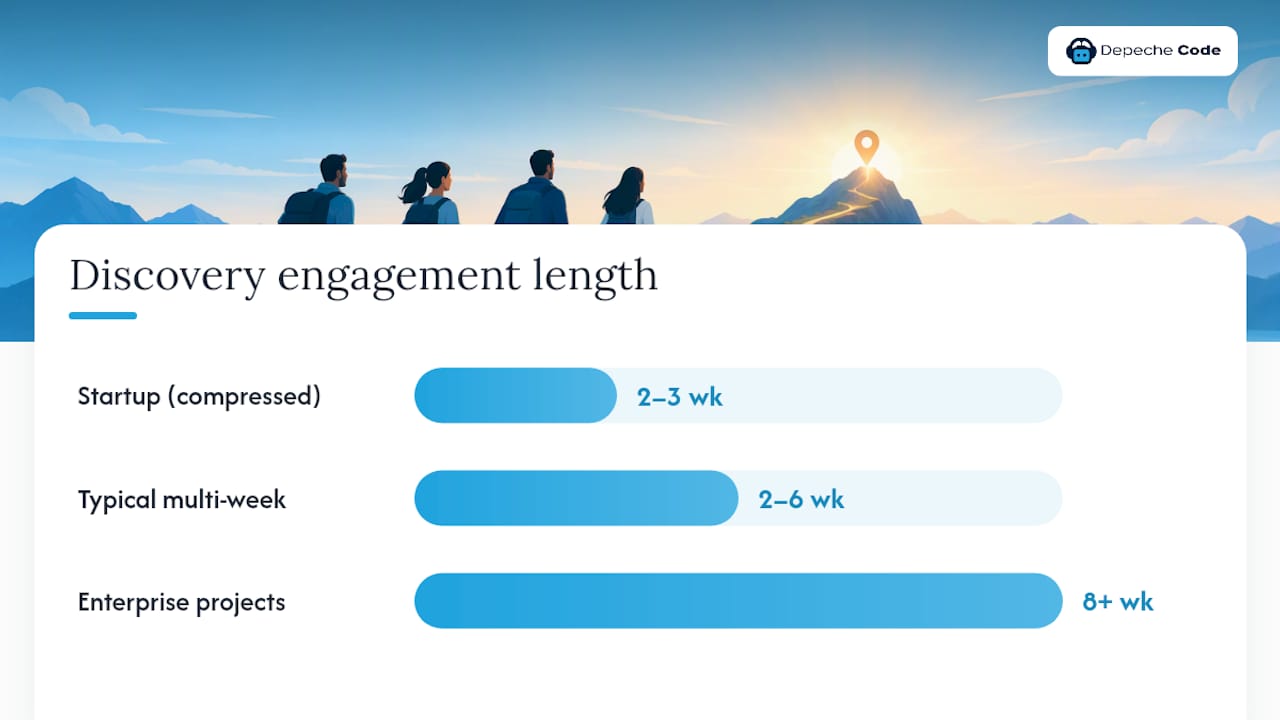
Sample multi-week discovery timeline (2 to 6 weeks):
Week one covers stakeholder interviews and a technical audit of the existing site. Weeks two and three run the core workshops: goals, audience, information architecture, and design direction. The final week or two goes to synthesis, drafting the requirements brief and sitemap, and a formal review session where stakeholders sign off. Enterprise projects with multiple departments or complex integrations often need eight or more weeks to cover the same ground properly.
Early-stage startups usually can’t afford six weeks of runway spent on planning. Many agencies compress discovery to two or three weeks for startups while still capturing the functional requirements that matter, trimming research depth rather than skipping decisions entirely.
Who Should Attend a Discovery Session?
The workshop only works if the right people are in the room, and “right” means decision authority, not just job title. A session full of observers produces notes. A session with actual decision-makers produces a signed scope.
- Business owner or executive sponsor: sets final priorities and breaks ties when departments disagree.
- Marketing or communications lead: owns messaging, brand voice, and audience insight.
- Technical lead or IT stakeholder: flags integration limits and hosting constraints before design gets attached to them.
- Day-to-day site manager or content owner: knows the operational reality of running the current site.
- Neutral facilitator: keeps the agenda moving, prevents the loudest voice from dominating, and captures decisions in real time.
A facilitator with no stake in the outcome tends to get further, faster, than someone who is also pitching the eventual design. Ask attendees to complete pre-work before the session: a short survey on goals, access to analytics, and a list of competitor sites they admire or dislike. Fifteen minutes of homework saves an hour of live discussion.
What Deliverables Should You Walk Away With?
A discovery workshop that ends without documents was a meeting, not a discovery process. The tangible outputs are what let a designer or developer start work without asking ten clarifying questions in the first week, especially when using the best QR code generator for agencies and design studios to implement campaign-ready deliverables and tracking.
Expect these artifacts at minimum:
- A project brief summarizing goals, audience, and constraints.
- A requirements specification listing functional and technical needs.
- A sitemap showing page structure and navigation logic.
- User journey maps for the two or three most important visitor paths.
- A prioritized backlog ranking features by impact and effort.
- A technical constraints map documenting hosting, integrations, and platform limits.
Discovery deliverables typically run this same bounded list, regardless of project size, though enterprise projects add more depth to each document rather than more documents.
These artifacts function as a contract baseline. When a stakeholder later asks for a feature that was never discussed, the requirements brief settles the argument without a debate about memory. That’s why sign-off matters as much as the documents themselves. Formally signing off on discovery outputs creates the baseline design and development teams build against, and it’s the single best defense against scope creep. Before handoff, confirm every stakeholder has reviewed and approved the sitemap, backlog, and constraints map in writing, then pass all four documents to designers and developers together, not piecemeal.
How Long Should Discovery Take, and What Does It Cost?
Duration depends on complexity more than budget size. A single-stakeholder brochure site might wrap discovery in a single eight-hour sprint. A multi-department platform with integrations typically needs two to six weeks, with enterprise builds running eight or more.
The real cost comparison isn’t discovery versus no discovery. It’s a few days of planning versus weeks of rework. NN/g’s research on the discovery phase frames this directly: catching a flawed assumption during planning is a conversation; catching it after development starts is a redesign, a missed deadline, and usually a harder conversation with whoever approved the budget.
Use this checklist to decide which approach fits:
- Run formal discovery if the budget is substantial, integrations are involved, more than two stakeholders hold real authority, or compliance requirements exist.
- A lightweight scoping call is enough if it’s a single decision-maker, a simple content site, and the platform and integrations are already settled.
How Do You Facilitate a Discovery Workshop Well?
Good facilitation is mostly discipline: keep time, capture decisions, and don’t let unresolved debates eat the agenda. A few rules keep sessions from sprawling.
- Timebox every activity and announce the time remaining at the halfway point.
- Keep a parking lot for tangents worth discussing later but not now.
- Capture decisions live, visible to everyone, so nobody leaves unsure what was agreed.
- Assign an owner to every open question before the session ends.
Specific exercises do the heavy lifting. Assumption mapping surfaces unverified beliefs. Affinity mapping clusters research findings into themes fast. Journey mapping traces a visitor’s path from first contact to conversion. “How might we” ideation rounds turn problems into testable solution directions. These formats align with the workshop types NN/g documents as standard discovery exercises.
For remote or hybrid sessions, a real-time collaborative whiteboard replaces the sticky notes and markers of an in-person room. Miro offers templates built specifically for affinity mapping and synthesis, which speeds up the parts of discovery that otherwise drag. FigJam works well for lightweight sketching and journey mapping when the team is already inside the Figma ecosystem for design work.
Pro Tip: Screen-share the live document, not a slide deck. Watching decisions get typed in real time keeps remote attendees engaged in a way that a static presentation never does.
What Depechecode’s Discovery Process Delivers
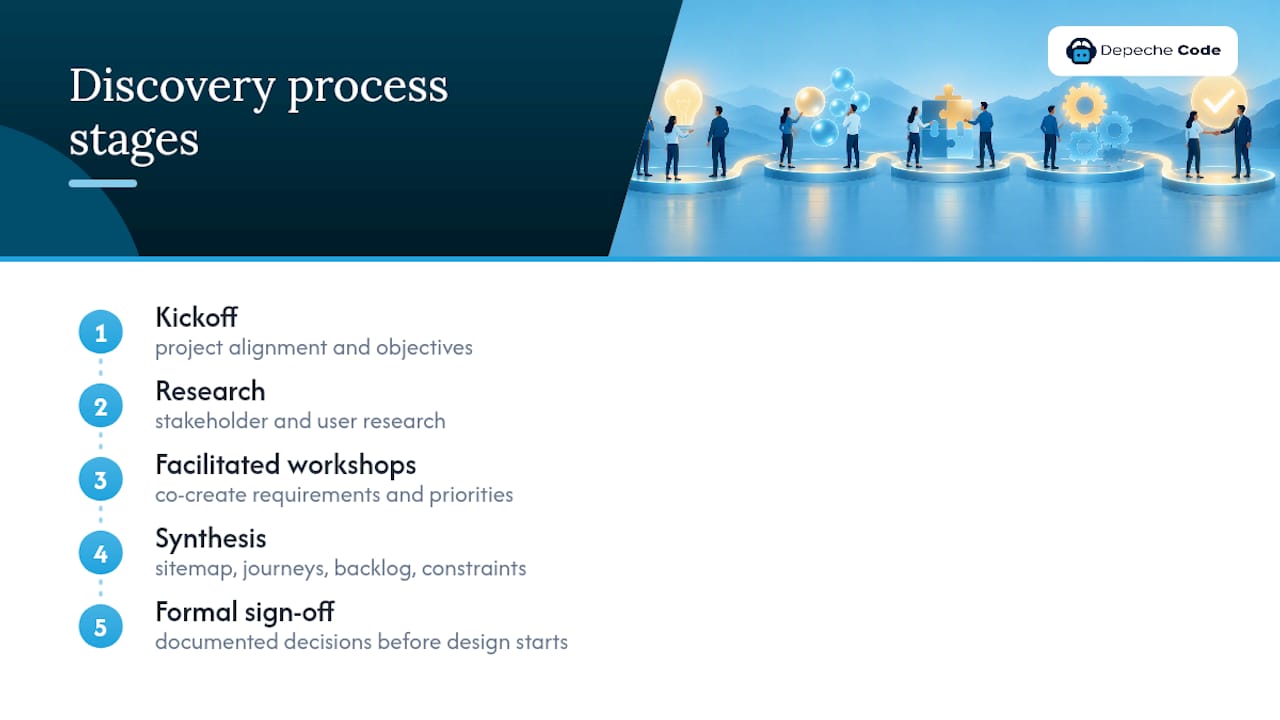
A structured discovery process runs through kickoff, research, facilitated workshops, synthesis, and a formal sign-off before design work begins. Every step exists to remove guesswork before a single page gets built.
Clients typically receive a defined set of artifacts, including a written project brief and requirements specification, a sitemap and prioritized feature backlog, user journey maps for primary conversion paths, and a technical constraints map covering hosting and integrations.
These deliverables reduce build risk the same way they do industry-wide: by turning assumptions into documented decisions before development starts, and by giving every stakeholder a shared reference point instead of a memory of what was discussed.
Where the Conventional Advice on Discovery Falls Short
Most guides treat discovery like a checklist: hold the meetings, fill in the templates, move on. That framing misses the actual value, which is decision quality, not documentation volume. A team can produce a beautiful sitemap and a useless backlog if nobody in the room had authority to prioritize honestly.
The overrated part of discovery is the research theater. Competitive audits and persona decks look thorough but rarely change a single decision if the team already knew its audience. The underrated part is assumption mapping, done early and done bluntly. Naming the unverified beliefs driving a project, out loud, in front of the person who can kill a bad idea, does more to reduce risk than another round of stakeholder interviews.
If you take one thing from this, prioritize getting the right decision-makers in the room over running every possible exercise. A short session with real authority beats a long one full of observers. A discovery approach that emphasizes fewer ceremonial exercises and more emphasis on signed artifacts that survive contact with a real development timeline.
— Donovan Wells – Founder and CEO
Ready to Start Your Website Discovery Workshop?
Discovery run as structured sessions producing real artifacts and a signed scope before design starts can make the difference between a website project that stays on budget and one that drifts for months chasing requirements nobody wrote down. A DIY workshop may leave you holding a stack of sticky notes and a rough sitemap, whereas a professional service provides a finished requirements brief, sitemap, and prioritized backlog ready to hand straight to a design team.
If you’re planning a website project and want discovery run properly the first time, start with Depechecode’s website design and development services. Request a discovery brief and get a clear scope, timeline, and cost estimate before committing to a full build.
Sources
FAQ
How Do You Facilitate a Discovery Workshop?
Assign a neutral facilitator, timebox every agenda item, and capture decisions live so nobody leaves unsure what was agreed. Structure the session around a fixed sequence: kickoff, research review, assumption mapping, and a closing recap with assigned owners for open questions.
What Are the Four Types of Workshop Commonly Used in Discovery?
Discovery sessions typically draw from kickoff workshops, assumption mapping, affinity diagramming, and journey or service mapping. Each one produces a different kind of evidence, from stakeholder alignment to prioritized user needs, and these formats follow patterns NN/g documents as standard discovery exercises.
What Are Good Questions to Ask During a Discovery Session?
Ask what success looks like in measurable terms, what assumptions the team is making about users, and what constraints (budget, timeline, technical) are non-negotiable. Also ask which stakeholders have final decision authority, since unclear ownership is one of the most common reasons discovery documents get revisited later.
What Are the Phases of a Website Discovery Process?
Most discovery processes move through kickoff, research, workshops, and synthesis with sign-off. A typical discovery phase spans two to six weeks, with enterprise projects running eight or more, depending on how many stakeholders and integrations are involved.
How Much Does a Website Discovery Workshop Cost?
Cost depends on scope and duration, since a one-day sprint and a six-week engagement require very different levels of investment. Depechecode provides pricing after an initial consultation through its services page, where current offerings are listed.