
A phased website build is a structured approach where a website is developed and launched in sequential stages, each focused on the highest-priority pages and features first. Instead of building everything at once and launching a complete site after months of work, you release core pages early, gather real feedback, and expand from there. This method manages risk, keeps budgets predictable, and gets revenue-driving pages live before the rest of the site is finished.
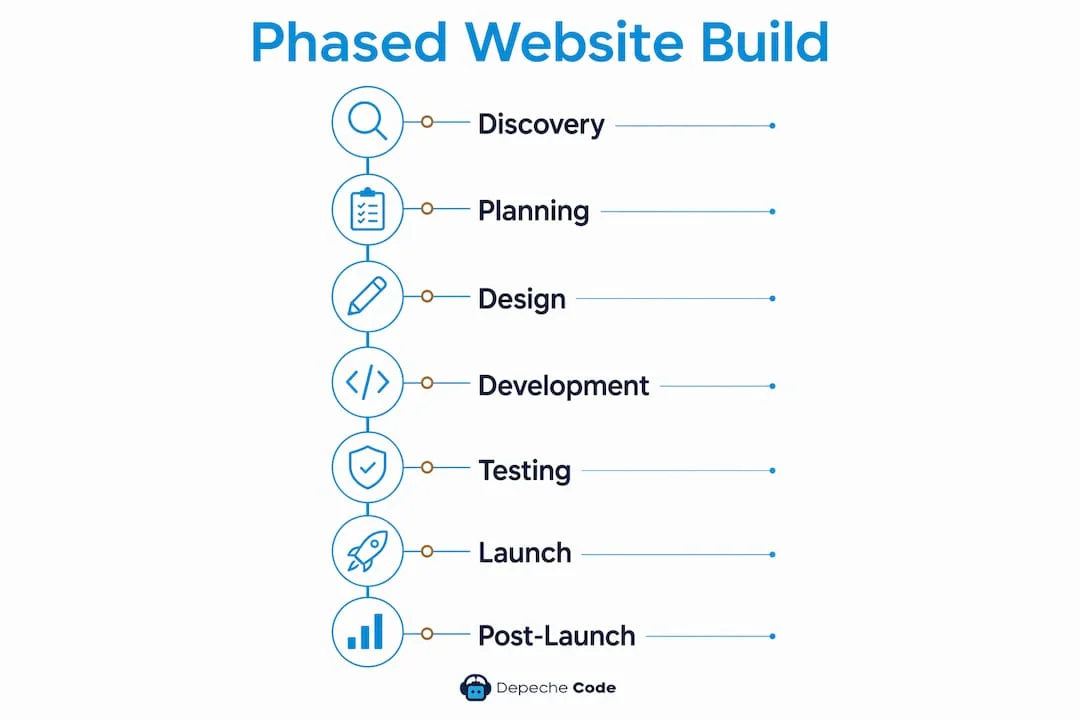
A typical phased website build plan includes these key stages: discovery, planning, design, development, testing, launch, and maintenance.
The core advantage is simple. Phased builds create a sequential testing environment where teams fix global issues once, train progressively, and capture value months earlier than a full-site launch would allow.
Table of Contents
- What is a phased website build, and why does it start with discovery?
- How the design and build phase shapes everything that follows
- Why testing in phases catches problems that full-site QA misses
- How to launch and maintain a phased website build effectively
- How aligning phases with business goals accelerates real results
- Depechecode builds websites the phased way, so you capture value faster
- Key Takeaways
- FAQ
What is a phased website build, and why does it start with discovery?
Discovery is where projects either get a solid foundation or quietly set themselves up to fail. Before a single wireframe gets drawn, this phase produces the decisions that shape everything else: who the site serves, what it needs to accomplish, and which pages matter most.
Key activities in this phase include:
- Stakeholder interviews: Align internal teams on goals, constraints, and priorities
- Competitor and market analysis: Identify gaps and positioning opportunities
- Requirements gathering: Document functional needs, integrations, and content scope
- Site architecture: Map out page hierarchy, navigation, and URL structure
- Scope definition: Establish what goes into Phase 1 versus later phases
Skipping or compressing discovery causes the most common project failures: unclear scope, repeated revision cycles, and sites that go live without actually serving the business. A structured project plan covering discovery, design, development, testing, launch, and maintenance prevents most of those headaches before they start.
Pro Tip: Tie every discovery deliverable to a specific business outcome. If a stakeholder can’t explain why a page or feature belongs in Phase 1, it probably belongs in Phase 2.
How the design and build phase shapes everything that follows
Phase 2 is where the site takes physical form, and the order of operations matters more than most teams expect. The right approach starts with the pages that drive the most traffic and conversions: the homepage, primary product or solution pages, and key navigation elements. Everything else waits.

This phase establishes the design system and component library that every future page will draw from. Getting those foundations right during Phase 1 of the build means Phase 2 content can be assembled by dropping components into the CMS rather than going back through wireframes and design approvals each time. That distinction has real operational consequences later.
Common risks in this phase:
- Rushing design reviews: Stakeholder sign-off on core pages prevents expensive rework downstream
- Skipping the component library: Without reusable components, every new page becomes a custom build
- Scope creep: Adding secondary pages to Phase 1 dilutes focus and delays launch
- Weak CMS setup: Internal teams need a CMS they can actually use independently in later phases
One underappreciated benefit of building core pages first is that internal stakeholders learn the CMS through real work during Phase 1, before they’re expected to build independently in later phases. That training happens organically, not through a separate onboarding process.
For businesses planning a website architecture strategy, the design phase is where those structural decisions get validated against real content and real user flows.
Why testing in phases catches problems that full-site QA misses
Testing a large site simultaneously is how bugs survive to launch day. Phased builds reduce the QA surface area per phase, which means teams can give critical pages the attention they actually need instead of spreading effort thin across everything at once.
The testing types that matter at this phase:
- Functional testing: Forms, CTAs, integrations, and interactive elements work as expected
- Cross-browser testing: Consistent rendering across Chrome, Safari, Firefox, and Edge
- Responsive testing: Mobile, tablet, and desktop layouts all hold up
- Performance testing: Page speed, Core Web Vitals, and load times under realistic conditions
- User feedback loops: Real users reveal navigation issues that internal teams overlook
The compounding benefit is significant. If a component breaks on mobile during Phase 1 QA, you catch it immediately and fix it once. That fix then protects every page built in Phase 2 that uses the same component. You’re not discovering the same mobile bug across dozens of landing pages months later.
Iterative revision cycles belong here too. Analytics from early-launched pages tell you what’s actually working before you commit the same patterns to the rest of the site. That feedback loop is one of the clearest advantages of incremental website development over a single big-bang launch.
How to launch and maintain a phased website build effectively
A phased launch means your highest-value pages go live first, not last. Homepage, product pages, and primary conversion paths launch in Phase 1. Blogs, case studies, resource hubs, and secondary landing pages follow in Phase 2, once the foundation is proven.
Post-launch maintenance tasks to plan for from day one:
- CMS updates and plugin management: Outdated software is the most common security vulnerability
- Performance monitoring: Track Core Web Vitals and uptime continuously, not just at launch
- Content updates: Fresh content signals relevance to both users and search engines
- Security audits: Regular scans catch vulnerabilities before they become incidents
- Analytics review: Monthly reviews of traffic, conversions, and user behavior drive iteration
The operational dynamic shifts after Phase 1 launches. Internal teams trained during Phase 1 gain the independence to build and maintain secondary pages in Phase 2 without waiting on agency resources for every update. That shift from vendor dependency to collaborative partnership is one of the most practical long-term benefits of a phased approach.
Maintenance also keeps the site aligned with evolving business goals. A site that launched in Q1 may need new landing pages by Q3 to support a product expansion or a new market. Planning for that from the start, rather than treating launch as the finish line, is what separates sites that grow with the business from ones that go stale.
Pro Tip: Build a maintenance calendar before launch day. Assign ownership for updates, security checks, and analytics reviews so nothing falls through the cracks once the agency engagement winds down.
How aligning phases with business goals accelerates real results
The most effective phased website builds aren’t organized around technical features. They’re organized around business milestones. Aligning phased build schedules with specific events like product launches, funding rounds, or conference dates increases strategic value and keeps the project pacing disciplined.
Here’s what that looks like in practice:
- Phase 1 deadline tied to a product launch: Core pages go live in time to support sales and marketing
- Phase 2 timed around a conference: New landing pages and case studies ready for a specific event
- Budget allocated by phase: Spend is tied to deliverables, not to a lump-sum agency contract
Launching core conversion paths first rather than waiting for every page to be perfect means revenue opportunities open months earlier. Your homepage and product pages could be driving pipeline in Q2 instead of Q4. That timing advantage affects lead generation, sales enablement, and competitive positioning simultaneously.
Resource allocation also becomes more predictable. When each phase has a defined scope and a clear business outcome, budget conversations are grounded in deliverables rather than estimates. Teams know what they’re getting and when. For businesses working through a website budget plan, phasing is one of the most effective ways to match spending to actual business need.
Pro Tip: Define each phase by the business outcome it needs to deliver, not just the pages it includes. “Phase 1 enables lead generation for the Q2 product launch” is a better phase definition than “Phase 1 covers the homepage and product pages.”
For professional services firms, this approach mirrors how mortgage website builders and other lead-focused sites prioritize conversion pages above all else in early development, getting the revenue engine live before worrying about secondary content.
Depechecode builds websites the phased way, so you capture value faster
Most agencies hand you a long timeline and a single launch date. Depechecode, based in Orlando, takes a different approach: structured phases tied to your actual business milestones, so your most important pages go live and start working for you while the rest of the site is still being built.

Depechecode’s website design and development service is built around this phased model. You get a custom design system, a CMS your team can actually use independently, and a launch sequence that prioritizes the pages driving your pipeline. No waiting for everything to be perfect before anything goes live. The agency also pairs each build with SEO options so your new pages rank from day one, not six months after launch.
If you’re a business owner ready to stop treating your website as a one-time project and start treating it as a growth asset, get a quote from Depechecode and see what a phased build looks like for your specific goals.
Key Takeaways
A phased website build delivers core business value early by launching priority pages first, then expanding the site in structured stages tied to real milestones.
| Point | Details |
|---|---|
| Launch priority pages first | Homepage and product pages go live before secondary content, opening revenue opportunities months earlier. |
| Fix bugs once, not repeatedly | Catching a component issue in Phase 1 QA protects every page built in Phase 2 that uses the same component. |
| Align phases to business events | Tying phase deadlines to product launches or funding rounds keeps pacing disciplined and spending predictable. |
| Train your team during Phase 1 | Internal stakeholders learn the CMS through real work, gaining independence to build pages without agency support later. |
| Depechecode structures builds this way | Depechecode’s phased development service ties each stage to your business milestones and includes SEO from day one. |
FAQ
A typical website build covers seven stages: discovery, planning, design, development, testing, launch, and post-launch maintenance. The weight placed on each phase shifts depending on the project type, but the sequence stays consistent.
What makes a phased build better than launching everything at once?
Phased builds reduce the QA surface area per stage, fix global issues before they multiply across the full site, and get core conversion pages generating leads months before a full-site launch would be ready. That earlier value capture is the primary operational advantage.
How does Depechecode approach phased website development?
Depechecode structures each build around your business milestones, prioritizing the pages that drive pipeline first and pairing the build with SEO so new pages rank from launch day. You can review their website development service to see how the phased model applies to your project.