

Competitor analysis is the systematic process of identifying rival businesses, gathering data on their offers and marketing, and using that information to find a defensible position in your market. The U.S. Small Business Administration frames it as a core part of business planning, and platforms like Coursera teach it as a repeatable skill rather than a one-time project. Depechecode treats it the same way when building strategy for clients: a living document, not a report you file and forget.
Your next step is simple. Pick your top three competitors right now and start pulling public information on each one: their pricing page, their reviews, their homepage messaging.
A basic competitor profile should include:
- The core offer and how it is packaged or bundled
- Price range and any visible discounting patterns
- Market positioning and the language used to describe it
- Notable strengths and weaknesses customers mention
- Customer signals like review volume, sentiment, and response speed
Key Takeaways
Competitor analysis works because it replaces guesswork with a repeatable process for spotting gaps, pricing correctly, and claiming market space competitors have left open.
| Point | Details |
|---|---|
| Start with three competitors | Identify your top 3 direct and 2 indirect competitors before gathering any data. |
| Use a consistent profile template | Capture offer, pricing, positioning, strengths, and weaknesses the same way for every competitor. |
| Weight what actually matters | Score competitors on factors your customers care about, not on gut impressions. |
| Repeat quarterly at minimum | Competitor data decays; a stale analysis leads to stale decisions. |
| Get help when bandwidth is tight | Depechecode runs full competitor audits and positioning maps as part of its business consulting service. |
Table of Contents
- What Is Competitor Analysis and Why Does It Matter for Small Businesses?
- When Should You Run a Competitor Analysis?
- How Do You Conduct a Competitor Analysis Step by Step?
- Where Can You Find Reliable Competitor Data?
- What Mistakes Undermine a Competitor Analysis?
- How Do You Turn This Into an Ongoing Habit?
- Why Consistent Competitor Analysis Actually Moves the Needle
- Want an Agency to Run This For You?
- Sources
- FAQ
What Is Competitor Analysis and Why Does It Matter for Small Businesses?
Competitor analysis and market research solve different problems. Market research tells you who your customers are and what they need. Competitor analysis tells you how the businesses chasing those same customers are meeting that need, and where they are falling short. Run together, they show you where a real opening exists instead of just where a crowded market is.
For a small business, the payoff is concrete. You are not trying to out-market a national chain. You are trying to find the two or three things you can genuinely do better, and competitor analysis is how you locate them instead of guessing.
Four benefits show up consistently for small operators:
- Finding a defensible niche. When three competitors all target “everyone,” the business that picks a specific segment and owns it tends to win that segment outright.
- Smarter pricing decisions. Seeing the actual price spread in your category stops you from underpricing out of fear or overpricing out of guesswork.
- Feature prioritization. If every competitor offers the same five features and none offer a sixth, that gap tells you where to spend your limited development time.
- Marketing channel discovery. Watching where competitors get little traction (a channel they clearly neglect) often points to where your marketing dollars stretch furthest.
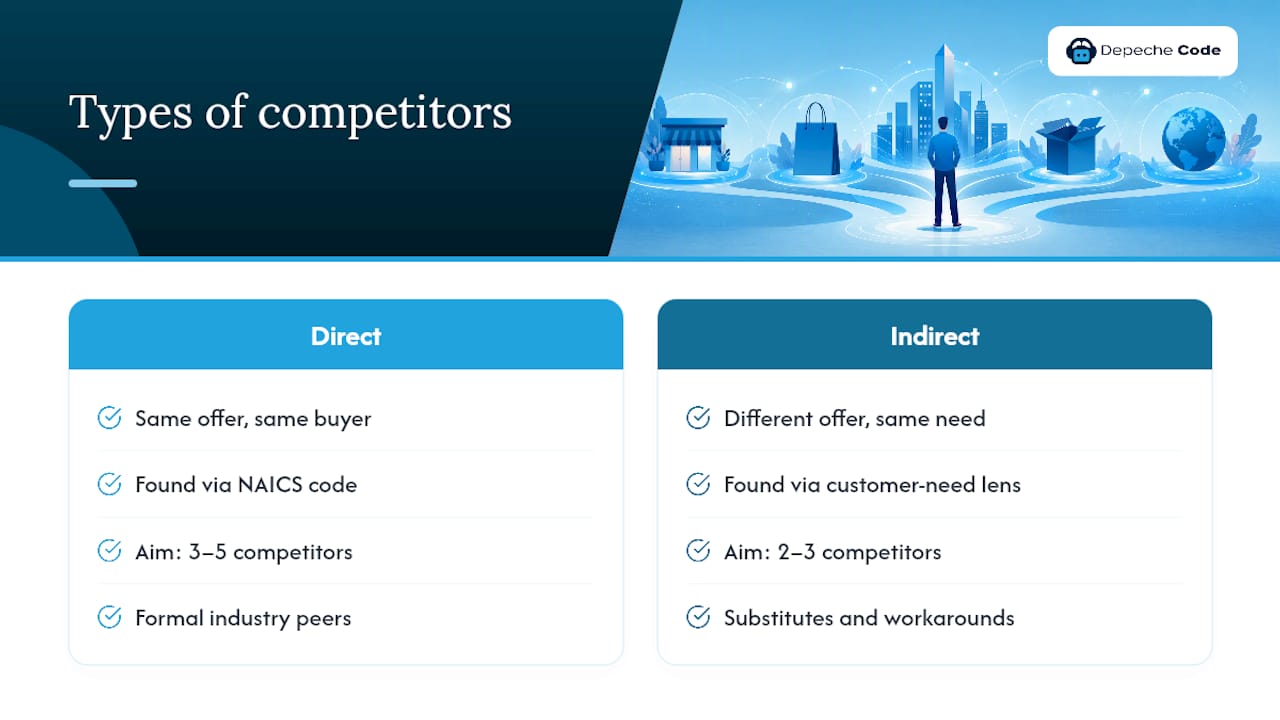
Scope matters here too. Direct competitors sell the same core offer to the same buyer. Indirect competitors solve the same underlying problem a different way; a scheduling app and a paper day planner compete for the same job even though they look nothing alike.
Competitive analysis is key to defining a competitive edge that creates sustainable revenue, according to SBA guidance, which also recommends assessing market share, strengths, barriers to entry, and indirect competitors as part of the process.
When Should You Run a Competitor Analysis?
Certain moments make competitor analysis urgent rather than optional. Watch for these triggers:
- Before launching a new product or service
- Before setting or revising your pricing
- Ahead of a major marketing push or rebrand
- Right after a competitor changes their product, pricing, or messaging
A first pass makes sense as a one-time deep dive before launch. After that, treat it as a recurring habit. Coursera’s guidance recommends repeating the process regularly since competitor moves and market conditions shift and the value of your findings decays over time.
Set a SMART goal for each round: “Identify two pricing gaps and one messaging gap within two weeks, and test one change within 30 days” beats a vague goal like “understand the competition.”
Pro Tip: Separate quick wins from strategic research up front. A pricing gap you can act on this week deserves priority over a positioning study that takes a month to validate.
How Do You Conduct a Competitor Analysis Step by Step?
This is the process you can start today with a spreadsheet, a few browser tabs, and an afternoon of focused time. Nothing here requires expensive software or a research team.
Step 1: Identify your competitors
Start by separating direct competitors (same offer, same buyer) from indirect competitors (different offer, same underlying need). Two lenses make this easier than relying on instinct alone, especially when leveraging professional marketing expertise from Marketing Support to identify and evaluate competitors effectively.
The first is your NAICS code. The U.S. Census Bureau’s NAICS system classifies businesses by industry, which helps you find the formal category your business sits in and who else is officially counted in it. It is a useful sanity check even though it will not catch every scrappy indirect competitor.
The second lens is customer need. According to the Wiley International Encyclopedia of Marketing, competitor identification should weigh market-structure factors like similarity of served needs, substitutability, switching costs, and how customers perceive each option relative to the others. In plain terms: ask what job the customer is hiring your product to do, then list every business, product, or workaround competing for that same job.
Aim for three to five direct competitors and two or three indirect ones. More than that and the research becomes unmanageable for a solo owner or small team.
Step 2: Gather reliable data
Once you have your list, collect data across these categories for each competitor:
- Offer details. What exactly do they sell, and how is it packaged?
- Pricing. Public pricing pages, quoted ranges from reviews, or third-party price comparison sites.
- Positioning language. How do they describe themselves on their homepage, in ads, and in their bios?
- Marketing channels. Where are they visible: search, social platforms, local directories, email?
- Customer reviews. Google Business Profile, Yelp, industry-specific review sites, and app store reviews if relevant.
- Traffic and visibility signals. Rough estimates of search visibility or social following size.
- Staffing and operational clues. Job postings, LinkedIn team pages, and press mentions often reveal where a competitor is investing.
Timestamp everything you collect. A screenshot of a pricing page dated today is worth far more six months from now than a note that just says “their prices seemed higher.”
Step 3: Build a competitor profile
A profile template keeps your research consistent across every competitor you study, which matters more than it sounds. Without a fixed template, you end up with three pages of notes on one competitor and two lines on another, and the comparison falls apart.
Here is a copyable structure:
| Field | What to capture |
|---|---|
| Company name and URL | Basic identification |
| Core offer | Product/service summary in one sentence |
| Price range | Low to high, with any tiers noted |
| Target customer | Who they appear to be marketing to |
| Positioning statement | Their own words, quoted directly |
| Top 3 strengths | From reviews, site copy, or observed traffic |
| Top 3 weaknesses | From reviews, complaints, or visible gaps |
| Primary marketing channel | Where they show up most |
| Date collected | Always timestamp |
Fill one row per competitor and you have a working reference document within an hour or two.
Step 4: Build a feature/price matrix and positioning map
A feature/price matrix lists every competitor down one side and every notable feature or offering across the top, with checkmarks or short notes filling the grid. This makes gaps visible instantly. If four competitors offer next-day delivery and you are the only one who does not, that row tells you exactly where you are losing ground before a customer ever compares prices.
A positioning map plots competitors on two axes you choose based on what matters most to your buyers. Price versus quality is the classic example, but price versus speed, or customization versus simplicity, often reveals more for service businesses. Plot each competitor by where their actual behavior and pricing place them, not where their marketing claims to place them. The empty quadrant on that map, the space nobody occupies, is often your clearest opening.
Step 5: Analyze what you found
A SWOT analysis adapted to competitor profiles works differently than the classic internal version. Instead of analyzing your own business, run it on each major competitor: their strengths, weaknesses, the opportunities their weaknesses create for you, and the threats their strengths pose to your plans.
For a sharper comparison, borrow the competitor array method described in academic teaching materials from the University of Minnesota. The approach: define your industry scope, list the factors customers care about most (price, quality, speed, support, and so on), assign a weight to each factor based on importance, then rate every competitor on each factor and multiply by the weight. Add up the weighted scores and you get a number that reflects overall competitive strength, not just a gut impression.
This matters because raw impressions mislead. A competitor with flashy marketing and mediocre reviews can look stronger than they are until you weight the actual factors your customers care about.
Step 6: Turn findings into decisions
Analysis without action is just an interesting document. Convert what you found into specific moves:
- Product changes. Close the feature gaps that showed up in your matrix, starting with the ones customers mention most in reviews.
- Messaging shifts. Rewrite your homepage or ads to claim the positioning space competitors left open.
- Pricing tests. If your pricing sits well outside the competitive range with no clear justification, test an adjustment on a small segment first.
- Channel shifts. Move budget toward channels where competitors are weak or absent.
Track these metrics after you act:
- Conversion rate on pages where you updated messaging
- Price-related objections in sales conversations, before and after a pricing test
- Review sentiment trends over the following quarter
- Share-of-voice signals in your primary marketing channel
Your one-afternoon action checklist
- List your top 3 direct and 2 indirect competitors.
- Fill out one profile per competitor using the template above.
- Build a simple feature/price matrix in a spreadsheet.
- Plot a two-axis positioning map by hand or in a slide tool.
- Run a weighted SWOT scoring pass on your top 3 direct competitors.
- Pick one product change, one messaging change, and one pricing test to act on this month.
Pro Tip: Archive every source you pull data from, links, screenshots, PDF exports, in a dated folder. Six months from now you will not remember whether that pricing screenshot came from March or June, and the analysis needs that timestamp to stay defensible.
Pro Tip: When two competitors seem equally strong on paper, check which one shows up in more recent customer reviews. Recency in reviews often signals which business is actively winning new customers right now versus coasting on older reputation.
Where Can You Find Reliable Competitor Data?
You do not need an expensive subscription to start. A layered approach, combining free, public, low-cost, and paid sources, gets a solo owner most of the way there.
Free tools cover the basics: Google Search for pricing pages and press mentions, Google Alerts to get notified when a competitor gets covered somewhere new, and Google Trends to compare relative search interest between your brand and theirs over time.

Public data sources add market context that individual competitor pages cannot. The Census Bureau’s NAICS system helps you size and categorize your industry segment correctly, while Data offers demographic and business data that can validate or challenge a competitor’s claims about market size. Bureau of Labor Statistics data on employment and price trends helps confirm whether a competitor’s hiring push or price increase reflects a broader industry pattern or something specific to them. If consumer spending context matters for your category, Federal Reserve consumer credit releases offer a useful macro backdrop.
Low-cost options include review aggregation sites you already have access to (Google Business Profile, Yelp, industry-specific directories) and free tiers of website traffic estimators that give rough visibility comparisons.
Paid tools make sense once you have outgrown manual tracking: dedicated traffic-analytics platforms, market-research subscriptions, and social listening tools that flag competitor mentions in real time. For most solo owners, these are worth adding only after the free and low-cost layer has proven the exercise is worth repeating.
A simple workflow: use Google Search and review sites to build your first competitor list, cross-check market size with NAICS and Census data, then layer in a paid traffic tool only once you need finer-grained visibility comparisons across five or more competitors.
What Mistakes Undermine a Competitor Analysis?
A handful of predictable errors quietly wreck otherwise solid research.
- Copying competitors outright. Matching every move a rival makes erases your differentiation instead of building it.
- Over-weighting anecdotal signals. One angry review does not represent a competitor’s overall customer sentiment; check volume and pattern, not a single data point.
- Ignoring indirect competitors. The business stealing your customers might not look anything like you.
- Using stale data. A profile built a year ago on pricing that has since changed will send you down the wrong path.
Three biases distort judgment even further. Confirmation bias pushes you to notice only the data that supports what you already believed about a competitor; counter it by having someone else review your findings cold. Recency bias overweights a competitor’s latest move while ignoring their longer track record; look at a full quarter of activity, not just last week. Survivorship bias makes you study only the competitors still standing while ignoring the ones that failed trying the same approach; ask why the failed ones actually failed before copying the survivors.
Red flags that should make you distrust an analysis: data pulled from a single source, assumptions nobody labeled as assumptions, and profiles with no collection date attached.
Pro Tip: Cross-verify any claim that surprises you against a second, independent source before you act on it. A surprising number is usually either a genuine insight or a data error, and the only way to tell the difference is to check.
How Do You Turn This Into an Ongoing Habit?
A one-time competitor analysis loses accuracy fast. Treat it as a recurring operational task the same way you treat monthly bookkeeping.
Three cadence options work depending on your bandwidth. A quarterly deep review rebuilds full profiles and reruns the weighted scoring matrix. A monthly quick scan just checks pricing pages, new reviews, and any announced changes. Event-driven checks run whenever a competitor launches something new or a customer mentions switching from a rival.
For a team of two or three, split the roles clearly: one person owns the cadence and calendar, one gathers raw data, and one turns the data into recommendations. In a solo operation, block dedicated calendar time instead. Treating this like an ad hoc task guarantees it gets skipped the first busy month.
Track a small dashboard over time rather than starting from scratch each round:
- Share-of-voice signals in your top marketing channel
- Price range changes across your top 3 direct competitors
- Feature additions or removals (product churn)
- Review sentiment trend over the past quarter
Benchmark your findings against authoritative sources rather than gut feel. Wikipedia’s overview of competitor analysis notes that the practice gives firms both offensive and defensive strategic context, letting them anticipate rival moves and respond faster. That speed advantage only holds if the underlying data stays current.
Why Consistent Competitor Analysis Actually Moves the Needle
Most businesses treat competitor research as a launch-day task, something you do once before opening your doors and then never touch again. That is backwards, and it is the single biggest reason competitor analysis gets a reputation for being a waste of time. A snapshot taken once tells you almost nothing about a market that keeps moving.
What I have come to believe, working through this material repeatedly, is that the format matters less than the habit. A messy spreadsheet updated every month beats a polished slide deck built once and never revisited. Small businesses do not need consultant-grade research; they need a repeatable ritual that surfaces one or two real decisions per quarter.
The businesses that skip this entirely are not lazy. They usually just never saw a version of the process short enough to actually finish. That is the gap the one-page checklist in this guide is meant to close: something you can run in an afternoon, not a week.
Try running the checklist once this month. You will likely find at least one gap worth acting on before you even finish the matrix.
Want an Agency to Run This For You?
If the six-step process above sounds worth doing but not worth your own afternoon, Depechecode runs full competitor analysis engagements as part of its business consulting work, and it costs less than the ongoing salary of hiring a dedicated market researcher.
A typical engagement covers the same ground this guide walks through, done for you instead of by you: competitor identification, data collection across pricing and positioning, a completed feature/price matrix, a positioning map, and a short list of prioritized recommendations tied to actual metrics. If your analysis points toward a customer service gap, Depechecode can also stand up a working solution directly, including AI chatbot plans built to close exactly that kind of gap. If the findings point toward a channel a competitor has neglected, social media management is available to build out that channel without adding headcount on your end.
The deliverable is a document you can act on immediately, not a stack of raw data you still have to interpret. Book a discovery call through Depechecode to scope what a competitor audit would look like for your specific market.
Sources
For readers who want to go deeper, these sources cover the practical and public-data sides of competitor analysis:
FAQ
What is meant by competitor analysis?
Competitor analysis means systematically identifying rival businesses and evaluating their offers, pricing, positioning, and marketing so you can find a defensible position in your market rather than guessing at one.
Is SWOT analysis the same as competitor analysis?
No. SWOT is one analytical technique you can apply within a competitor analysis, run separately for each rival, but competitor analysis also includes identifying competitors, gathering data, building matrices, and converting findings into action.
What are the 6 steps of competitive analysis?
A practical version covers: identifying competitors, gathering reliable data, building competitor profiles, creating a feature/price matrix and positioning map, applying analysis techniques like weighted SWOT scoring, and converting findings into decisions and tracked metrics.
Why is a competitor analysis important?
It reveals pricing gaps, unmet feature needs, and neglected marketing channels before you commit resources, and according to Wikipedia, it gives businesses both offensive and defensive strategic context that improves how fast they can respond to rivals.
How often should a small business repeat this process?
Repeat a full review quarterly, semiannually, or annually since Coursera’s guidance notes that competitor data loses accuracy over time, with lighter monthly scans in between major reviews.