

TL;DR:
- Cross-platform development enables writing a single codebase that deploys simultaneously on iOS, Android, web, and desktop platforms. Modern frameworks like React Native, Flutter, and Kotlin Multiplatform reduce costs and accelerate time-to-market, achieving near-native performance for most business applications. However, native expertise remains essential for integrating platform-specific features, ensuring reliable, high-quality apps that adapt to evolving OS updates and hardware requirements.
Cross-platform development is a software engineering method that allows developers to write a single codebase and deploy applications to iOS, Android, web, and desktop simultaneously. Frameworks like React Native, Flutter, and Kotlin Multiplatform have made this approach the default choice for most business and SaaS applications in 2026. Teams adopting this strategy reduce development costs by 30% to 50% compared to building separate native apps, while reaching every major platform from one shared code repository. If you are evaluating whether cross-platform app development fits your next project, this guide covers the architecture, tools, trade-offs, and practical decisions that matter most.
What is cross-platform development and how does it work?
Cross-platform development works by abstracting platform-specific code behind a shared layer that compiles or interprets into native instructions for each target operating system. The shared codebase is typically written in JavaScript, Dart, Kotlin, or C#, depending on the framework. That code then passes through a runtime layer or compiler that translates it into something each platform can execute.
The mechanism differs significantly across frameworks, and understanding those differences is critical before choosing one.
- React Native uses a JavaScript runtime and a bridge (now replaced by the JSI architecture) to communicate with native iOS and Android modules. Your UI components map to actual native widgets, so the app feels native rather than rendered in a web view.
- Flutter takes a different path entirely. It ships its own rendering engine (Skia, now Impeller) and draws every pixel itself, bypassing native UI components. This gives Flutter pixel-perfect consistency across platforms but means the app does not inherit system UI changes automatically.
- Kotlin Multiplatform shares only business logic and data layers across platforms, leaving the UI fully native on each target. This is the least opinionated approach and the easiest to adopt incrementally in an existing native app.
- Capacitor and Ionic wrap a web application inside a native shell using a WebView. This approach maximizes code reuse for teams already working in HTML, CSS, and TypeScript, but it trades some performance and native feel for that convenience.
- .NET MAUI (Microsoft’s successor to Xamarin) uses C# and XAML to target iOS, Android, macOS, and Windows from one project, making it a natural fit for teams already in the Microsoft ecosystem.
Pro Tip: Before picking a framework, map out every platform-specific feature your app needs, such as biometrics, background tasks, or Bluetooth. The framework’s native bridging capability for those features matters more than its general popularity.
The architecture choice determines how much native knowledge your team needs, how close to native performance you will get, and how easily you can access platform APIs that the framework does not expose out of the box.

Cross-platform vs native development: benefits and real trade-offs
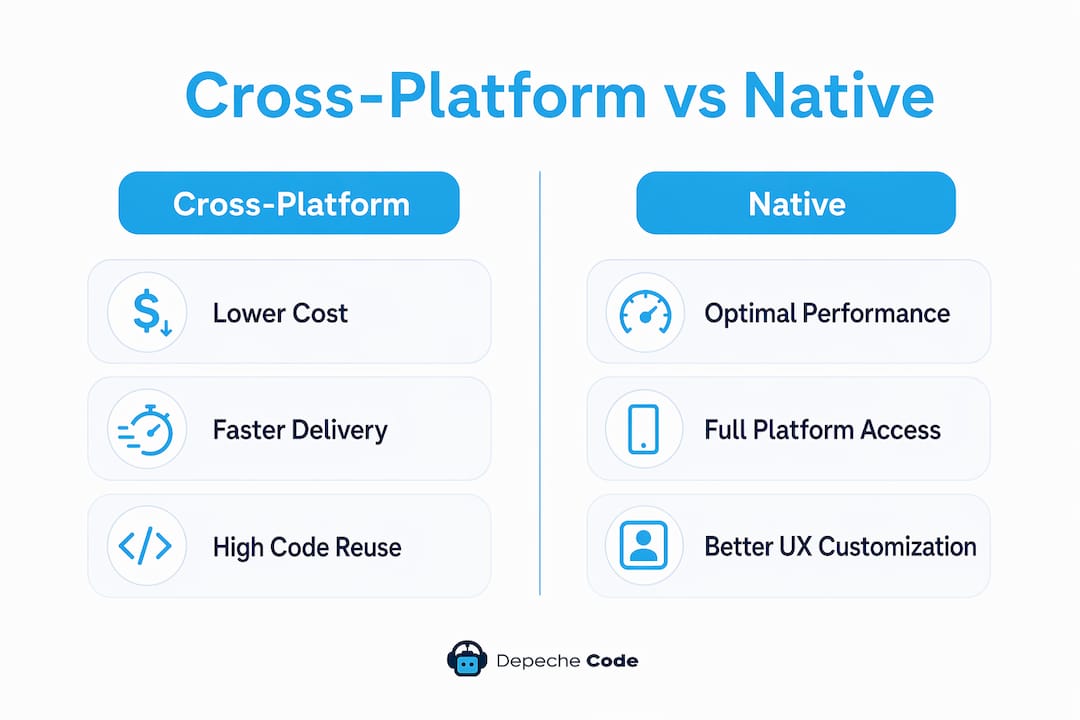
The native vs. cross-platform debate is now primarily a business decision rather than a pure performance question. That shift happened because modern frameworks have closed the performance gap to a point where most apps cannot justify the cost of separate native codebases.
Where cross-platform wins clearly
Teams using cross-platform frameworks ship first app versions 40% faster than native-only teams. That speed advantage is most valuable at the product validation stage, when getting to market quickly matters more than squeezing out every frame of rendering performance. Beyond launch, feature parity from a single codebase eliminates the release delays that plague teams maintaining separate iOS and Android repositories, where one platform always lags the other by a sprint or two.
Code reusability between 70% and 95% is the engine behind those savings. When your authentication logic, API layer, state management, and business rules live in one place, fixing a bug or adding a feature propagates everywhere at once. This also improves brand consistency because both platforms ship the same behavior on the same day.
Where native still wins
Modern cross-platform frameworks achieve 95% to 99% of native performance for business and SaaS applications. That remaining 1% to 5% gap becomes significant only in specific categories: high-performance 3D gaming, augmented reality experiences, and apps requiring deep hardware integration like camera pipelines or real-time sensor processing. If your app lives in one of those categories, native development is the correct choice. For everything else, the performance argument against cross-platform is largely obsolete.
| Factor | Cross-platform | Native |
|---|---|---|
| Initial development cost | 30%–50% lower | Higher per platform |
| Time to first release | ~40% faster | Slower, parallel teams needed |
| Long-term feature updates | ~12% faster | Platform-specific pace |
| Performance ceiling | 95%–99% of native | 100% |
| Best for | Business apps, SaaS, e-commerce | Gaming, AR, deep hardware |
| Code maintenance | Single codebase | Separate codebases per platform |
Pro Tip: Do not overestimate the “write once, run everywhere” promise. Complex apps always require platform-specific shims for OS features. Budget 15% to 25% of development time for those adjustments from the start.
The long-term maintenance picture is also more nuanced than the headline numbers suggest. Initial gains reach up to 40% faster shipping, but ongoing feature updates see roughly a 12% improvement. As an app matures and accumulates platform-specific edge cases, the maintenance savings shrink. Plan for that reality rather than projecting launch-phase savings indefinitely.
Top cross-platform development tools and frameworks in 2026
Choosing among cross-platform development tools comes down to your team’s existing skills, your UI requirements, and how much native platform access your app demands. Here is how the leading frameworks compare.
| Framework | Language | UI approach | Best use case |
|---|---|---|---|
| React Native | JavaScript / TypeScript | Native components via bridge | Consumer apps, large JS teams |
| Flutter | Dart | Custom rendering engine | High-fidelity UI, design-heavy apps |
| Kotlin Multiplatform | Kotlin | Native UI per platform | Incremental adoption, shared logic |
| .NET MAUI | C# / XAML | Native controls mapping | Enterprise, Microsoft ecosystem |
| Capacitor / Ionic | HTML, CSS, TypeScript | WebView wrapper | Web-first teams, PWA-adjacent apps |
- React Native powers apps like Meta’s own products and Shopify’s mobile storefront. Its massive JavaScript ecosystem and Meta’s continued investment make it a safe long-term bet for teams already writing TypeScript.
- Flutter is Google’s answer to pixel-perfect cross-platform UI. Apps like Google Pay and BMW’s in-car interface use Flutter. Its Impeller rendering engine, which replaced Skia in recent versions, delivers smoother animations on both iOS and Android.
- Kotlin Multiplatform is the choice when you want to share business logic without rewriting your existing native UI. JetBrains and Google both back it, and its adoption in enterprise Android shops has accelerated significantly through 2025 and 2026.
- .NET MAUI suits teams building internal enterprise tools where the Microsoft stack is already in place. It targets iOS, Android, macOS, and Windows from a single C# project.
- Capacitor, developed by the Ionic team, is the modern replacement for Cordova. It wraps web apps in a native shell and provides clean JavaScript APIs for native device features, making it the fastest path for web developers entering mobile.
The ability to interface with native code is more impactful for long-term project success than framework popularity alone. A framework with a smaller community but excellent native bridging will serve you better than a popular one that blocks access to critical platform APIs.
Common pitfalls and best practices for cross-platform projects
Most cross-platform projects that struggle do so for predictable reasons. Avoiding these mistakes is straightforward once you know where they appear.
-
Treat native knowledge as non-negotiable. Effective cross-platform teams maintain strong native expertise alongside their shared codebase. When a platform-specific bug surfaces or a new OS API needs integration, someone on the team must understand the underlying platform. Hiring only JavaScript or Dart developers and ignoring Swift and Kotlin creates a ceiling on what your app can do.
-
Plan for platform-specific shims before you need them. Cross-platform development requires writing platform-specific shims for OS features like biometrics, background tasks, and push notification handling. These are not edge cases. They are standard requirements in most production apps. Designing your architecture to accommodate native modules from day one prevents painful refactors later.
-
Test on real devices across every target platform. Simulators and emulators miss real-world performance issues, rendering differences, and hardware-specific behaviors. A Flutter app that looks perfect on an iOS simulator may have font rendering issues on a mid-range Android device. Allocate budget for a physical device testing matrix early in the project.
-
Choose frameworks based on bridge integration, not trends. Lack of native API access can block advanced features entirely. Evaluate your framework’s bridging story for the specific APIs your app needs before committing. Check the framework’s issue tracker for unresolved native integration bugs in your target feature areas.
-
Balance code reuse with intentional native module development. Chasing 95% code reuse as a metric leads to awkward abstractions. Some features are better written natively and exposed to the shared layer through a clean interface. The goal is a maintainable product, not a high reuse percentage on a dashboard.
Pro Tip: Set up your CI/CD pipeline to build and test on both iOS and Android from the first sprint. Discovering platform divergence late in a project is far more expensive than catching it continuously.
Future trends shaping cross-platform development in 2026 and beyond
The trajectory of cross-platform development points toward wider adoption and tighter integration with AI-assisted tooling.
- AI-assisted coding compresses timelines further. Cross-platform solutions leverage AI tooling trends to reduce development time and improve code reusability. Tools like GitHub Copilot and Cursor generate framework-specific boilerplate, write platform shims, and suggest native module integrations, cutting the setup overhead that previously made cross-platform projects slower to start.
- Cross-platform is becoming the default, not the exception. For most business applications, the question is no longer whether to go cross-platform but which framework to use. The reduction in vendor lock-in risks and the flexibility to target new platforms without rewriting core logic make this approach strategically sound for any product with multi-platform ambitions.
- OS update cycles demand framework agility. Apple and Google release major OS updates annually, and frameworks must track those changes. Flutter’s Impeller engine and React Native’s new architecture (Fabric and TurboModules) are direct responses to OS-level rendering and performance changes. Choosing a framework with active maintenance and a clear roadmap protects your investment.
- Unified codebases accelerate brand consistency at scale. When a product team ships the same feature to iOS, Android, and web on the same day, marketing campaigns, support documentation, and user onboarding all align. That operational benefit compounds over time and is one of the strongest arguments for cross-platform in a business context. You can read more about the strategic business benefits of this approach in the context of broader mobile strategy.
Key takeaways
Cross-platform development delivers the strongest return when teams combine a shared codebase with deliberate native integration planning from the start.
| Point | Details |
|---|---|
| Cost and speed advantage | Cross-platform cuts development costs 30%–50% and ships first versions 40% faster than native. |
| Performance is no longer the barrier | Modern frameworks hit 95%–99% of native performance for most business apps. |
| Framework choice is a long-term decision | Native bridging capability matters more than community size when selecting a framework. |
| Native expertise remains required | Teams must maintain Swift and Kotlin knowledge even when using shared codebases. |
| AI tooling accelerates adoption | AI-assisted coding reduces setup overhead and compresses cross-platform timelines further in 2026. |
Why I think most developers underestimate the native knowledge requirement
After working across React Native, Flutter, and Kotlin Multiplatform projects, the pattern I see most often is teams treating cross-platform as a way to avoid learning native development. That assumption creates the most expensive problems I encounter.
The framework handles 80% of your app beautifully. Then you hit a requirement for background location tracking, a custom camera pipeline, or a Bluetooth peripheral integration, and suddenly you are reading Apple developer documentation and Android NDK guides anyway. The teams that handle this gracefully are the ones who kept at least one developer current on Swift and Kotlin throughout the project, not just at the start.
My honest recommendation: start cross-platform by default for any app that does not have explicit high-performance or deep hardware requirements. React Native and Flutter are both mature enough in 2026 that the risk of choosing them is low. But invest in native platform knowledge as a team capability, not as a fallback. The developers who understand both the shared layer and the native layer beneath it are the ones who ship reliable, high-quality apps consistently.
The long-term maintenance picture also rewards teams that build this way. Apps that age well are the ones where the native integration points were designed cleanly, not bolted on under deadline pressure.
— Donovan
Build your cross-platform app with Depeche Code

Depeche Code is a top-rated digital agency based in Orlando that builds cross-platform mobile apps and websites for businesses of every size. Whether you need a React Native app, a Flutter product, or a full web and mobile solution from a single development engagement, the team at Depeche Code delivers on time and within budget. Their mobile app development services cover architecture, build, testing, and ongoing maintenance so your product stays current as frameworks and operating systems evolve. If you are ready to reduce your development costs and ship faster across every platform, explore Depeche Code’s web and app development solutions and get a custom quote for your project.
FAQ
What is cross-platform development in simple terms?
Cross-platform development means writing one codebase that runs on multiple operating systems like iOS, Android, and web. Frameworks like React Native and Flutter handle the translation to each platform automatically.
How does cross-platform development differ from native development?
Native development means writing separate codebases in Swift for iOS and Kotlin for Android, while cross-platform uses a single shared codebase. Cross-platform reduces costs by 30%–50% but may require native code for advanced hardware features.
What are the most popular cross-platform development tools?
React Native, Flutter, Kotlin Multiplatform, .NET MAUI, and Capacitor are the leading frameworks in 2026. Each uses a different language and rendering approach, so the right choice depends on your team’s skills and app requirements.
Is cross-platform development good for performance?
Modern cross-platform frameworks achieve 95%–99% of native performance for most business and SaaS applications. Native development is only preferable for high-performance gaming, AR, or deep hardware integration scenarios.
How much code can you actually share in a cross-platform project?
Teams typically share 70%–95% of their code across platforms using frameworks like Flutter or React Native. The remaining code handles platform-specific features like biometrics, notifications, and background tasks.