

TL;DR:
- Value-based web design focuses on aligning website development with measurable business outcomes. It emphasizes proactive goal setting, data-driven decisions, and interactive tools to drive conversions. Implementing this approach leads to better results, shorter project cycles, and competitive advantages.
Value-based web design is the practice of building websites that prioritize measurable economic and strategic outcomes over visual style or technical complexity alone. The industry term most closely aligned with this approach is “value-driven design,” a framework that design strategist Nick Disabato has championed as the missing link between creative work and business results. Where traditional web design asks “Does it look good?”, value-driven design asks “Does it grow the business?” For business owners and developers, that shift in question changes everything from how projects start to how success gets measured.
Most websites are built around aesthetics and content. Value-based web design is built around outcomes. Design tied to business objectives focuses on economic and strategic goals rather than creative preferences, which produces measurably better results. That distinction matters because it determines whether your website is a cost center or a revenue driver.
What is value-based web design and its core principles?
Value-based web design rests on five principles that separate it from conventional approaches.
- Proactive goal alignment. Values must be defined at the start of a project and govern every stage from ideation through deployment. Retrofitting business goals onto a finished design is expensive and rarely effective.
- Measurement and experimentation. Design tied to business outcomes requires adding measurement and experimentation alongside standard research. Without data, you cannot know whether a design decision helped or hurt.
- Procedural over declarative content. Static pages tell users what you do. Interactive tools, calculators, and decision trees help users do something. Procedural design increases conversion by helping users take initial actions before they feel stuck or disengaged.
- Economic focus. Every design decision connects to a business metric: conversion rate, average order value, customer retention, or cost per acquisition. Decoration without a metric is waste.
- Long-term value over minimum spend. Spending more on features like accessibility or ethical storytelling can build trust and deliver economic value that exceeds the initial investment. Value-based design is not about cutting costs.
One point that confuses many business owners: value-based design is not value engineering. Value engineering optimizes function and lifecycle cost without compromising quality, but its goal is efficiency. Value-based design can justify higher spending when that spending produces greater long-term returns. The two approaches share a vocabulary but serve different purposes.
Pro Tip: Before your next web project kicks off, write down three business metrics the site must move. Share them with your designer on day one. That single act puts the project on a value-based track from the start.

How does value-based web design benefit businesses and developers?
The benefits of value-based design show up in four concrete areas.
- Shorter, cheaper decision cycles. Early alignment reduces project risk and rework by surfacing conflicts between business goals and design alternatives before development begins. Fixing a structural problem in a wireframe costs a fraction of fixing it in a live site.
- Higher conversion rates. Design experiences that minimize user effort drive engagement and loyalty more effectively than static information pages. A mortgage calculator on a lender’s homepage outperforms a page of bullet points about loan types every time.
- Budget predictability. Target value design reduces cost overruns by integrating cost and schedule constraints early in the design process. That same logic applies directly to web projects: when financial constraints are part of the design brief, surprises shrink.
- Competitive differentiation. Business goals embedded as central to design give companies a measurable edge over competitors whose sites are built on aesthetic preference alone. A site that converts better wins, regardless of which one looks more polished.
For developers, the shift to value-based thinking also changes pricing conversations. Many designers struggle to price based on value rather than hourly rates because they cannot tie their work directly to business outcomes. When you can show that a redesigned checkout flow lifted revenue by a specific amount, the conversation moves from “how many hours did this take?” to “what is this result worth?” That is a far stronger position for both parties.
The importance of web design value becomes clearest when a project goes wrong. Sites built without defined business metrics get redesigned every two or three years because no one can prove they are working. Sites built on measurable outcomes get iterated and improved because the data shows exactly what to fix.
What are common challenges and misconceptions about value-based design?
The biggest misconception is that value-based design means spending less. It does not. The word “value” gets conflated with “cheap” because of its use in retail pricing. In design, value means the ratio of benefit to cost, and sometimes the right answer is to spend more.
- Mindset shift from time to results. Hourly billing is the default for most agencies and freelancers. Shifting to results-based pricing requires the ability to measure outcomes, which many teams have not built yet.
- Retrofitting values late. Core values must govern ideation through deployment, not get added at the end. A site built without accessibility in mind cannot become accessible with a quick patch. The cost of retrofitting is always higher than the cost of building correctly from the start.
- Measurement gaps. Many businesses track traffic but not conversions, or conversions but not revenue per visitor. Without a full measurement stack, connecting design decisions to business outcomes is guesswork.
- Organizational resistance. Stakeholders accustomed to approving designs based on personal preference resist the shift to data-driven decisions. Getting buy-in requires showing early wins, not just explaining the theory.
Pro Tip: Set up Google Analytics 4 conversion events before your redesign launches, not after. You need a baseline to prove that the new design moved the needle.
The procedural design shift also creates technical barriers. Building a quality web design that includes interactive calculators, personalized decision trees, or dynamic content requires more development time upfront. Teams that have only built static sites need new skills or new partners to execute it well.
How to implement value-based web design effectively
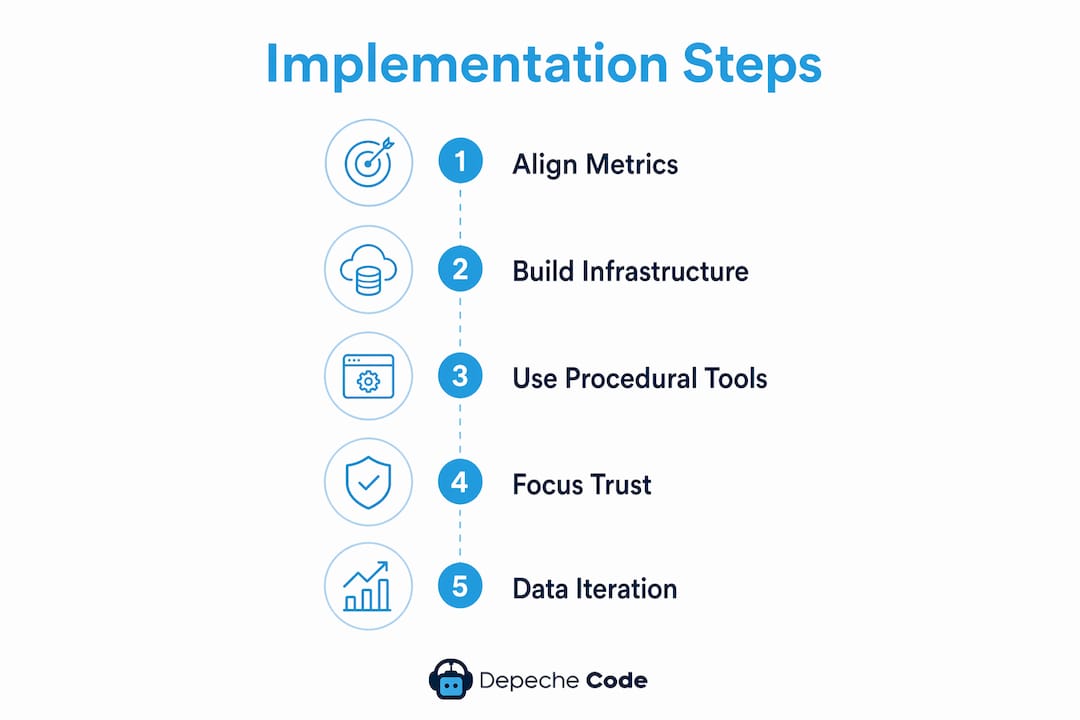
Implementation follows a clear sequence. Skipping steps is where projects fail.
Step 1: Align stakeholders on value metrics first
Before any wireframe gets drawn, every stakeholder must agree on what success looks like in numbers. Pick two or three metrics: conversion rate, revenue per session, or time to first purchase. Write them into the project brief. This single step prevents the most common cause of redesign failure, which is disagreement about goals that surfaces only after launch.
Step 2: Build measurement infrastructure early
Iterative business and solution design improves decision-making in evolving contexts. The same principle applies to web projects: set up analytics, heatmaps, and A/B testing frameworks before the site goes live. Measurement is not a post-launch task. It is a design input.
Step 3: Shift from static pages to procedural tools
Replace “About Us” walls of text with interactive content that helps users accomplish something. A service business can replace a generic services page with a pricing estimator. An e-commerce site can replace a category page with a product finder quiz. Procedural tools drive user action in ways that declarative content simply cannot match.
Step 4: Invest where trust and conversion intersect
| Design Feature | Declarative Approach | Procedural/Value-Based Approach |
|---|---|---|
| Pricing page | List of prices | Interactive calculator with instant estimates |
| Services page | Bullet list of offerings | Decision tree guiding users to the right service |
| Contact form | Generic form | Intake form that qualifies leads and sets expectations |
| Accessibility | Afterthought | Built in from the start, expanding audience reach |
| Trust signals | Static testimonials | Dynamic reviews tied to specific products or outcomes |
Step 5: Iterate based on data, not opinion
Launch, measure, and improve in short cycles. Exploring design alternatives concurrently maintains adaptability as business contexts change. A value-based site is never finished. It is always being tested against the metrics defined in step one.
For business owners who want to understand how this connects to responsive web design, the answer is direct: a site that does not work on mobile cannot deliver value to the majority of users who browse on phones. Responsiveness is a prerequisite for value-based design, not a separate concern.
Key Takeaways
Value-based web design produces better business outcomes because it ties every design decision to a measurable metric from the very start of a project.
| Point | Details |
|---|---|
| Define metrics before design | Agree on conversion, revenue, or retention goals before any wireframe is created. |
| Proactive alignment cuts costs | Early stakeholder alignment reduces rework and budget overruns throughout development. |
| Procedural tools outperform static content | Interactive calculators and decision trees drive more user action than informational pages. |
| Value-based is not cost-cutting | Spending more on accessibility or trust features often delivers greater long-term returns. |
| Measurement must be built in | Analytics and A/B testing infrastructure must be set up before launch, not after. |
Why value-driven design is the only approach worth taking
I have watched hundreds of web projects launch with beautiful designs that moved no business metrics at all. The pattern is always the same: the brief focused on aesthetics, the stakeholders approved based on personal taste, and nobody agreed on what success looked like before the first pixel was placed.
The shift to value-driven design is not a trend. It is a correction. Websites have always been business tools. The industry just spent two decades pretending they were art projects. When I see a team spend three months debating button colors without once looking at their checkout abandonment rate, I know the project is already in trouble.
What actually works is starting with the number you need to move and working backward to the design that moves it. That sounds obvious. It is almost never done. The teams that do it consistently build sites that get better over time instead of getting replaced every few years.
The procedural design shift is where I see the biggest untapped opportunity right now. Most business websites are still built around static information. The companies that replace that static content with tools that help users make decisions are seeing real conversion lifts. That is not a coincidence. It is what happens when design serves the user’s goal instead of the company’s ego.
— Donovan
Depechecode builds websites designed around your business goals
Depechecode is a full-service digital agency based in Orlando that builds websites around measurable outcomes, not just visual style. Every project starts with a clear understanding of the business metrics that matter most to you.
Whether you need a new site built from scratch or a redesign that finally moves the needle, Depechecode’s team aligns design decisions with your conversion and revenue goals from day one. Their custom website design and development services cover everything from interactive tools and accessibility to technical SEO and ongoing performance tracking. If you want a website that works as hard as your business does, Depechecode is the partner to call.
FAQ
What is value-based web design in simple terms?
Value-based web design is the practice of building websites where every design decision connects to a measurable business outcome, such as conversion rate or revenue per visitor, rather than visual preference alone.
How does value-based design differ from traditional web design?
Traditional web design focuses on aesthetics and content presentation. Value-based design starts with business metrics and works backward to the design choices that move those numbers.
What is user-centered design and how does it relate?
User-centered design focuses on the needs and behaviors of the end user. Value-based design incorporates user-centered thinking but adds a layer of business metric alignment, so the user experience also drives economic results.
Why do value-based design projects cost more upfront?
Procedural tools like calculators and decision trees require more development time than static pages. Spending more initially on these features builds user trust and delivers conversion gains that exceed the extra cost over time.
How do I start implementing value-based design principles?
Start by writing down two or three business metrics your site must improve, share them with your design team before any work begins, and set up analytics to measure those metrics before the site launches.