

TL;DR:
- Cheap websites often lead to higher costs over time due to emergency repairs, poor SEO, and early rebuilds. High-quality sites improve lead generation, search rankings, and scalability, providing better long-term value. Investing in a professional website with ongoing support reduces total ownership costs and enhances business growth.
Cheap websites are defined by low upfront prices, templated builds, and minimal custom development. That low price is the trap. Business owners who choose the cheapest option often discover why cheap websites cost more the hard way: through emergency fixes, lost leads, and full rebuilds that arrive faster than expected. Budget sites can cost 2–3x more over three years compared to a professionally built site. The initial savings evaporate quickly once technical debt, poor performance, and scaling limits start compounding.
What hidden costs arise after launching a cheap website?
The real cost of a cheap website shows up after launch, not before. Most business owners budget for the build and forget everything else. That oversight is expensive.
Emergency fixes are the most immediate surprise. Cheap websites often rely on bloated templates and outdated plugins. Every browser or security update can break an unstable foundation, triggering pay-per-fix repair bills that add up fast. One plugin conflict or failed update can take a site offline for days.
Lost revenue from poor SEO and slow performance is a cost that never shows up on an invoice. A site that loads slowly or ranks on page three of Google is not generating leads. That lost traffic is real money left on the table every single month.
Rebuild costs arrive sooner than expected. Cheap websites frequently require full rebuilds within two years because the original platform or template cannot support business growth. The rebuild costs more than the original site, and the downtime during the transition costs even more in lost leads.
Maintenance fees are another overlooked category. Maintenance over five years often exceeds the original build cost, especially for business and ecommerce sites. Hosting, security updates, and backups alone account for the majority of ongoing spend.
Here is where the costs pile up on a budget site:
- Emergency bug fixes after plugin or browser updates
- Security breach recovery, which can cost $5,000–$50,000 according to industry estimates
- Hosting fees that grow as traffic increases but the platform cannot handle it
- SEO remediation when a cheap template ships with poor site structure
- Redesign or rebuild costs when the site fails to convert or scale
Pro Tip: Before signing any web development contract, ask for a full breakdown of post-launch costs including hosting, maintenance, and update fees. If the vendor cannot provide one, that is a red flag.
How does website quality affect business growth and lead generation?
A website that cannot convert visitors or rank on search engines actively costs the business money. Every visitor lost to poor performance is a real missed opportunity. This is the part of the cost equation that most business owners underestimate.
Professional website quality affects growth in five measurable ways:
-
Conversion rate. Poor UX design, slow load times, and confusing navigation reduce the percentage of visitors who take action. A professionally structured site guides visitors toward a call, a form, or a purchase. A cheap template does not.
-
Search engine rankings. Cheap templates lack SEO and UX optimizations that search engines reward. Google’s Core Web Vitals score penalizes slow, poorly coded sites. A site that ranks on page two gets a fraction of the traffic of a page-one result.
-
Lead capture. Effective lead generation requires clear calls to action, fast load speeds, and mobile-friendly design. Budget builds routinely skip these elements. The result is a site that attracts visitors but fails to turn them into customers.
-
Scalability. Low-quality code and entry-level platforms impose hard limits on what a site can do. Adding an ecommerce function, a booking system, or a customer portal to a cheap template often requires starting over from scratch.
-
Brand credibility. A site that looks outdated or breaks on mobile tells visitors the business is not serious. That perception is hard to reverse and directly affects whether a prospect picks up the phone.
The connection between high-quality website design and lead generation is not theoretical. Businesses that invest in professional UX and structured development consistently outperform those that do not, because their sites work as sales tools rather than digital brochures.
Cheap vs. professional websites: what does ownership really cost?
The upfront price difference between a cheap website and a professional build looks significant. The three-year total cost of ownership tells a different story.

| Cost Category | Cheap Website | Professional Website |
|---|---|---|
| Initial build cost | $500–$2,000 | $5,000–$15,000 |
| Annual maintenance | High and unpredictable | Planned and consistent |
| Emergency fixes | Frequent, per-incident billing | Rare, covered by maintenance plan |
| Rebuild timeline | 1–2 years | 4–6 years or longer |
| SEO performance | Poor without remediation | Built-in from day one |
| Total 3-year cost | Often 2–3x the initial price | Predictable and controlled |
Total costs for budget sites can reach 11 times the initial investment when you factor in 24 months of lost conversions and rebuild expenses. That number is not an outlier. It is the predictable result of technical debt compounding over time.
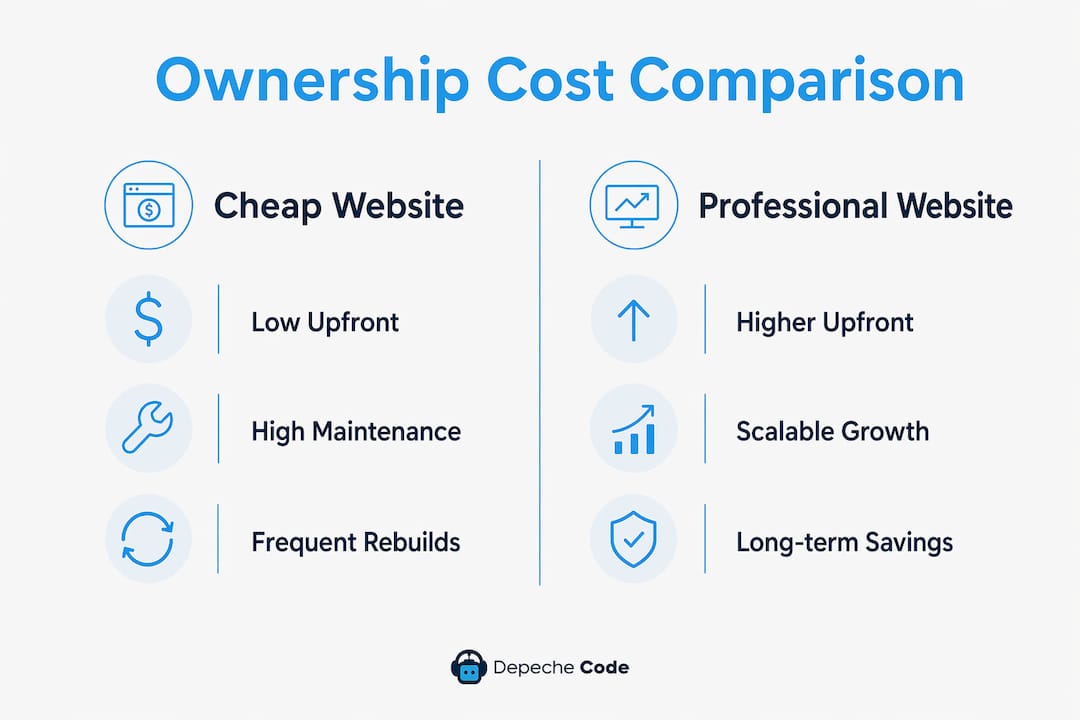
Technical debt from cheap builds works like a high-interest loan. Every software update or security patch adds risk to an unstable foundation. The longer you wait to address it, the more expensive the fix becomes.
There are also non-obvious costs that never appear in a line-item budget. Opportunity cost is the biggest one. A site that fails to rank or convert is not just breaking even. It is actively costing the business by failing to generate revenue it could have earned. Reputation damage from a site that looks unprofessional or goes offline is another cost that is real but hard to quantify.
Hosting alone is recommended at 3–5% of the build cost annually. For a $10,000 site, that is $300–$500 per year. For a cheap $500 site on shared hosting, the infrastructure is often inadequate from day one, which creates performance problems that compound every other issue.
Pro Tip: When comparing website quotes, ask each vendor for a five-year total cost of ownership estimate, not just the build price. Include hosting, maintenance, expected updates, and one potential rebuild. The numbers will change how you evaluate the options.
How can business owners avoid the pitfalls of cheap websites?
Avoiding the cheap website pitfalls starts before you talk to a single vendor. Business owners who define their goals first make better decisions.
- Align your website strategy with business goals. A site built to generate leads needs different architecture than one built to display a portfolio. Know what you need before you budget for it.
- Budget for the full lifecycle, not just the build. Include hosting, ongoing maintenance, security, and at least one round of updates in your initial budget. A site without a maintenance plan is a liability.
- Prioritize custom UX planning over template shortcuts. Templates are fast and cheap to launch. They are expensive to customize later and often impossible to scale without a rebuild.
- Watch for red flags in low-cost proposals. Vague scope, no mention of post-launch support, and promises of a full site in under a week are all warning signs. Low-budget websites have limited scope and revisions built into the contract, which means you pay extra for anything beyond the basics.
- Ask vendors the right questions. Before committing, ask: What platform will this be built on? Who owns the code? What happens if I need to add features in 18 months? What does ongoing support cost? How will this site perform on Google’s Core Web Vitals?
A well-built website development plan that accounts for scalability and maintenance from the start will always outperform a cheap build over a three-year horizon. The goal is not to spend more. The goal is to spend wisely and avoid the compounding costs that come from spending too little.
Key Takeaways
Cheap websites cost more over time because technical debt, poor performance, and forced rebuilds multiply the total investment far beyond the initial price.
| Point | Details |
|---|---|
| Hidden costs accumulate fast | Emergency fixes, security breaches, and maintenance fees often exceed the original build cost within two years. |
| Poor quality kills lead generation | Sites without SEO foundations and professional UX lose traffic and conversions every single month. |
| Rebuilds arrive sooner than expected | Budget sites frequently require full rebuilds within two years, adding cost and downtime. |
| Total cost of ownership matters most | A cheap site can cost 2–3x more over three years than a professionally built alternative. |
| Smart budgeting includes lifecycle costs | Hosting, maintenance, and scalability planning must be part of the initial budget, not afterthoughts. |
Why I stopped recommending cheap websites to any business that wants to grow
I have reviewed hundreds of websites built on tight budgets, and the pattern is consistent. The business owner saved money upfront, felt good about the decision for about six months, and then started noticing the problems. The site was slow. It was not ranking. A plugin broke something and the original developer was unreachable. By the time they came to us, they had already spent more on fixes than the original build cost.
The uncomfortable truth is that a cheap website is not a neutral choice. It is an active drag on the business. Every month a site fails to rank or convert is a month of lost revenue. That cost is invisible on a spreadsheet, but it is real.
What I tell business owners now is this: treat your website like a sales hire, not a one-time purchase. You would not hire the cheapest salesperson with no training and no support and expect results. The same logic applies to your site. A professionally built site with a maintenance plan and an SEO foundation is an asset. A cheap template with no support is a liability that gets more expensive over time.
The businesses I have seen grow fastest online share one trait. They invested in quality from the start, kept their site maintained, and treated web development as ongoing infrastructure rather than a box to check. That mindset is the difference between a site that generates leads and one that just exists.
— Donovan
How Depechecode helps you avoid costly website mistakes
Depechecode builds websites that work as business tools from day one, not templates that need constant repair.

Depechecode is a full-service digital agency based in Orlando with a track record of delivering custom-built sites for small and large businesses. Every project includes professional UX planning, scalable architecture, and ongoing maintenance support so you never face an unexpected rebuild bill. The agency’s website design and development services are built around long-term value, not the lowest possible upfront number. If you want a site that generates leads, ranks on Google, and grows with your business, Depechecode is the right partner. You can also explore the free website development option if upfront costs are a constraint.
FAQ
Why do cheap websites end up costing more?
Cheap websites generate hidden costs through emergency fixes, poor SEO performance, and forced rebuilds. Total costs can reach 11x the initial investment over time when lost conversions and rebuild expenses are included.
What is technical debt in web development?
Technical debt is the accumulated cost of shortcuts taken during development. Cheap builds using outdated plugins and bloated templates create technical debt that grows more expensive with every software or security update.
How often do cheap websites need to be rebuilt?
Budget sites frequently require full rebuilds within two years because they cannot scale to meet business needs. Each rebuild costs more than the original build and creates downtime that costs additional leads.
What should I budget for website maintenance?
Hosting, security, updates, and backups form the majority of ongoing website spend. Budgeting 3–5% of your build cost annually for hosting alone is a reasonable starting point, with additional funds for updates and support.
How does a cheap website hurt my SEO?
Cheap templates ship with poor site structure, slow load speeds, and no SEO foundation. Google’s ranking algorithm penalizes these factors directly, which means a budget site will consistently underperform a professionally built site in search results.