

TL;DR:
- Most users abandon websites after poor experiences.
- Website development involves multiple layers, including frontend, backend, and full-stack work.
- Modern best practices focus on mobile-first design, speed, accessibility, and continuous iteration.
Nearly 88% of users abandon a website after a poor experience. That single number should reshape how you think about your online presence. Most business owners assume website development is about picking colors, fonts, and a nice layout. It is so much more than that. It covers a structured process of planning, building, testing, and maintaining every layer of your site, from what users see to the server logic running behind the scenes. This article walks you through the full scope of website development, the methodologies teams use, the modern essentials you cannot ignore, and how a well-executed redesign can deliver returns you might not expect.
Table of Contents
- Defining website development: Beyond aesthetics
- Key methodologies: Waterfall, Agile, and hybrid approaches
- Modern development essentials: Mobile-first, speed, and accessibility
- Website redesign ROI and practical tips
- Why most business websites miss the mark (and how to fix it)
- Take your website from idea to impact with expert help
- Frequently asked questions
Key Takeaways
| Point | Details |
|---|---|
| Process covers everything | Website development goes far beyond design, including planning, building, and ongoing maintenance. |
| Methodology impacts results | Choosing the right project management style—Waterfall, Agile, or hybrid—can make or break timelines and ROI. |
| Modern must-haves | Mobile-first design, accessibility, and performance testing are essential to attract users and prevent abandonment. |
| Redesign for ROI | Refreshing your site every 2-3 years can deliver up to 400% ROI through improved user experience. |
| Expert help drives impact | Professional services help overcome pitfalls and maximize business value from your website investment. |
Defining website development: Beyond aesthetics
Website development is not a single task. It is a coordinated effort across multiple disciplines. According to the structured development definition, website development is the structured process encompassing frontend, backend, and full-stack work, each playing a distinct role in how your site performs and converts.
Here is what each layer actually does:
- Frontend development builds everything a visitor sees and interacts with: layouts, buttons, navigation, and visual feedback.
- Backend development handles the server, databases, and application logic that power your site invisibly.
- Full-stack development combines both, giving one developer or team end-to-end control over the product.
For business owners, understanding these distinctions matters because problems in any layer affect your bottom line. A beautiful frontend sitting on a slow, poorly structured backend will still frustrate users and cost you conversions.
The process itself typically follows these stages:
- Discovery and planning (goals, audience, content strategy)
- Design (wireframes, prototypes, visual direction)
- Development (coding frontend and backend components)
- Testing (functionality, performance, cross-device checks)
- Deployment (launch and server configuration)
- Maintenance (updates, security patches, performance monitoring)
Skipping any stage is where most budget-focused projects go wrong. Rushing from design to development without proper planning creates technical debt that costs more to fix later than it would have cost to do it right the first time.
“Your website is not a brochure. It is a living system that requires ongoing attention to stay competitive and secure.”
Pro Tip: Before starting any development project, document your business goals alongside your design preferences. Developers who understand your conversion targets will make smarter technical decisions throughout the build.
If you are new to the technical side, brushing up on responsive web design basics will help you ask better questions and make more informed choices with your development team.
Key methodologies: Waterfall, Agile, and hybrid approaches
Once you understand what website development covers, the next question is how to manage the project. The methodology you choose directly affects your timeline, budget, and ability to adapt when requirements change.

Waterfall, Agile/Scrum, and hybrid methods dominate web development today, each suited to different project types.
| Methodology | Best for | Key strength | Key risk |
|---|---|---|---|
| Waterfall | Fixed-scope corporate sites | Predictable timeline and cost | Rigid; costly to change mid-project |
| Agile/Scrum | Custom or evolving builds | Flexible, iterative delivery | Requires active client involvement |
| Hybrid (Water-Scrum-Fall) | Complex redesigns | Balances structure with flexibility | Needs experienced project management |
Here is a quick breakdown of when to use each:
- Waterfall works well when your requirements are locked in from day one, such as a corporate website refresh with a defined scope and hard deadline.
- Agile/Scrum suits projects where features evolve, like a custom e-commerce platform or a web app with user-tested iterations.
- Hybrid is increasingly popular for mid-size business redesigns where the overall structure is planned upfront but individual features are built in sprints.
AI-assisted development tools are also entering the picture in 2026. These tools can generate boilerplate code, suggest design patterns, and automate testing, which helps budget-conscious businesses move faster without sacrificing quality.
“Choosing the wrong methodology for your project type is one of the most expensive mistakes a business can make in web development.”
If you are planning a redesign, reviewing choosing redesign methodology options with a professional team can save you significant time and money. You can also explore service business methodologies to understand how agencies structure their engagements.
Modern development essentials: Mobile-first, speed, and accessibility
With methodology in place, the focus shifts to what your website actually needs to perform in 2026. User expectations have risen sharply, and the technical bar has moved with them.
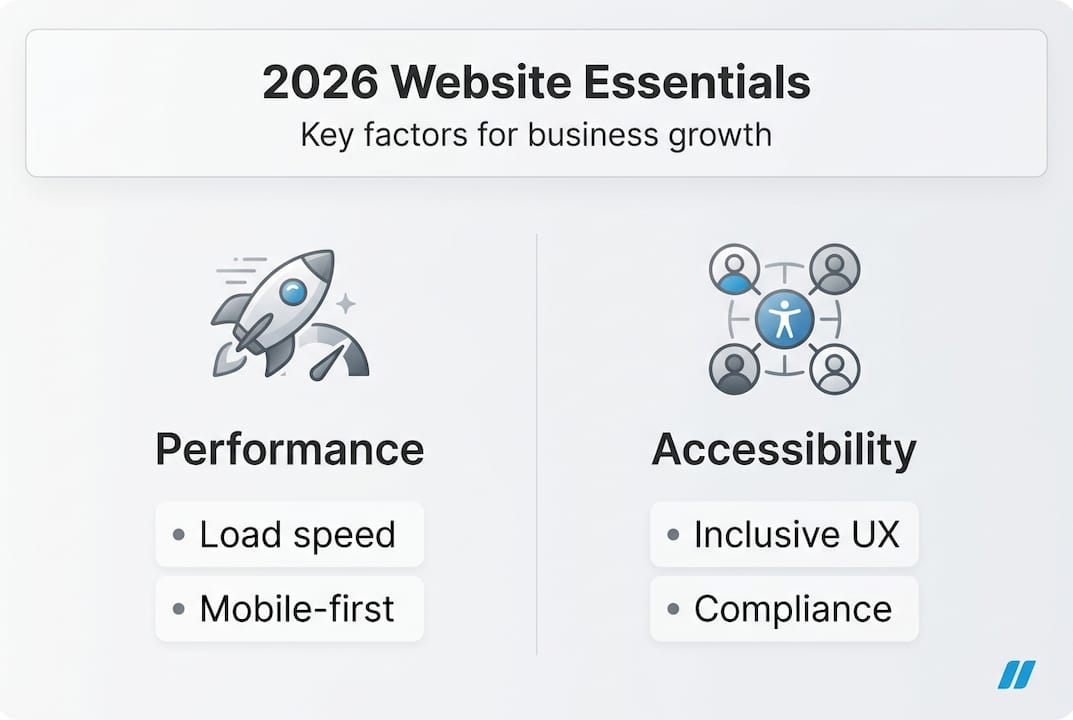
Mobile traffic now accounts for 58-74% of all web visits, which means designing for desktop first is a strategy that actively hurts your business. Mobile-first development means starting with the smallest screen and scaling up, not the reverse. It forces cleaner layouts, faster load times, and better touch interactions.
Here are the essentials every modern business website needs:
- Mobile-first design: Build for phones before desktops to capture the majority of your audience.
- API-driven development: Connecting your site to third-party services through APIs speeds up builds and supports integrations like payment systems, CRMs, and chatbots.
- Core Web Vitals (CWV): Google’s performance benchmarks measure loading speed, visual stability, and interactivity. Failing these metrics hurts both user experience and search rankings.
- INP (Interaction to Next Paint): Replaced FID in 2024 as the key responsiveness metric. A slow INP means users feel lag when they click or tap.
- Accessibility: WCAG compliance is not optional. It expands your audience and reduces legal risk.
| Metric | What it measures | Target value |
|---|---|---|
| LCP (Largest Contentful Paint) | Load speed of main content | Under 2.5 seconds |
| INP (Interaction to Next Paint) | Responsiveness to user input | Under 200ms |
| CLS (Cumulative Layout Shift) | Visual stability during load | Under 0.1 |
Pro Tip: Always test your site on real physical devices, not just browser simulations. Emulators miss real-world performance issues that only show up on actual hardware with varying network conditions.
For deeper guidance on building sites that work across every screen, explore mobile-first design approaches and responsive web design strategies. The progressive enhancement framework is also worth understanding as a foundational principle for accessible, resilient builds.
Website redesign ROI and practical tips
Knowing how to build a site well is one thing. Knowing when to rebuild it is another. Many businesses hold onto outdated websites far too long, quietly losing customers to competitors with faster, cleaner, more trustworthy online experiences.
Stat to know: Redesigning every 2-3 years yields a 200-400% UX ROI when done correctly, addressing edge cases and accessibility gaps early in the process.
Signs it is time to redesign:
- Your bounce rate has climbed steadily over the past 6-12 months.
- The site looks visually dated compared to competitors.
- Conversion rates have dropped without a clear marketing explanation.
- The site is not accessible on newer devices or browsers.
- Page load times exceed 3 seconds on mobile.
A redesign is not just cosmetic. When done strategically, it restructures your information architecture, improves technical performance, and aligns your messaging with what your current audience actually needs. That combination is what drives the ROI numbers.
Pro Tip: Before launching a redesign, run a full accessibility audit and test on at least five different real devices. Edge cases, like users on older Android phones or with screen readers, represent real customers you cannot afford to lose.
Actionable steps to maximize redesign ROI:
- Start with data. Analyze heatmaps, session recordings, and conversion funnels before writing a single design brief.
- Set measurable goals. Define what success looks like in terms of conversion rate, load time, and engagement metrics.
- Prioritize accessibility from day one, not as an afterthought.
- Build in a content strategy. A redesign without updated copy rarely moves the needle.
- Plan for post-launch testing. The first version is never the final version.
For more actionable guidance, check out these website redesign tips or connect with a team offering professional redesign services to structure your project correctly from the start.
Why most business websites miss the mark (and how to fix it)
Here is the uncomfortable truth we see repeatedly: most businesses invest in a website launch and then treat it as finished. They obsess over the visual design during the build, then ignore performance data entirely once the site goes live. That is backwards.
The businesses that get the best ROI from their websites are the ones treating them like products, not projects. Products get iterated. Products get tested against real user behavior. Projects get delivered and forgotten.
Another common mistake is skipping edge case testing entirely. Your developer might show you a perfect demo on a fast laptop with a strong Wi-Fi connection. But a significant portion of your customers are on mid-range phones with inconsistent mobile data. That gap between demo and reality is where conversions die.
We also see businesses focus heavily on aesthetics while ignoring accessibility. This is not just a legal risk. It is a missed revenue opportunity. Accessible sites consistently outperform inaccessible ones in both engagement and search visibility.
The fix is straightforward: invest upfront in structure, real device testing, and accessibility. Work with top design firms that measure outcomes, not just deliverables. Your website should be earning its keep every single month.
Take your website from idea to impact with expert help
Understanding the full scope of website development is the first step. Acting on it is where real business growth happens.
At Depeche Code, we work with small and large businesses to design, build, and optimize websites that perform. Whether you need a first-time build or a strategic website redesign that actually moves your conversion numbers, our team handles every layer. We also offer SEO services to make sure your site gets found, and mobile app development when your business is ready to extend beyond the browser. Let us help you turn your website into your best-performing sales asset.
Frequently asked questions
How long does website development typically take?
Most business websites require 4-12 weeks depending on complexity, team size, and the project management approach used. Agile projects with active client collaboration often move faster than fixed-scope waterfall builds.
What’s the difference between frontend and backend development?
Frontend handles everything the user sees and interacts with, while backend manages data processing, server logic, and integrations. Both layers are covered in the full development scope of any professional build.
How often should I redesign my business website?
Experts recommend a redesign every 2-3 years to maintain strong UX and conversion performance, or sooner if you notice declining engagement or major shifts in your audience’s device preferences.
What performance metrics matter most for websites in 2026?
Core Web Vitals, INP, mobile responsiveness, and accessibility compliance are the metrics that most directly impact engagement and conversion. INP and CWV benchmarks are now standard expectations, not optional improvements.
Is AI changing website development?
AI tools are accelerating builds and reducing costs, but they require careful integration and human oversight to match the conversion performance of thoughtfully designed manual builds.