

TL;DR:
- Nearly half of Google searches have local intent, making local SEO crucial for visibility.
- Optimizing Google Business Profile, reviews, citations, and website content improves local rankings and foot traffic.
- Ongoing efforts over several months yield significant increases in local visibility, calls, and in-person visits.
Nearly half of all Google searches carry local intent, yet countless businesses remain invisible to customers searching just blocks away. 46% of Google searches have local intent, meaning people are actively looking for products and services near them right now. If your business isn’t showing up in those moments, you’re handing customers directly to your competitors. This guide breaks down exactly what local SEO is, how Google decides which businesses to show, and the specific steps you can take to start winning more nearby customers, whether you run a single storefront or manage dozens of locations.
Table of Contents
- Defining local SEO
- How local SEO works: Key ranking factors
- Core elements of a successful local SEO strategy
- Real-world impact of local SEO: What results to expect
- Why most businesses get local SEO wrong (and how you can stand out)
- Take the first step to local SEO success
- Frequently asked questions
Key Takeaways
| Point | Details |
|---|---|
| Local intent is huge | Nearly half of all searches are local, so being found nearby is essential. |
| Three factors drive rankings | Relevance, distance, and prominence shape which businesses show in local search. |
| Strategy brings results | A complete plan including reviews, local content, and directories delivers more visits and sales. |
| Consistency is king | Up-to-date and consistent business information across platforms is critical for success. |
Defining local SEO
Local SEO is the process of optimizing a business’s online presence to attract more customers from location-based searches. Think of searches like “pizza near me,” “plumber in Orlando,” or “best hair salon downtown.” These are people with immediate needs, and local SEO is what puts your business in front of them at exactly the right moment.
The most visible outcome of local SEO is appearing in the local pack, which is the block of three business listings that appears at the top of Google’s search results, usually accompanied by a map. That prime real estate captures the majority of clicks for local queries, far outperforming standard organic results below it.
“The local pack captures the majority of clicks for local searches, making it the most valuable real estate in local search results.”
Local SEO matters for businesses of every size. A family-owned bakery needs it to beat the chain down the street. A regional law firm needs it to dominate searches across multiple cities. Even national brands with physical locations rely on local SEO to drive foot traffic and phone calls to individual stores.
Here’s a quick snapshot of why local search is so powerful:
| Metric | Data point |
|---|---|
| Share of Google searches with local intent | 46% |
| Nearby searchers who visit a business within 24 hours | 76% |
| Local searchers who make a purchase within 24 hours | 28% |
| Mobile searches that lead to a store visit | More than 50% |
Businesses that benefit most from local SEO include:
- Service providers (plumbers, electricians, HVAC technicians)
- Healthcare practices (dentists, chiropractors, urgent care clinics)
- Restaurants and cafes
- Retail stores and boutiques
- Legal and financial professionals
- Real estate agencies
- Auto repair and dealerships
If customers can physically visit you, call you, or hire you based on your location, local SEO is one of the highest-return investments you can make. Our Local SEO Growth and Local SEO Prime packages are built specifically around these needs.
How local SEO works: Key ranking factors
Once you understand who benefits from local SEO, it’s important to know how Google decides which results to show. Google’s local algorithm ranks businesses based on three core factors: Relevance, Distance, and Prominence. Understanding each one helps you know exactly where to focus your energy.
Relevance measures how well your business matches what someone searched for. If a person searches “emergency dentist Orlando” and your profile clearly describes emergency dental services in Orlando, you’re highly relevant. Vague or incomplete business descriptions hurt your relevance score.
Distance is straightforward: how close is your business to the person searching, or to the location they specified? You can’t move your building, but you can make sure Google knows your exact service area and location details.

Prominence reflects how well-known and trusted your business is online. This includes the quantity and quality of your reviews, how often your business is mentioned across the web, and your overall authority in your category.
Here’s how local ranking factors compare to general SEO priorities:
| Factor | Local SEO weight | General SEO weight |
|---|---|---|
| Google Business Profile (GBP) | Very high | Low |
| Reviews and ratings | High | Low |
| Local citations (NAP consistency) | High | Low |
| On-page content with location terms | High | High |
| Backlinks and domain authority | Moderate | Very high |
| Mobile friendliness | High | High |
Here’s how to improve each ranking factor:
- Verify your Google Business Profile and fill out every field completely, including categories, services, and business description.
- Add location keywords to your website’s page titles, headings, and meta descriptions.
- Collect reviews consistently by asking satisfied customers directly after a positive interaction.
- Build local citations by listing your business in directories like Yelp, Apple Maps, and industry-specific sites.
- Ensure your website loads fast and is fully functional on mobile devices.
Pro Tip: Consistent NAP (Name, Address, Phone) data boosts both Relevance and Prominence. Even a small variation, like “St.” vs. “Street,” can confuse search engines and hurt your rankings. Audit every online directory to make sure your information matches exactly. Pairing this with a solid SEO strategy for business ROI compounds your results over time.
Core elements of a successful local SEO strategy
It’s not just about understanding the ranking factors. You need specific tactics to start moving up local results. These are the foundational elements every business should have in place before worrying about advanced strategies.
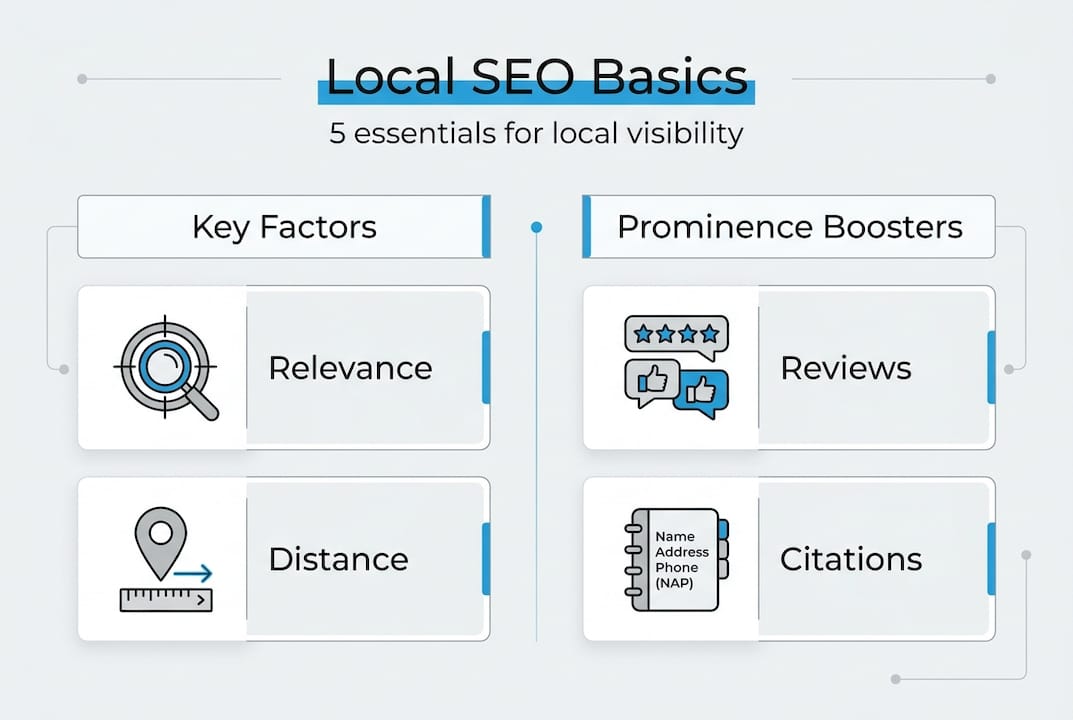
On-page signals influence both local pack and organic rankings, so your website and your Google Business Profile need to work together as a unified system.
Here are the minimum core elements of any effective local SEO strategy:
- Google Business Profile (GBP): Claim, verify, and fully optimize your listing. This is the single most important local SEO asset you have.
- On-page SEO with local terms: Include your city, neighborhood, and service area in page titles, headings, and body content. Create dedicated location pages if you serve multiple areas.
- Review management: Actively request reviews from happy customers and respond to every review, positive or negative. Silence signals indifference.
- Local citations and directories: Get listed in relevant directories with consistent NAP information. Think Google, Yelp, Bing Places, and niche industry directories.
- Mobile-friendly website: Most local searches happen on phones. A slow or broken mobile experience kills conversions before they start.
These five elements reinforce each other. A complete GBP drives more reviews. More reviews boost your Prominence score. Strong on-page content improves Relevance. Citations reinforce your location signals across the web.
Common pitfalls to avoid include inconsistent contact information across listings, ignoring or deleting negative reviews, and publishing thin local content that doesn’t actually help users. Each of these mistakes quietly drains your local rankings over time.
Pro Tip: Photos and up-to-date business hours on your GBP boost clicks and in-person visits significantly. Businesses with photos receive 42% more requests for directions and 35% more website clicks than those without images. Our Local SEO Starter package gets all of these fundamentals set up quickly and correctly.
Real-world impact of local SEO: What results to expect
Applying these tactics can translate into real business growth. Here’s what you can realistically expect from effective local SEO.
The numbers are striking. 76% of nearby mobile searches lead to a store visit within 24 hours, and 28% of those searches result in a purchase within the same day. That’s not website traffic sitting in a funnel. That’s foot traffic and phone calls converting almost immediately.
Here’s what consistent local SEO effort typically produces over time:
- More website visits from people in your service area who are ready to buy
- Higher map clicks as your GBP climbs in local pack rankings
- More inbound calls from customers who found you on Google Maps
- Increased in-person visits driven by “near me” and location-based searches
- A growing review profile that builds trust with future customers
- Better visibility for voice search queries like “find a plumber near me”
One thing to set realistic expectations about: local SEO is not a one-time fix. Results compound over time. In the first few weeks, you might see small improvements in impressions and profile views. Over two to three months, rankings begin to stabilize. After six months of consistent effort, the gap between you and competitors who aren’t doing this work becomes very clear.
The local pack draws the most attention and clicks for local queries. Businesses that earn a spot in that top three listing see dramatically more engagement than those ranked fourth or below. That’s why every optimization you make, from reviews to citations to GBP completeness, is pushing toward that top position. Pairing local and organic efforts through an Organic + Local SEO Combo strategy accelerates how quickly you get there.
Why most businesses get local SEO wrong (and how you can stand out)
Now that you have a full picture of local SEO’s value and mechanics, let’s cut through the noise with some straight talk.
The single biggest mistake we see businesses make is treating local SEO as a one-time setup task. They claim their Google Business Profile, fill in the basics, and then never touch it again. Local SEO rewards ongoing attention. Google notices when your profile is stale, when reviews go unanswered, and when your website hasn’t been updated in months.
Another overlooked factor is user experience. A business can rank in the local pack and still lose the customer because their website loads slowly, looks broken on mobile, or makes it hard to find a phone number. The click is only the beginning.
The biggest missed opportunity? Failing to actively ask for reviews. Most satisfied customers won’t leave a review unless prompted. A simple follow-up text or email asking for feedback can double your review velocity within weeks. Businesses that respond to reviews, especially negative ones, signal to both Google and potential customers that they care.
Savvy businesses also monitor competitors and adapt when Google updates its local algorithm. Tracking what your top-ranked competitors are doing differently is one of the fastest ways to identify gaps in your own strategy. Investing in ROI-focused local SEO means treating it as a living, breathing part of your business, not a checkbox.
Take the first step to local SEO success
Ready to put this knowledge to work and leap ahead of local competition? Local SEO doesn’t have to feel overwhelming, especially when you have the right partner in your corner.
At Depeche Code, we’ve helped businesses across industries get found by the customers who matter most: the ones searching nearby right now. Whether you’re just getting started with our Local SEO Starter package or you’re ready to explore our full range of SEO plans, we make the process fast, clear, and built for real results. Our team also pairs local SEO with website development services to make sure your site converts the traffic you earn.
Frequently asked questions
What is the difference between local SEO and traditional SEO?
Local SEO prioritizes location-based searches and helps your business appear in relevant local results, while traditional SEO targets broader, often nationwide, online visibility. Google’s local algorithm ranks businesses based on location relevance and prominence in the searcher’s area, which is a distinct process from standard organic ranking.
How long does it take to see results from local SEO?
You may notice small improvements in a few weeks, but impactful, lasting results from local SEO typically take 2 to 3 months or more as your profile gains authority and reviews accumulate.
How important are online reviews for local SEO?
Reviews are a major ranking factor in local search. Prominence via reviews and citations heavily influences local rankings, and more positive reviews also build customer trust before anyone even clicks your listing.
Can large businesses benefit from local SEO?
Absolutely. Local SEO benefits all sizes of business, large and small, by improving visibility in nearby searches. Multi-location and enterprise brands can dramatically increase local engagement and store visits by optimizing each location individually.