

TL;DR:
- Organic SEO builds lasting visibility and trust over time, unlike paid ads that vanish once your budget runs out.
- Focusing on content quality, relevant keywords, authoritative backlinks, and technical SEO enhances rankings in a predictable, sustainable way.
- A long-term commitment and strategic blend of organic growth and paid campaigns are essential for durable online success.
Paying for ads might feel like the fastest route to online growth, but that investment disappears the moment your budget runs out. Organic SEO works differently. It builds visibility that compounds over time, earns trust from search engines and customers alike, and keeps delivering traffic long after the work is done. In this guide, we’ll break down exactly how organic SEO works, what drives rankings in 2026, and how to build a practical action plan that generates real business results without constantly feeding an ad budget.
Table of Contents
- What is organic SEO and why does it matter?
- How organic SEO works: Key factors behind top rankings
- Organic SEO vs paid search: Cost, trust, and results
- The new rules: AI, search evolution, and modern SEO best practices
- Step-by-step: Building your organic SEO action plan
- The truth most SEO experts miss about sustainable growth
- Take your organic SEO further with expert solutions
- Frequently asked questions
Key Takeaways
| Point | Details |
|---|---|
| Organic SEO delivers compounding results | Unlike paid ads, organic SEO builds lasting momentum that continues to grow over time. |
| Content, keywords, and backlinks are crucial | Focusing on these pillars drives higher rankings and visibility. |
| AI rewards structured, authoritative sites | Modern SEO success comes from well-structured content and topical authority. |
| A step-by-step approach works best | Following a practical sequence makes it easier for any business to start or improve organic SEO. |
| Patience and consistency pay off | Sticking with organic SEO yields greater trust and more sustainable growth versus quick-fix approaches. |
What is organic SEO and why does it matter?
Organic SEO is the practice of improving your website’s visibility in unpaid search results. Unlike pay-per-click advertising (PPC), you’re not buying your way to the top of Google. Instead, you’re earning it by making your site more relevant, trustworthy, and useful than your competitors. That distinction matters enormously for your business.
When someone searches for a product or service you offer and finds your site in the organic results, that click costs you nothing. More importantly, it often carries more trust. Most users skip sponsored listings and click organic results because they perceive them as more credible. That trust translates directly into higher conversion rates and lower customer acquisition costs over time.
The key advantages of organic SEO include:
- Compounding traffic: Rankings built over months continue to grow without ongoing ad spend.
- Higher credibility: Organic listings are perceived as more trustworthy than ads.
- Sustainable ROI: Unlike paid search, the results don’t disappear when spending stops.
- Brand authority: Consistent top rankings position your business as an industry leader.
- Cost efficiency: Once established, organic traffic is essentially free at the click level.
Research reinforces what most experienced marketers know intuitively. A peer-reviewed meta-analysis confirms that SEO produces a high effect size (d=1.049) on organic rankings and traffic, making it one of the highest-impact marketing investments available to businesses of any size.
“Organic search results consistently outperform paid placements in click-through rates because users trust them more. The long-term economics are simply better.”
Pro Tip: Before doing anything else, make sure your website has a clean, logical structure. Search engines need to crawl and understand your site easily. A messy technical foundation will undermine even the best content strategy, so tackle structure first. For a deeper look at SEO ROI for business, there’s a lot more to consider beyond just traffic numbers.
How organic SEO works: Key factors behind top rankings
Organic SEO isn’t one single action. It’s a combination of signals that search engines weigh together to determine which pages deserve to rank at the top. Understanding these factors is what separates businesses that see consistent growth from those that spin their wheels.
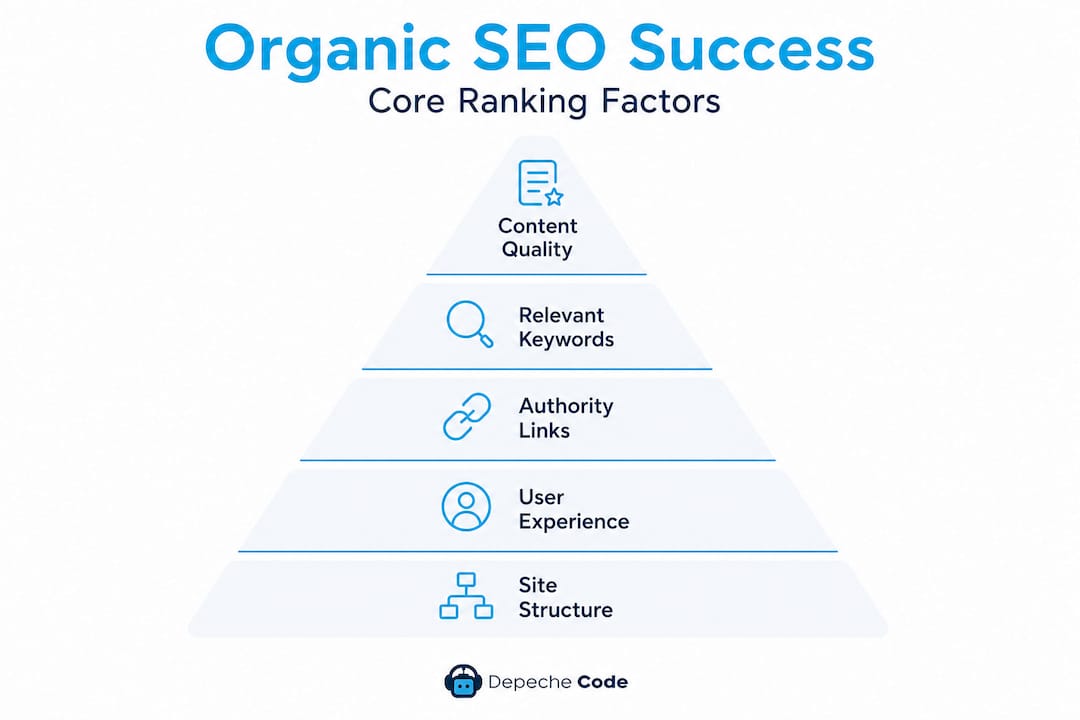
The three pillars driving organic rankings are content quality, keyword optimization, and authoritative backlinks. These key ranking factors work together rather than independently. Strong content without links won’t rank as well as it should. Great backlinks pointing to thin content won’t hold their value. The three must align.
Breaking down each pillar:
- Content quality: Pages that answer questions thoroughly, use clear formatting, and cover a topic in depth outperform shallow content consistently.
- Keyword optimization: Placing relevant terms naturally in titles, headers, body text, and metadata signals topical relevance to search engines.
- Backlinks: When reputable websites link to yours, it signals authority. A single high-quality backlink from a trusted source outweighs dozens of low-quality ones.
- Technical SEO: Site speed, mobile responsiveness, secure HTTPS connections, and crawlable architecture are the foundation everything else rests on.
- User experience (UX): Bounce rates, dwell time, and pages per session tell search engines whether users found your content valuable.
Here’s how the major ranking factors compare in terms of impact and your ability to control them:
| Ranking factor | Impact on rankings | Time to see results | Your control level |
|---|---|---|---|
| Content quality | Very high | 2 to 4 months | Full control |
| Keyword optimization | High | 1 to 3 months | Full control |
| Backlinks | Very high | 3 to 6 months | Partial control |
| Technical SEO | High | Weeks | Full control |
| User experience | Moderate to high | 1 to 3 months | Full control |
Modern search engines, especially those powered by AI, now favor entity-rich content. An entity is a clearly defined concept, person, place, or thing that search engines can connect to a broader web of knowledge. Writing content that clearly establishes what your business does, where it operates, and who it serves helps AI-powered search understand and surface your pages. Investing in organic SEO growth means building this kind of structured, contextually rich content from the ground up.
Organic SEO vs paid search: Cost, trust, and results
Every business eventually faces this question: should we spend on ads or invest in organic SEO? The honest answer is that both have a role, but they solve different problems at different stages.
Paid search (PPC) delivers immediate visibility. You launch a campaign today and can get clicks tonight. That speed is genuinely valuable for product launches, seasonal promotions, or testing a new market. But the moment your budget runs out or your campaign ends, the traffic stops. There’s no residual value. The long-term economics of organic are fundamentally different: organic compounds over time, builds evergreen traffic, and earns higher trust, even though it starts slower and requires upfront investment.
“The best SEO strategy is one that acknowledges what paid search can do quickly and what organic search can do permanently—then sequences them deliberately.”
A practical way to think about your approach:
- Start with paid search to generate immediate revenue and gather keyword data about what actually converts for your business.
- Use that data to prioritize the organic content and landing pages most likely to drive sales.
- Build organic assets around those high-value topics, gradually reducing reliance on paid spend.
- Reduce paid budgets in areas where organic rankings are established, reinvesting savings into more organic content.
- Maintain paid campaigns for competitive terms or new offerings while organic authority grows.
This sequenced approach is how growth-oriented businesses get the best of both worlds. They use paid search as a data engine and fast-start mechanism, then let organic SEO build the durable foundation. If you’re exploring options for combining organic SEO and PPC, a hybrid strategy often delivers the best return across both short and long timeframes.
The new rules: AI, search evolution, and modern SEO best practices
Search has changed more in the past two years than in the previous decade. AI-generated summaries now appear at the top of many search results pages. Voice search continues to grow. And Google’s algorithms increasingly reward sites that demonstrate genuine expertise, authority, and trustworthiness rather than just keyword density.

What this means for your business is that SEO success in 2026 depends heavily on context, including your competition, your site’s current state, and your user’s intent. There’s no single formula. But there are updated best practices that apply broadly.
The modern SEO checklist for AI-ready websites:
- Structured data and schema markup: Add schema code to your pages so search engines and AI can clearly categorize your content, products, and services.
- Entity-based content: Write about your business and topics in ways that establish clear relationships and context, not just keyword repetition.
- E-E-A-T signals: Experience, Expertise, Authoritativeness, and Trustworthiness are the four pillars Google’s quality evaluators use. Demonstrate all four on every key page.
- Comprehensive page topics: Cover topics fully rather than superficially. A single in-depth page often outranks five thin pages on related subtopics.
- Clear site architecture: Logical internal linking helps search engines and users navigate your site efficiently, distributing authority to your most important pages.
Practical steps to prepare your site for AI-powered search:
- Run a technical audit using a reliable crawl tool to identify broken links, slow pages, and indexing issues.
- Review your existing content for thin or outdated material. Update or consolidate pages rather than letting old content dilute your authority.
- Add structured data markup for your business type, FAQs, products, and reviews.
- Build content clusters around your core services. Each cluster should have a detailed pillar page supported by related, specific pages that link back to it.
Pro Tip: Update your Google Business Profile regularly and align your website’s content, name, address, and phone number details with your local listings. AI-powered local search now cross-references multiple sources to verify business legitimacy. Consistency across all data points strengthens your authority signals significantly. For businesses interested in AI-driven SEO practices, structured content and local signals are the starting point.
Step-by-step: Building your organic SEO action plan
Knowing the theory is only useful if you can execute. Here’s a practical, repeatable process you can start applying immediately, regardless of where your business is in its SEO journey.
Your organic SEO action plan:
- Audit your current website. Identify pages with thin content, technical errors, or poor performance. Tools like Google Search Console show which pages receive impressions but no clicks, signaling missed opportunities.
- Research keywords strategically. Focus on terms your customers actually use when looking for your services. Long-tail keywords (three or more words) often have less competition and higher purchase intent.
- Create structured, high-quality content. Write pages that answer specific questions your customers ask. Use clear headers, short paragraphs, bullet points, and internal links to make content easy to scan and navigate.
- Optimize on-page elements. Every page needs a unique title tag, a compelling meta description, properly structured headers (H1 through H3), and images with descriptive alt text.
- Earn backlinks through relationships. Reach out to industry publications, local business organizations, or complementary service providers for guest posts, partnerships, or mentions.
- Monitor and adapt. Use Google Analytics and Search Console monthly to track organic traffic, ranking changes, and conversion performance. Adjust your strategy based on real data, not assumptions.
Research confirms this disciplined approach pays off: organic rankings improve significantly with consistent, well-structured SEO effort, with effect sizes that outperform many other digital marketing channels.
Pro Tip: Don’t try to optimize your entire site at once. Pick your top five revenue-driving pages and make them excellent before moving on. Concentrated effort on your highest-value content delivers faster, more measurable results than spreading thin improvements across hundreds of pages.
Key metrics to track monthly:
- Organic sessions (total and by landing page)
- Average position for target keywords
- Click-through rate (CTR) from search results
- Conversion rate from organic traffic
- New backlinks earned and lost
If you’re just getting started and want a structured approach with expert guidance, exploring an SEO starter plan can give you a clear foundation to build from.
The truth most SEO experts miss about sustainable growth
Here’s what rarely gets said plainly: most businesses that fail at SEO don’t fail because they chose the wrong keywords or missed a technical update. They fail because they quit too soon.
Organic SEO is genuinely slow at the start. The compounding effect doesn’t kick in for several months. During that window, it’s tempting to chase a trending tactic, shift budget back to paid ads, or conclude that SEO “isn’t working.” We’ve seen this happen repeatedly with businesses across virtually every industry.
The businesses that win with organic search share one trait: they commit to fundamentals long enough for the compounding to begin. High-quality content, consistent publishing, clean technical architecture, and steady link earning aren’t exciting strategies. But they are the ones that produce rankings that hold, even through algorithm updates and AI disruptions. The latest changes to AI-driven search actually reinforce this. Algorithmic shortcuts and keyword stuffing are increasingly penalized. Genuine expertise and structured authority are increasingly rewarded.
The uncomfortable truth is that the best time to start building organic authority was a year ago. The second-best time is now. Every week you delay is a week your competitors are extending their lead, because SEO compounds both ways. Those who invest early gain advantages that become harder to overcome over time.
If your business is serious about lasting growth through SEO, stop measuring SEO in weeks and start measuring it in quarters. Set a 12-month minimum commitment, track the right metrics, and resist the urge to pivot every time a new tactic appears in your feed. The fundamentals will still be working long after the latest “growth hack” is forgotten.
Take your organic SEO further with expert solutions
Understanding organic SEO is only the starting point. Implementing it consistently, at the depth required to compete, takes time, expertise, and the right technical tools. Many business owners find that partnering with specialists dramatically shortens the path from learning to ranking.
At Depeche Code, we’ve built flexible SEO options and plans designed for businesses at every stage of growth. Whether you need a clear foundation to build from or a full-scale strategy to accelerate your visibility, we can put the right plan in place. Our organic SEO starter package is specifically built for businesses ready to get serious about sustainable rankings without getting lost in complexity. From technical audits to content strategy and AI-ready schema setup, we handle the work so you can focus on running your business while the results compound.
Frequently asked questions
How long does it take to see results from organic SEO?
It typically takes 3 to 6 months to see substantial results because organic SEO builds momentum gradually, with rankings and traffic strengthening as authority accumulates over time.
Is organic SEO more effective than paid ads for long-term growth?
Yes. Organic SEO delivers compounding, evergreen results and earns higher user trust, while paid ads stop generating traffic the moment your budget ends and the campaign stops running.
What are the most important ranking factors in organic SEO?
The main factors are content quality, relevant keyword usage, and authoritative backlinks, all of which work together to signal relevance and authority to search engines.
How is AI changing organic SEO strategies?
AI-driven search algorithms now place greater value on structured, entity-rich content and reward sites that clearly demonstrate expertise, authority, and trustworthiness across all pages.
Can I do organic SEO on my own, or do I need an agency?
Many foundational steps can be handled in-house if you have the time and willingness to learn, but an experienced agency can accelerate timelines, avoid costly mistakes, and amplify your results significantly faster.