TL;DR:
- Website visibility is essential for attracting visitors and converts; it depends on continuous measurement and adaptation.
- A solid technical foundation, including sitemap submission and error fixing, ensures search engines can discover and index your content effectively.
You built a great website. You have a real product, a real service, and real value to offer. But your phone stays quiet, your contact form collects dust, and your analytics show a trickle of visitors you can almost count by hand. The problem is not your business. The problem is visibility. When potential customers search for what you offer, your site simply does not show up. This guide gives you a clear, step-by-step path to fix that, using proven techniques grounded in real data and modern search behavior.
Table of Contents
- Understand and measure website visibility
- Technical foundations: crawling, indexing, and site structure
- Content and SEO fundamentals: optimizing for search intent
- Local optimization and Google Business Profile: standing out locally
- Benchmarking and continuous improvement: track, compare, and adapt
- The overlooked reality of website visibility: what most guides miss
- Let Depeche Code help you unlock greater visibility
- Frequently asked questions
Key Takeaways
| Point | Details |
|---|---|
| Visibility means more than ranking | Stand out with SERP features, impressions, and clicks, not just positions. |
| Technical health first | Sites must be crawlable and indexable before content can rank. |
| Content aligns with user needs | Optimize pages for real user intent, quality, and internal links. |
| Local SEO drives local traffic | A complete Google Business Profile can significantly increase visibility in location-based searches. |
| Ongoing benchmarking is essential | Regularly track, adapt, and benchmark against competitors and your own past performance. |
Understand and measure website visibility
Before you change anything, you need to know where you stand. Many business owners skip this step and end up optimizing blindly, investing time and money with no clear sense of whether it is working.
Website visibility is not just about where you rank in Google. As the Organic Search Visibility Guide explains, visibility also depends on clicks and SERP presentation, including rich results, featured snippets, and AI-powered experiences. You need to measure impressions (how often your site appears), click-through rate (CTR, the percentage of people who click), and SERP feature appearances, not just position numbers.
Here is a quick comparison of the key visibility metrics every business owner should track:
| Metric | What it measures | Why it matters |
|---|---|---|
| Organic impressions | How often your pages appear in search | Shows reach and brand awareness |
| Click-through rate (CTR) | % of impressions that lead to clicks | Reveals if your titles and descriptions attract attention |
| Average position | Average rank across keywords | A baseline, not the whole picture |
| SERP features | Featured snippets, maps, reviews | High-visibility placements beyond standard rankings |
| Index coverage | Pages Google has indexed | Uncovers hidden technical problems |
Use Google Search Console (free) to access all of these numbers in one place. Set a baseline before you make any changes. That way, when you implement improvements, you can actually prove they worked.
Key metrics to monitor from day one:
- Organic traffic volume (weekly and monthly)
- Impressions by page and by query
- CTR per page and per keyword
- Number of SERP features your site appears in
- Pages with indexing errors or warnings
The SEO Benchmarking guide recommends comparing your performance against competitors, industry standards, and your own historical data rather than focusing solely on rank tracking. This three-way comparison gives you a full picture of where you are losing ground and where opportunity exists. Think of it like a health checkup: the goal is not just to feel okay today but to catch problems early and build strength over time.
“Visibility is not a destination you reach and then maintain effortlessly. It is an ongoing practice that requires consistent measurement, regular adjustments, and a willingness to evolve as search engines evolve.”
Understanding SEO ROI and growth begins with knowing your baseline metrics. Once you have them, everything else becomes measurable, and measurability is what separates smart investment from guesswork. Businesses that also focus on lead generation strategies alongside visibility see compounding benefits as traffic quality improves.
Technical foundations: crawling, indexing, and site structure
Search engines discover your content by sending automated programs called crawlers (or bots) across the web. If those bots cannot reach your pages, or if your pages are blocked from being saved in Google’s index, you will never appear in search results no matter how great your content is.
Here is how to set up a solid technical foundation:
- Submit an XML sitemap. A sitemap is a file that lists all the important pages on your site. Submit it in Google Search Console so Google always knows which pages to visit. This is especially important for large or frequently updated sites.
- Check your index coverage report. In Search Console, the Coverage tab shows pages that are indexed, excluded, or have errors. Review this weekly when you are making active changes.
- Fix crawl errors immediately. Broken links (404 errors), server errors (500s), and redirect loops all waste crawl budget and frustrate both bots and real visitors.
- Review your robots.txt file. This file tells search engines what they are allowed to crawl. A misconfigured robots.txt can accidentally block your most important pages.
- Build logical internal links. Every important page on your site should be reachable within two or three clicks from the homepage. Internal links help bots discover content and tell Google which pages you consider most important.
- Use clean, descriptive URLs. A URL like "/services/seo-for-small-business
is far easier for bots and humans to understand than/page?id=47`.
Google’s Search Console guidance confirms that increasing website visibility starts with ensuring Google can crawl and index important pages, including publishing a sitemap and verifying index coverage. This is the non-negotiable starting point, not a nice-to-have.
There is also an important edge case worth knowing. According to Google’s documentation on AI Features in Search, pages blocked by robots.txt or tagged with noindex will not be eligible to appear as AI supporting links in search results. As AI-powered search summaries become more common, this matters more than ever. Visibility now depends on crawl and index eligibility, not just publishing content.
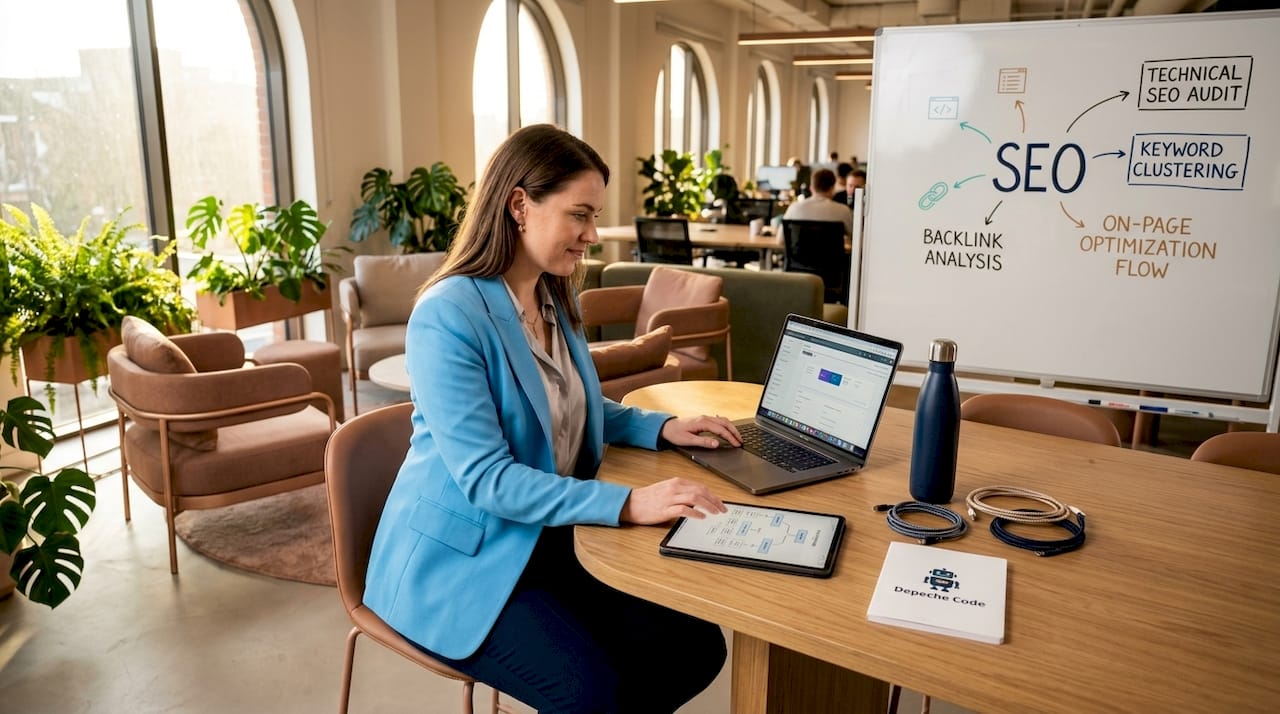
Pro Tip: Use the URL Inspection tool inside Google Search Console to check any specific page. It tells you whether Google has indexed it, when it was last crawled, and whether there are any issues blocking it.
A strong technical foundation also supports your website redesign SEO checklist, especially if you are planning to refresh your site in 2026 without losing the rankings you have already earned. The SEO optimization strategies you layer on top will only work if the foundation is solid. Think of it the same way you would think about process optimization in business operations: efficiency starts with getting the fundamentals right.
Content and SEO fundamentals: optimizing for search intent
Content is where most of the opportunity lives, but only if it is aligned with what your audience is actually searching for. Writing about topics that interest you is not the same as writing content that earns search visibility. The difference is search intent, meaning the underlying goal a person has when they type a query into Google.
There are four main types of intent:
- Informational (the person wants to learn something)
- Navigational (the person is looking for a specific brand or website)
- Commercial (the person is comparing options before buying)
- Transactional (the person is ready to take action right now)
Every page on your site should clearly serve one of these intents. A service page targets transactional intent. A blog post explaining how something works targets informational intent.
| SEO action | Impact on visibility | Difficulty level |
|---|---|---|
| Match page content to search intent | High | Low to medium |
| Optimize title tags and meta descriptions | High | Low |
| Add schema markup (structured data) | Medium to high | Medium |
| Refresh outdated content | Medium | Low |
| Improve page speed and mobile experience | High | Medium to high |
| Build topical authority through content clusters | Very high | High |
According to Moz’s SEO fundamentals, visibility improves when you match content to search intent, do thorough keyword research, optimize on-page elements, and build internal linking so key pages are easily discoverable. These four actions alone, done consistently, can move the needle significantly.
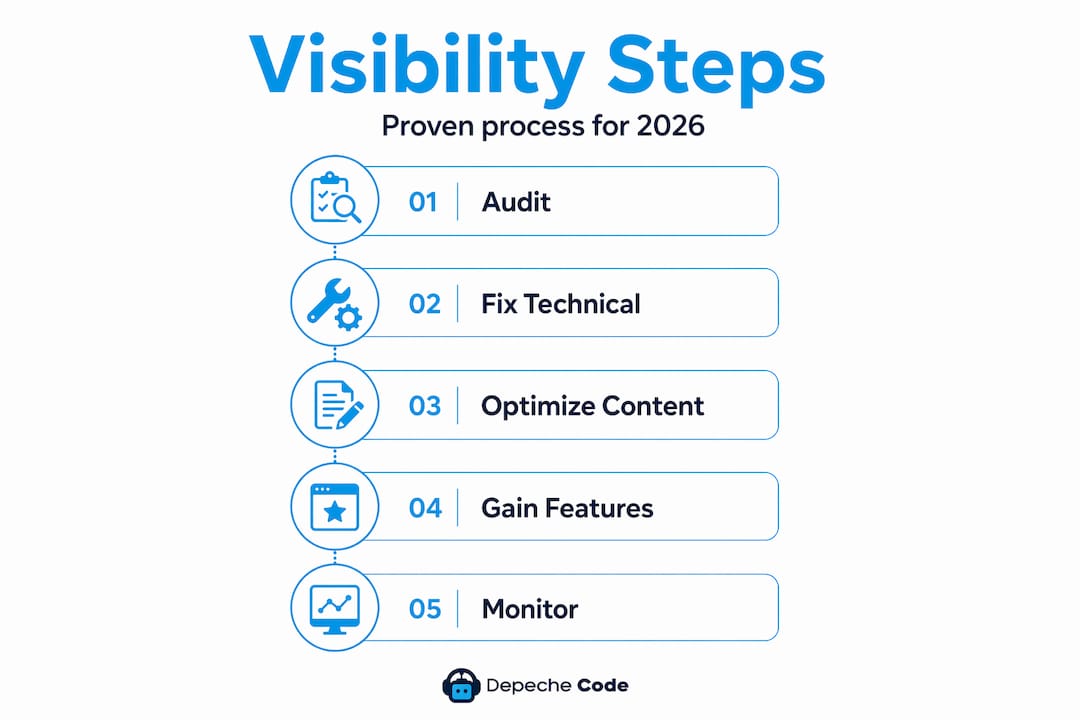
SERP features like rich results such as how-to panels, FAQ boxes, and star ratings can be won by adding schema markup to your pages. Schema tells Google exactly what type of content you have, making it easier to display your information in a more prominent, eye-catching format. SEO content optimization best practices consistently emphasize that combining technical health with page experience factors like mobile responsiveness and load speed produces the most measurable growth.
Pro Tip: Before writing new content, search your target keyword and study the top five results. What format do they use? What questions do they answer? Your content needs to match that intent and go deeper to earn a competitive spot.
Explore SEO options and plans if you want a structured approach to content and keyword strategy without doing all the research from scratch. Pairing strong content with smart website lead generation tactics turns search traffic into actual business results.
Local optimization and Google Business Profile: standing out locally
For any business that serves a specific city, region, or physical location, local SEO is one of the highest-return activities you can invest in. It targets people who are already nearby and already searching for what you offer, which means they are close to making a decision.
Here is how to build strong local visibility:
- Claim and fully complete your Google Business Profile. Add your business name, address, phone number, website, hours, photos, services, and a description. Incomplete profiles rank lower and earn less trust.
- Keep your NAP consistent. NAP stands for Name, Address, Phone number. These details must be identical across every directory, social profile, and citation where your business appears. Even small variations (like “St.” vs “Street”) can confuse search engines.
- Build local citations. List your business in relevant directories such as Yelp, the Better Business Bureau, and industry-specific platforms. Each listing reinforces your location and legitimacy.
- Actively request and respond to reviews. Reviews are a major local ranking signal. Ask satisfied customers directly and respond to every review, positive or negative. Your response shows future customers you are attentive and professional.
- Post regular updates to your Google Business Profile. Share offers, events, new services, and photos. Active profiles rank higher and attract more clicks than static ones.
Stat callout: According to digital marketing research for small businesses, local SEO and Google Business Profile optimization are among the highest-ROI tactics available, because consistent business information and strong review management directly support local discovery. Customers trust businesses with complete profiles and recent reviews far more than those with sparse or outdated listings.
Pro Tip: After a job or purchase is complete, send a short follow-up message with a direct link to your Google review page. Remove any friction, and you will see review volume increase significantly within weeks.
Explore Local SEO growth methods to see how AI-powered tools can accelerate your local visibility in a fraction of the time traditional methods require.
Benchmarking and continuous improvement: track, compare, and adapt
One of the most common mistakes in SEO is treating it as a project with a start date and an end date. It is not. Search algorithms update constantly. Competitors publish new content. User behavior shifts. What worked in January may underperform by June.
Key benchmarking actions to build into your routine:
- Compare your organic traffic month over month and year over year
- Track which SERP features your pages appear in, and which you are missing
- Monitor competitors’ keyword rankings using tools like Google Search Console data for your own site plus free comparison tools
- Set quarterly goals for impressions, CTR, and index health
The SEO Benchmarking guide is clear: comparing performance against competitors, industry standards, and your own historical baselines gives you far more actionable insight than checking your keyword position once a month. Position alone does not tell you whether clicks are growing.
| Review frequency | What to check |
|---|---|
| Weekly | Crawl errors, index coverage, manual actions |
| Monthly | Organic traffic trends, CTR by page, new SERP features |
| Quarterly | Competitor comparison, keyword gap analysis, content refresh list |
| Annually | Full technical audit, strategy review, goal reset |
Search Console guidance specifically notes that SEO is not a set-and-forget activity because new content and algorithm changes affect visibility continuously. Businesses that build regular review cycles into their operations consistently outperform those that only look at their site when something breaks.
Pro Tip: Set up a recurring monthly calendar event titled “SEO review.” Block 30 minutes to check your Search Console data, compare it to last month, and make at least one small improvement. Consistency over 12 months produces results that sporadic large efforts rarely achieve.
For a structured approach to ongoing SEO optimization, having a documented process makes it far easier to delegate or scale as your business grows.
The overlooked reality of website visibility: what most guides miss
Here is something most SEO articles will not say directly: ranking number one for a keyword no longer guarantees the traffic it once did. In 2026, Google’s search results page is more crowded than ever, with AI-generated summaries, featured snippets, local packs, shopping panels, and video carousels all competing for attention above the traditional organic listings.
A page sitting at position three with a compelling title and a rich snippet can outperform a page sitting at position one with a plain listing. We have seen this happen repeatedly. The click belongs to whoever earns attention, not just whoever ranks highest. This is why measuring CTR and SERP feature presence matters more than obsessing over position.
The businesses that win long-term treat visibility as a system, not a campaign. They publish content consistently, fix technical issues as they appear, keep their local profiles active, and review their data regularly. They do not chase algorithm updates reactively. They build authority steadily, and that authority holds up even when rankings shift.
Another uncomfortable truth: many businesses invest heavily in traffic while completely neglecting conversion. Getting 10,000 monthly visitors means nothing if none of them take action. Visibility and conversion work together. Your pages need to be found, yes, but they also need to compel action once someone arrives. Understanding business ROI with SEO means looking at the full funnel, not just the top of it.
The brands that outperform their peers do not have bigger budgets. They have clearer strategies, better measurement habits, and the discipline to keep improving even when results feel slow.
Let Depeche Code help you unlock greater visibility
Applying everything in this guide takes time, skill, and consistency. If you are ready to accelerate your results without doing it all alone, Depeche Code is built for exactly that.
We work with small and large businesses across industries to deliver affordable, high-impact digital solutions. Whether you need SEO plans tailored to your keyword goals, local SEO services powered by AI to dominate nearby searches, or a full website design and development overhaul that is built for speed, mobile performance, and search visibility from day one, we have the team and the track record to deliver. Based in Orlando and serving businesses nationwide, we combine technical expertise with a genuine commitment to measurable results you can actually see in your data.
Frequently asked questions
What metric should I prioritize for website visibility?
Track impressions, click-through rate, and SERP feature presence, not just traditional rankings. As the Organic Search Visibility Guide explains, visibility depends on clicks and SERP presentation, not position alone.
How long does it take to see improvements in website visibility?
You may notice early improvements in a few weeks after fixing technical issues, but sustained results generally take three to six months of continuous effort across content, technical health, and link signals.
What stops my website from appearing in Google?
Crawl and index issues are the most common culprits. According to Google’s AI Features in Search documentation, pages blocked by robots.txt or tagged with noindex are not eligible to appear in search results, including newer AI-powered features.
Is local SEO important for online-only businesses?
Local SEO is less critical for businesses with no geographic footprint, but for any company serving a specific region, digital marketing research consistently shows that local optimization and Google Business Profile management are among the highest-ROI tactics available.
Why do I need to update my website regularly?
Search algorithms and competitors change continuously, so regular content updates, technical reviews, and fresh signals help your site maintain and improve its position in an evolving search landscape.
Recommended
Related Articles

Depeche Code
April 16, 2026
Depeche Code
April 16, 2026