

TL;DR:
- Effective SEO in 2026 hinges on creating content that aligns with search intent, demonstrates expertise, and avoids bloat, as Google’s AI increasingly prioritizes genuine value. Every aspect of site structure, including topical authority and precise internal linking, influences rankings more than sheer volume, requiring strategic planning and ongoing audits. Measuring performance and refining content based on data is essential for sustainable growth and maintaining search visibility.
Most businesses treat SEO as a technical puzzle. Fix the meta tags, earn a few backlinks, sprinkle in keywords, and wait. But the real role of content in SEO goes far deeper than that, and in 2026, the gap between businesses that understand this and those that don’t has never been wider. Google’s AI-driven search features, updated ranking signals, and a sharper focus on genuine expertise have fundamentally changed what content must do to earn and hold rankings. This guide breaks down exactly what that means for your strategy.
Table of Contents
- Key Takeaways
- The role of content in SEO success
- Advanced content strategy for SEO in 2026
- Practical content optimization techniques
- Corporate and local content strategy alignment
- Measuring content performance and adapting
- My take on content and SEO after years in the field
- Ready to turn your content into a ranking engine?
- FAQ
Key Takeaways
| Point | Details |
|---|---|
| Content drives all SEO outcomes | Search engines use content to determine relevance, authority, and value for every query. |
| Search intent alignment is non-negotiable | Content that mismatches user intent loses rankings regardless of keyword optimization. |
| E-E-A-T shapes ranking signals | Author credentials, citations, and real experience are now measurable ranking factors. |
| Content bloat hurts more than it helps | Large unmanaged content libraries dilute authority and create crawl budget problems. |
| Measurement drives sustained growth | Tracking engagement, rankings, and conversions reveals which content deserves investment. |
The role of content in SEO success
Content is not one piece of the SEO puzzle. It is the puzzle. Every signal search engines use to evaluate your site flows through content. Keywords live in content. Backlinks point to content. User engagement happens because of content. When you treat content as an afterthought, you are essentially asking Google to rank a store with empty shelves.
Understanding search intent is the starting point. When someone types a query, they have a specific goal: find information, compare options, or make a purchase. Content that aligns with that goal in format, depth, and tone performs. Content that technically contains the keyword but misses the intent does not. A 2,000-word guide when someone wants a quick answer, or a thin paragraph when someone needs detailed instructions, both fail on intent even if they rank temporarily.
Google’s Helpful Content System makes this judgment at scale. It rewards pages that demonstrate genuine value and penalizes thin or generic content that exists mainly to capture traffic. The importance of content in SEO has only grown as these systems become more precise at separating real value from manufactured relevance.
The E-E-A-T framework (Experience, Expertise, Authoritativeness, Trustworthiness) is no longer abstract guidance. Since the February 2026 core update, author credentials have become a measurable ranking factor. That means who writes your content matters, not just what it says. High-quality content also naturally attracts backlinks, which compounds authority over time.
Pro Tip: Add a verified author bio with credentials and relevant experience to every key page. This single change directly supports your E-E-A-T signals without touching a single line of code.
Advanced content strategy for SEO in 2026
Most content strategies in 2026 fail not because of poor writing but because of poor architecture. Publishing more articles without a structural plan creates a tangled library where pages compete with each other, confuse search engines, and spread authority too thin.
Entity-rich content is one of the most underutilized tools available. When your content maps relationships between topics, mentions credible sources, and uses precise terminology consistently, search engines can better understand what your site is genuinely about. This builds topical authority and AI inclusion potential, meaning your content is more likely to be cited in AI-generated summaries.

Topic clusters solve the architecture problem. A strong pillar page covers a broad subject with authority, and cluster pages go deep on specific subtopics, all linking back to the pillar. This structure tells search engines that your site owns a topic area rather than just touching it occasionally. It also distributes internal link equity in a way that lifts the entire cluster.
Here is how the two approaches compare:
| Approach | What it does well | Where it breaks down |
|---|---|---|
| Volume-based publishing | Covers many queries quickly | Creates crawl bloat and cannibalization |
| Topic cluster model | Builds concentrated authority | Requires upfront planning and ongoing maintenance |
| Consolidation and pruning | Recovers lost authority efficiently | Takes time and requires honest content audits |
Large content volumes without pruning lead to crawl budget inefficiencies that reduce SEO impact across the entire site. Pages that once ranked can lose visibility simply because search engines are wasting crawl allocation on hundreds of thin or redundant articles.
Pro Tip: Run a content audit every six months. Flag pages with fewer than 300 words, minimal traffic, and no backlinks. Consolidate related thin pages into one authoritative piece rather than letting them drain your crawl budget.
SEO in 2026 operates like a growth operating system that rewards authentic, experience-driven content over generic summaries. Successful content strategy for SEO prioritizes keywords by business value and competitor difficulty, not search volume alone.
Practical content optimization techniques
Getting the strategy right is half the battle. The other half is execution at the page level. These are the content optimization techniques that consistently move rankings.
- Title tags and meta descriptions: A strong title tag answers what the page is about, who it’s for, and why someone should click. Title tags drive CTR more than almost any other on-page element. Your meta description supports the title by adding a specific benefit or detail that reinforces the click.
- Heading structure (H1, H2, H3): Headings do two jobs simultaneously. They guide the reader through the page and signal content hierarchy to search engines. Use one H1 per page, use H2s for major sections, and use H3s for supporting details within those sections.
- Image optimization: Every image should have descriptive alt text, a relevant filename, and a compressed file size. Alt text supports both SEO and accessibility, and search engines do read it.
- Internal linking: Strategic internal links reinforce your site architecture and guide users to related content. Link from high-authority pages to pages you want to rank, using anchor text that describes the destination accurately.
- Schema markup: FAQ and HowTo schema give search engines structured data that can produce rich results. These enhanced listings take up more space in the SERP and increase click-through rates for the pages that earn them.
| Optimization element | Direct SEO impact | Secondary benefit |
|---|---|---|
| Title tag | Higher CTR from SERPs | Sets user expectations |
| Schema markup | Rich result eligibility | Increased SERP real estate |
| Internal links | Authority distribution | Improved user navigation |
| Image alt text | Image search visibility | Accessibility compliance |
Content freshness and regular updates prevent content decay and preserve rankings over time. A page that ranked well two years ago but has not been touched since will slowly lose ground to fresher, more current competitors.
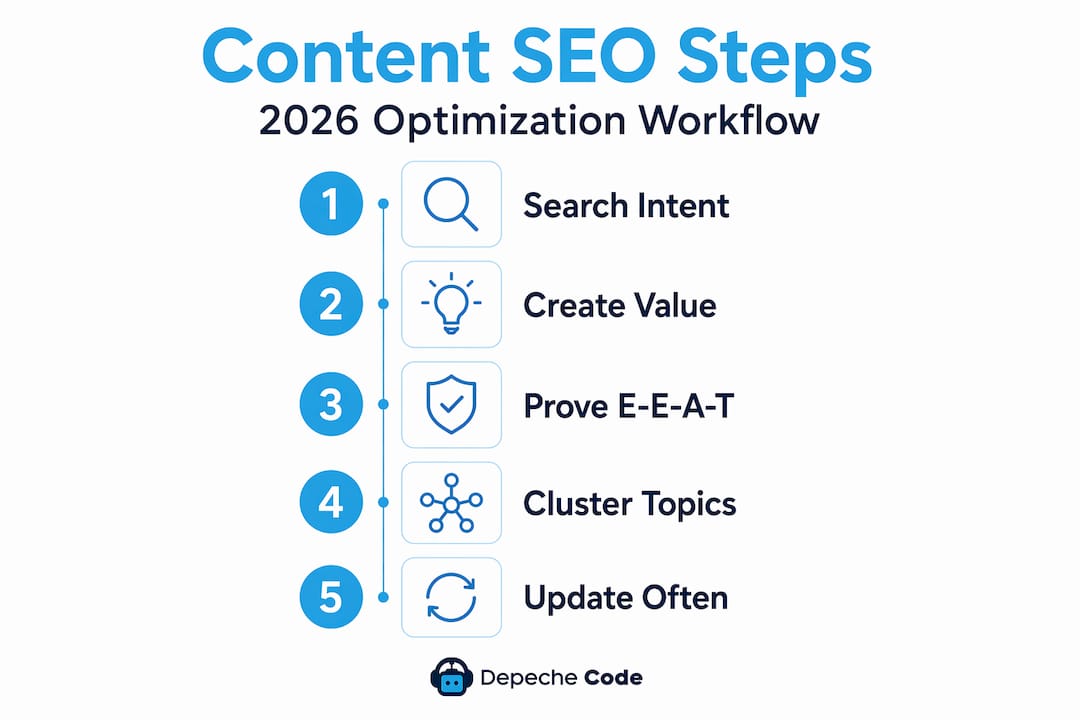
Pro Tip: When updating existing content, add a “Last Updated” date near the top of the page. Users notice it, trust it more, and search engines treat it as a freshness signal.
Corporate and local content strategy alignment
For businesses operating across multiple locations or managing both a corporate site and location-specific pages, content strategy gets complicated fast. The biggest threat is self-competition. When your Houston page and your Dallas page both target the same keywords with near-identical content, neither one ranks well because they are essentially fighting each other.
Multi-location sites face keyword cannibalization and crawl bloat when content ownership is unclear. The fix requires deliberate division of responsibility.
Here is how to structure it:
- Assign content ownership at the corporate level. Corporate pages should hold broad, authoritative content covering industry topics, brand messaging, and high-level service descriptions. This is where you build domain authority.
- Build geo-targeted pages for each location with genuinely unique content. Each location page should include locally specific details: neighborhood references, local staff profiles, location-specific offers, and city-relevant customer scenarios. Copying and slightly modifying a corporate page template does not qualify as unique content.
- Create a centralized keyword map. Document which keywords each page owns. When two pages target the same keyword, one of them needs to change focus or the pages need to merge.
- Build internal links that support the corporate-local hierarchy. Corporate pages should link to location pages as evidence of geographic reach. Location pages should link back to corporate service pages to pass authority upward.
- Consolidate duplicate topics into one authoritative page. If five location pages all have thin “about us” content targeting the same phrase, consider replacing them with location-specific landing pages focused on conversion rather than keyword rankings.
Corporate teams handling broad authority content while local teams focus on geo-specific pages is the structural model that prevents internal competition and maximizes the SEO benefits of high-quality content at both levels. Businesses using Local SEO growth strategies are getting much better results by following exactly this division.
Measuring content performance and adapting
Publishing content without measuring it is guesswork at scale. The businesses that compound their SEO growth over time are the ones that treat content performance data as a feedback loop, not a vanity report.
These are the metrics that actually tell you something useful:
- Organic traffic and ranking positions: Your baseline. Are the pages you optimized actually climbing? Use position tracking for target keywords alongside traffic data to verify that rank improvements are translating into visits.
- Click-through rate (CTR): Low CTR on a page that ranks well signals a weak title tag or meta description. Fix the copy before adding more content.
- Time on page and bounce rate: These engagement signals indicate whether users find what they expected. A high bounce rate on an informational page often means the content does not match the query intent, not that the page is technically broken.
- Conversions and revenue attribution: Traffic that never converts is a budget drain. Map content to funnel stages and track which pages influence purchase decisions, not just which ones get clicks.
- Backlink acquisition: Pages earning organic backlinks are demonstrating real authority. Track these separately and treat them as candidates for further investment.
When you identify underperforming content, you have three options: refresh it with new data and better structure, consolidate it with a related page that performs better, or remove it entirely if it serves no purpose. Pruning thin and redundant content into authoritative pillars increases both crawl efficiency and domain authority. The impact of content on rankings is most visible when you compare a well-maintained content library against one that has been left to accumulate without review.
My take on content and SEO after years in the field
I’ve spent years watching businesses chase content volume as if sheer quantity were a strategy. More articles, more pages, more words. What that approach usually produces is a bloated site where nothing ranks well because nothing is truly authoritative.
What I’ve learned is that 10 genuinely excellent pages will outperform 100 mediocre ones, and that truth is even more pronounced now that AI Overviews influence roughly 30% of search queries. AI systems pull structured, well-cited, clearly authored content. Generic content that reads like it was assembled from templates does not make the cut.
The uncomfortable reality I’ve seen repeatedly is that most content problems are actually strategy problems. Teams publish without a keyword map. Multiple writers cover the same topics. Pages compete with each other instead of reinforcing each other. Fixing these structural issues almost always produces faster ranking gains than publishing new content.
My personal recommendation is this: before you create anything new, audit what you already have. Identify your 20 best-performing pages and build your strategy around supporting and extending them. Consolidate the weakest pages. Then invest in creating content that demonstrates real experience, includes credible citations, and carries a named author with verifiable credentials. That combination is what E-E-A-T in practice actually looks like, and it is the only content approach I’d stake a client’s rankings on in 2026.
— Donovan
Ready to turn your content into a ranking engine?
Understanding content strategy and executing it consistently are two different challenges. At Depechecode, we work with businesses in Orlando and across the country to build SEO content strategies that actually produce rankings and revenue. Whether you are starting from scratch or trying to fix a site that has stalled, our team handles everything from technical architecture to content planning.
Explore our SEO options and plans to see how we structure content-driven campaigns for sustainable growth. If your business depends on local visibility, our Local SEO Prime plan is built specifically for multi-location and geo-targeted content strategies. For businesses ready to compete in AI-driven search, our website design and development services create the content-optimized foundation that makes every SEO effort more effective. Let’s build something that ranks.
FAQ
What is the role of content in SEO?
Content is the primary vehicle through which search engines understand your site’s relevance, authority, and value. Every ranking signal, from keywords to backlinks to engagement metrics, flows through the content you publish.
Why is E-E-A-T important for content SEO?
E-E-A-T (Experience, Expertise, Authoritativeness, Trustworthiness) represents the quality standards Google uses to evaluate content. Since the February 2026 core update, author credentials and real-world experience are now direct ranking factors.
How often should you update existing content?
Substantive content refreshes are necessary to prevent content decay and preserve rankings. A practical approach is to audit and update your top-performing pages every six to twelve months, adding new data, improving structure, and aligning with current search intent.
What causes keyword cannibalization?
Keyword cannibalization happens when multiple pages on the same site target the same or very similar keywords, causing them to compete with each other rather than reinforce each other. The fix is a centralized keyword map that assigns clear ownership to each page.
How does content volume affect SEO in 2026?
More content is not automatically better. Large unmanaged content libraries cause crawl budget problems and dilute domain authority. A focused library of high-quality, well-maintained pages consistently outperforms a high-volume approach without a pruning strategy.