

TL;DR:
- A website development brief is a concise document that defines project goals, scope, and requirements before coding begins. It aligns stakeholders, reduces miscommunication, and guides decision-making, leading to better project outcomes. Clear, prioritized, and up-to-date briefs help prevent scope creep and ensure the final website meets measurable business objectives.
A website development brief is a concise document that defines your project’s goals, scope, audience, and requirements before a single line of code is written. Known in professional project management circles as a “project brief” or “creative brief,” this document serves as the single source of truth for everyone involved in a web project. Without one, agencies quote blindly, developers build the wrong thing, and business owners pay for revisions that should never have happened. The best briefs run between two and six pages, giving teams enough context to act without drowning in unnecessary detail.
What is a website development brief and why does it matter?
A website development brief is the foundational document that aligns every stakeholder before work begins. It captures your business background, project goals, audience profile, and technical requirements in one place. Think of it as the blueprint an architect hands a contractor before construction starts. Without it, every decision becomes a guess.

The brief functions as a decision-making tool that connects your business vision to technical execution. That connection matters because web projects fail most often due to miscommunication, not technical inability. When a developer understands why you need a feature, not just what it looks like, the result is far closer to what you actually want.
Project managers benefit just as much as business owners. A clear website project brief gives project managers a reference point for every decision, from approving a design mockup to resolving a scope dispute. It replaces the back-and-forth email chain with a single agreed-upon document.
What are the essential components of a website development brief?
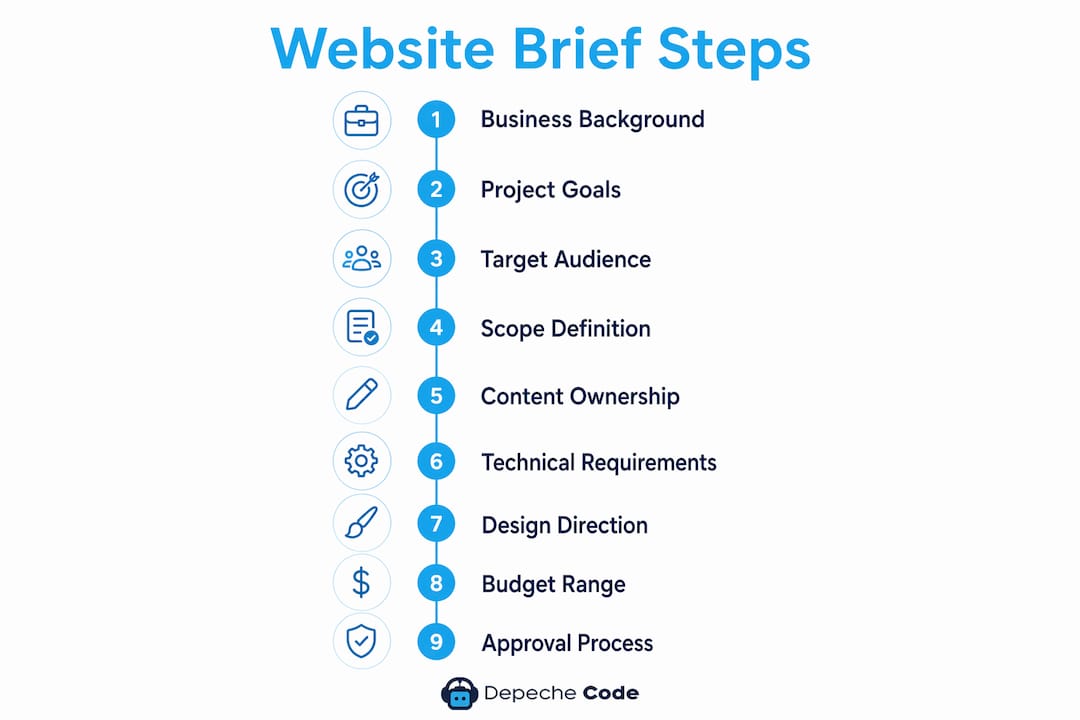
2026 best practices identify nine core components that every effective brief must include. Each one serves a specific purpose, and skipping any of them forces your agency to fill in the gaps with assumptions.
- Business background. Describe what your company does, who your customers are, and what makes you different from others in your space.
- Project goals with measurable success metrics. State what success looks like. “Increase online leads by 30% within six months” is a goal. “Make the website better” is not.
- Target audience profile. Define the demographics, behaviors, and pain points of the people you want to reach. The more specific, the better.
- Project scope. List the pages, features, and functionality you need. Specify what is in scope and, just as importantly, what is out of scope.
- Content ownership. Clarify who writes the copy, provides the images, and delivers the assets. Agencies cannot build what they do not have.
- Technical and functional requirements. Note any integrations, CMS preferences, accessibility standards, or performance benchmarks the site must meet.
- Design preferences and constraints. Share your brand guidelines, color palette, and any visual direction you have already established.
- Budget range. Give a realistic range. Sharing your budget upfront leads to proposals that actually fit your financial reality, rather than generic quotes that miss the mark.
- Timeline. Identify your launch date and any hard deadlines tied to campaigns, events, or product releases.
Pro Tip: Share your budget range in the brief, even if it feels uncomfortable. Agencies report that clients who do this receive proposals tailored to what they can actually afford, which saves weeks of negotiation.
A well-structured website design project outline built around these nine elements gives your agency everything it needs to quote accurately and start work with confidence. You can explore how these elements connect to the full web development process to see how each piece feeds into the next phase.
How does a website development brief improve project outcomes?
A well-written brief reduces revision cycles by eliminating ambiguity before work begins. Every hour spent clarifying the brief upfront saves multiple hours of rework later. That math holds across projects of every size.
The brief also protects both sides of the relationship. When scope creep appears, and it always does, the brief becomes the reference point for deciding what was agreed upon. Without that document, every new request becomes a negotiation with no anchor.
A brief is not paperwork. It is a communication tool that replaces assumptions with agreements. The agencies that treat briefs as living documents, rather than one-time forms, report fewer project stalls and stronger client relationships throughout the build.
Living documents evolve as the project progresses. An agency may use the brief to identify gaps in a client’s thinking and recommend a paid discovery phase before full development begins. That is not a delay. It is a sign the brief is doing its job.
Clear approval processes also belong in the brief. Defining who approves decisions and how content gets reviewed prevents the common scenario where a project stalls because no one knows who has final say. Name the decision-maker. Set the review timeline. Put it in writing.
The brief also helps agencies build trust signals into the site from the start. If you include case studies, testimonials, or certifications in your brief, the development team can plan the site architecture around them rather than retrofitting them later.
Common challenges when writing a website brief and how to avoid them
The most common mistake business owners make is treating the brief as a binding contract. Briefs are decision frameworks, not legal agreements. When clients treat them as contracts, they resist updating the document as the project evolves, which causes bigger problems down the line.
A second common pitfall is writing a brief that is too long or too technical. Documents of 10 or more pages often introduce more noise than clarity. Stick to the two-to-six-page range and focus on outcomes, not specifications. Your agency’s technical team will handle the “how.”
Abstract design feedback creates real confusion on development teams. Telling a designer you want something “modern” or “professional” gives them nothing concrete to work with. Sharing two or three reference websites with specific notes on what you like about each one is far more useful than any adjective.
Here are the most common brief-writing mistakes and how to fix them:
- Vague goals. Replace “improve our online presence” with “generate 50 qualified leads per month through the contact form.”
- Missing decision-maker. Name one person who has final approval authority. Committees slow projects down.
- No content plan. Identify who owns each content type before the project starts, not after.
- Pixel-level design direction. Focus on brand feel and user outcomes, not specific button colors or font sizes.
- No trust signals. Include your reviews, certifications, or case studies so the agency can plan for them structurally.
Pro Tip: Focus your brief on the “what” and the “why” of your business needs. Leave the “how” to your technical team. Clients who do this consistently get better results because they are not constraining the agency’s expertise.
Building an effective IT team around your project also matters. Understanding how technical hiring works can help you ask better questions when evaluating agencies and ensure the people building your site have the right skills.
How do you create an effective website brief step by step?
A practical website brief follows a clear structure. The sections below represent the format that produces the most accurate quotes and the fewest revision cycles.
- Company background. Two to three sentences on what your business does, your industry, and your competitive position.
- Project background. Explain why you need a new or redesigned website now. What changed? What is not working?
- Objectives. List two to four measurable goals. Tie each one to a business outcome, not a design preference.
- Audience. Describe your primary and secondary audiences. Include demographics, motivations, and any known behaviors on your current site.
- Scope. List every page and feature you need. Note any third-party integrations, such as CRM systems, payment gateways, or booking tools.
- Content. Specify who writes the copy, who provides photography, and when assets will be delivered.
- Technical requirements. Note your preferred CMS, hosting environment, performance targets, and any accessibility standards you must meet.
- Design direction. Share your brand guidelines and two to three reference websites with notes on what specifically appeals to you about each one.
- Budget. Provide a realistic range. Even a broad range helps agencies propose the right solution.
- Timeline. State your target launch date and any fixed milestones.
- Approval process. Name the decision-maker and describe how feedback rounds will work.
The table below shows the difference between a weak brief entry and a strong one for the same section.
| Brief section | Weak entry | Strong entry |
|---|---|---|
| Project goal | Make the website look better | Increase contact form submissions by 40% in 90 days |
| Target audience | Small business owners | U.S.-based service business owners, ages 35–55, researching vendors on mobile |
| Design direction | Modern and clean | Reference: [site A] for layout simplicity, [site B] for color use |
| Budget | As low as possible | $8,000–$12,000 for design and development |
| Timeline | ASAP | Launch by september 15, 2026, ahead of Q4 campaign |
Treat the brief as a living document that you update as the project progresses. The first draft does not need to be perfect. It needs to be honest and specific enough to start a productive conversation with your agency. Depechecode’s approach to website design and development is built around exactly this kind of structured collaboration from day one.
Key Takeaways
A website development brief is the single most effective tool for preventing miscommunication, controlling scope, and delivering a website that meets measurable business goals.
| Point | Details |
|---|---|
| Define goals with numbers | Replace vague goals with measurable outcomes tied to business results. |
| Keep the brief concise | Two to six pages is the proven range; longer documents add confusion, not clarity. |
| Share your budget upfront | Clients who disclose budget ranges receive proposals that actually fit their needs. |
| Treat it as a living document | Update the brief as the project evolves to keep all stakeholders aligned. |
| Name one decision-maker | Defining approval authority prevents project stalls and scope disputes. |
Why I think most businesses underestimate the brief
After working on web projects across dozens of industries, the pattern is consistent. The projects that go sideways almost always trace back to a weak or missing brief, not to technical problems. The technology is rarely the issue. The communication is.
What surprises most business owners is how much the brief protects them, not just the agency. When a developer builds something you did not ask for, the brief is your evidence. When a project runs over budget, the brief is your reference point for what was agreed. Without it, you are negotiating from memory.
The other thing I have seen repeatedly is that clients who struggle to complete a brief often do not yet know what they want. That is not a criticism. It is useful information. A good agency will recognize this and suggest a discovery phase before committing to a full build. That conversation only happens because the brief revealed the gap.
My advice is to write the first draft yourself, without worrying about whether it is perfect. A rough brief that reflects your real thinking is more useful than a polished document that says nothing specific. Your agency can help you refine it. What they cannot do is invent your business goals for you.
Balancing detail and brevity is the real skill. Aim for enough specificity that a developer could make a decision without calling you, but not so much detail that you are designing the site yourself. That balance is where the best briefs live.
— Donovan
Depechecode’s approach to turning your brief into a real website
Starting a web project without a clear brief is like hiring a contractor without blueprints. Depechecode works with business owners and project managers to translate project goals into websites that perform.

Depechecode’s team in Orlando handles the full process, from reviewing your initial brief to delivering a site built around your specific business goals. Whether you need a new build or a redesign, the process starts with understanding what you actually need, not just what you think you want. Visit the website design and development service page to see how Depechecode structures projects for clarity and results. If budget is a concern, the free website development option is worth reviewing as a starting point.
FAQ
What is the ideal length for a website development brief?
The most effective briefs run two to six pages. Documents longer than ten pages typically add confusion rather than clarity.
What should I include in a website project brief?
A complete brief covers nine elements: business background, project goals, target audience, scope, content ownership, technical requirements, design direction, budget, and timeline.
Is a website brief the same as a contract?
No. A brief is a communication and decision-making tool, not a legal agreement. It should evolve as the project progresses and new information surfaces.
How specific should design direction be in a website brief?
Skip adjectives like “modern” or “clean.” Share two or three reference websites with specific notes on what you like about each one. That gives designers concrete direction to work from.
When should I share my budget in a website brief?
Share your budget range as early as possible. Agencies produce more accurate and fitting proposals when they know the financial parameters upfront rather than quoting blindly.