

TL;DR:
- Hiring local web developers involves reviewing portfolios, verifying results, and ensuring they include local SEO and hosting. A structured process from discovery to launch covers design, development, testing, and training, typically taking several weeks. Depechecode offers comprehensive web services, including free development options and local SEO expertise, tailored for U.S. small businesses.
If you’re searching for website developers near me, the move is simple: contact a vetted local agency or freelancer today, schedule a discovery call, and walk away with a written scope and estimate. Local providers handle everything from custom design and WordPress development to hosting and local SEO, so you’re not piecing together three different vendors.
Before that first call, have these ready:
- Your current website URL (if you have one) and what’s broken or missing
- Two or three competitor or inspiration sites you like
- A rough sense of your goals (more leads, online sales, better mobile experience)
- Access to any existing Google Analytics or Search Console data
Marketplaces like Thumbtack list dozens of WordPress developers in most U.S. cities, with profile reviews, hire counts, and free estimate offers built right in. A Google Maps search surfaces agencies with verified reviews and local addresses. Both are solid starting points, but neither replaces a direct conversation.
Table of Contents
- What do website developers near me actually offer?
- What does a professional web project look like, phase by phase?
- How do you choose the right local web developer?
- How do you evaluate portfolios and trust signals?
- Why do local SEO and hosting choices matter for your site?
- How do you go from search to signed contract?
- Why Depechecode is worth a call if you’re searching locally
- Key Takeaways
- What most business owners get wrong when hiring a web developer
- Depechecode handles the full picture, not just the build
- Useful sources
- FAQ
What do website developers near me actually offer?
Local web developers sell a wider range of services than most business owners expect. Here’s what a full-service provider typically covers:
Core development services:
- Custom website design and branding-aligned front-end builds
- WordPress development and theme customization
- E-commerce via WooCommerce or Shopify integrations
- Mobile-responsive layouts and CMS setup with owner training
Supporting services:
- Managed hosting, SSL, automated backups, and uptime monitoring
- Local SEO and Google Business Profile optimization
- AI chatbot integration for lead capture and customer support
- Analytics setup, conversion tracking, and ongoing content retainers
Local web developers commonly package these as a one-off project, a monthly retainer, or a hosting bundle that rolls maintenance into a flat fee. Hourly support is also available for smaller tasks.
Pro Tip: For most small U.S. businesses, the highest-ROI combination is WordPress plus managed hosting plus a local SEO launch package. You get a site that ranks in your city, loads fast, and doesn’t require a developer every time you update a page.
What does a professional web project look like, phase by phase?
A credible agency follows a structured process. Here’s what each phase delivers and roughly how long it takes.
- Discovery — Kick-off call, goal alignment, competitor review, and a signed scope document. Expect a few business days.
- Strategy and information architecture — Sitemap, page hierarchy, and content outline. Deliverable: a wireframe or site map PDF.
- Design — Visual mockups (desktop and mobile) for key pages. Deliverable: design comps in Figma or Adobe XD, typically 1–2 revision rounds.
- Development — CMS build, page assembly, plugin configuration, form setup, and third-party integrations. Deliverable: a password-protected staging site.
- QA and testing — Cross-browser checks, mobile testing, speed audit (Google PageSpeed Insights), and broken-link scan. Deliverable: a QA checklist signed off by both parties.
- Launch — DNS transfer, SSL activation, redirect setup, and Google Search Console submission. Deliverable: live site confirmation and launch checklist.
- Training and support — CMS walkthrough, documentation, and a defined support window. Deliverable: training recording or written guide.
A standard brochure site runs several weeks from kick-off to launch. E-commerce builds or sites with custom integrations typically take longer. Milestone-based payments (deposit at signing, mid-point at staging approval, final at launch) protect both sides and keep the project moving.

How do you choose the right local web developer?
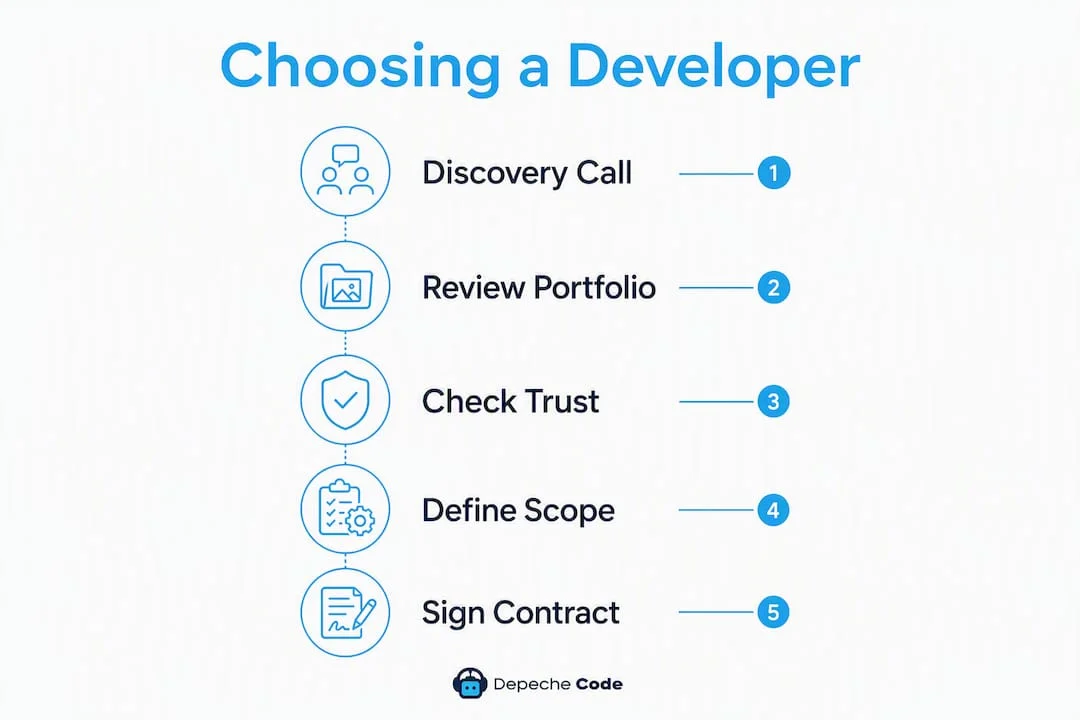
Use this framework to compare candidates without getting lost in sales pitches.
Selection criteria checklist:
- Technical fit: do they build in the CMS you’ll actually use (WordPress, Webflow, Shopify)?
- Industry experience: have they built sites for businesses like yours?
- Portfolio relevance: are their past projects in a similar complexity range?
- Communication: do they respond within one business day during the sales process?
- Post-launch support: is there a defined support plan, or does the relationship end at launch?
- Security practices: do they include SSL, regular backups, and plugin update management?
Questions to ask on the first call:
- Which CMS do you recommend for my business, and why?
- Where will my site be hosted, and what’s the uptime guarantee?
- How are backups handled, and how quickly can you restore a site?
- What’s your baseline SEO setup at launch (meta tags, schema, sitemap)?
- What page-speed score do you target, and how do you measure it?
- Who is my day-to-day contact during the project?
- What happens if I need changes after launch?
Pricing models and what they mean:
Fixed-price packages give you scope certainty but limit flexibility mid-project. Hourly rates offer flexibility but can increase if scope isn’t locked. Retainer models work well for ongoing SEO, content, or maintenance but require trust in the relationship first. Most small-business sites fall in a mid-to-high price range for a custom build; e-commerce and custom integrations push higher.
Red flags to walk away from:
- A scope document that lists deliverables in vague terms (“website pages as needed”)
- No references or case studies with measurable outcomes
- Outsourced development with no named team contact
- No staging environment before launch
- No written contract or unclear IP ownership terms
How do you evaluate portfolios and trust signals?
A polished portfolio page proves design taste. It doesn’t prove results. Here’s how to dig deeper.
What to look for in a portfolio:
- Industry match: have they built sites for businesses in your sector?
- Measurable outcomes: traffic growth, lead volume, or conversion rate improvements
- Before/after screenshots or case study write-ups
- Live sites you can actually visit, test on mobile, and run through Google PageSpeed Insights
Vetting reviews and references:
Directory listings on platforms like Thumbtack display review stars, hire counts, and responsiveness badges. Those signals matter, but check the dates. A developer with 40 reviews from three years ago and nothing recent may have changed teams or quality. Look for repeated praise around communication, meeting deadlines, and post-launch support, not just “great design.”
Verification checklist:
- Visit every live site in the portfolio and test the contact form
- Check the Google Maps listing for the agency: is the address real, and are reviews recent?
- Ask for two references you can call, and ask those references specifically about timeline adherence and what happened when something went wrong
Why do local SEO and hosting choices matter for your site?
A beautiful site that no one in your city can find is a missed opportunity. Local SEO and hosting decisions made at the start of a project are far easier to get right than to fix later.
Local SEO essentials to confirm with your developer:
- Google Business Profile setup and optimization
- NAP (name, address, phone) consistency across your site and citations
- Local schema markup on key pages
- Location pages or service-area pages targeting your city and surrounding areas
- A citation strategy covering directories like Yelp, Bing Places, and Apple Maps
Hosting considerations for U.S. businesses:
- U.S.-based hosting or a CDN with U.S. edge nodes keeps load times low for domestic visitors
- Confirm uptime guarantees (99.9% is the standard floor)
- Ask whether staging environments are included for testing updates before they go live
- SSL should be included, not an add-on
- Site speed benchmarks: aim for a Google PageSpeed score above 80 on mobile
Technical checklist for proposals:
- Who manages DNS records and domain renewal?
- How often are backups taken, and where are they stored?
- Who handles security patching for plugins and the CMS core?
- Is performance monitoring included, or is it reactive (you notice the problem first)?
Local SEO services are frequently offered alongside web development, and agencies that bundle both tend to produce better launch-day results for local businesses.
Pro Tip: For small businesses, managed WordPress hosting with automated daily backups and staged updates removes the single biggest post-launch headache. You get peace of mind without needing a developer on call.
How do you go from search to signed contract?
Follow these steps and you’ll have a signed agreement within two weeks of starting your search.
- Shortlist three to five candidates from Google Maps, Thumbtack, or referrals. Check each portfolio before reaching out.
- Schedule 15–30 minute discovery calls with each. Use the question list from the hiring checklist above.
- Request a written scope and estimate from your top two or three. A free estimate is standard practice among reputable local providers.
- Compare proposals on deliverables, timeline, payment schedule, revision limits, and post-launch support terms, not just price.
- Check references for your top choice. One call to a past client is worth more than an hour of sales conversation.
- Sign a contract that specifies deliverables, milestones, IP ownership, revision rounds, and what happens if the project stalls.
What to request in a written estimate:
- Full deliverable list with acceptance criteria
- Project timeline with milestone dates
- Payment schedule tied to milestones
- Number of revision rounds included
- Hosting and maintenance terms post-launch
Have these ready before your first meeting:
- Brand assets (logo files, brand colors, fonts)
- Goal metrics (what does success look like in 90 days?)
- Two or three example sites you admire
- Access to existing analytics if you have them
A typical small-business site moves from discovery to launch in 8–12 weeks when the client is responsive and assets arrive on time.
Why Depechecode is worth a call if you’re searching locally
Depechecode is a full-service digital agency with a strong presence in Orlando and regional service pages covering cities including Seattle and Milwaukee. The agency handles website design and development, WordPress builds, managed hosting, local SEO, AI chatbot integration, and mobile app development under one roof.
What sets Depechecode apart:
- A free website development option that reduces the upfront barrier for budget-conscious businesses
- Managed hosting with ongoing technical support built into service plans
- Local SEO expertise tied directly to the development process, not bolted on afterward
- AI chatbot integration for businesses that want automated lead capture from day one
- Consistent positive reviews citing responsiveness, professionalism, and on-time delivery
For a scoped estimate, contact Depechecode directly. Most estimates are turned around quickly after an initial discovery call.
Key Takeaways
Hiring a local web developer in 2026 comes down to three things: a clear written scope, verifiable proof of results, and a developer who handles design, hosting, and local SEO together.
| Point | Details |
|---|---|
| Start with a discovery call | Book a 15–30 minute call with shortlisted developers and bring goals, assets, and example sites. |
| Verify results, not just design | Ask for specific metrics from past projects: traffic growth, lead volume, or conversion improvements. |
| Expect several weeks to a few months to launch | Standard brochure sites take multiple weeks; e-commerce or custom builds can take longer. |
| Bundle services for best ROI | WordPress plus managed hosting plus local SEO at launch reduces long-term maintenance risk. |
| Depechecode as a local option | Depechecode offers free website development, managed hosting, and local SEO for U.S. businesses. |
What most business owners get wrong when hiring a web developer
The most common mistake isn’t choosing the wrong CMS or underestimating the budget. It’s treating the website as a one-time purchase instead of an ongoing business asset.
A site that launches without a local SEO foundation, a clear content update plan, and a defined maintenance owner will drift. Pages go stale. Plugins go unpatched. Google Business Profile data falls out of sync with the site. Within 18 months, the business is back to square one, shopping for a redesign.
The developers who actually move the needle for small businesses are the ones who ask about your lead-gen goals before they talk about design. They want to know what a conversion looks like on your site, what your current traffic is, and whether you have a Google Business Profile set up correctly. Those questions signal that the work is tied to outcomes, not just deliverables.
Budget conversations are where most projects go sideways. A $2,500 website sounds attractive until you realize it doesn’t include hosting, SEO setup, or post-launch support. Get every line item in writing. A developer who resists itemizing the scope is telling you something important about how they’ll handle scope creep later.
Depechecode handles the full picture, not just the build
Most local businesses don’t need a bigger website. They need a site that actually works: fast, mobile-ready, visible in local search, and connected to a lead-capture system that runs without constant attention.
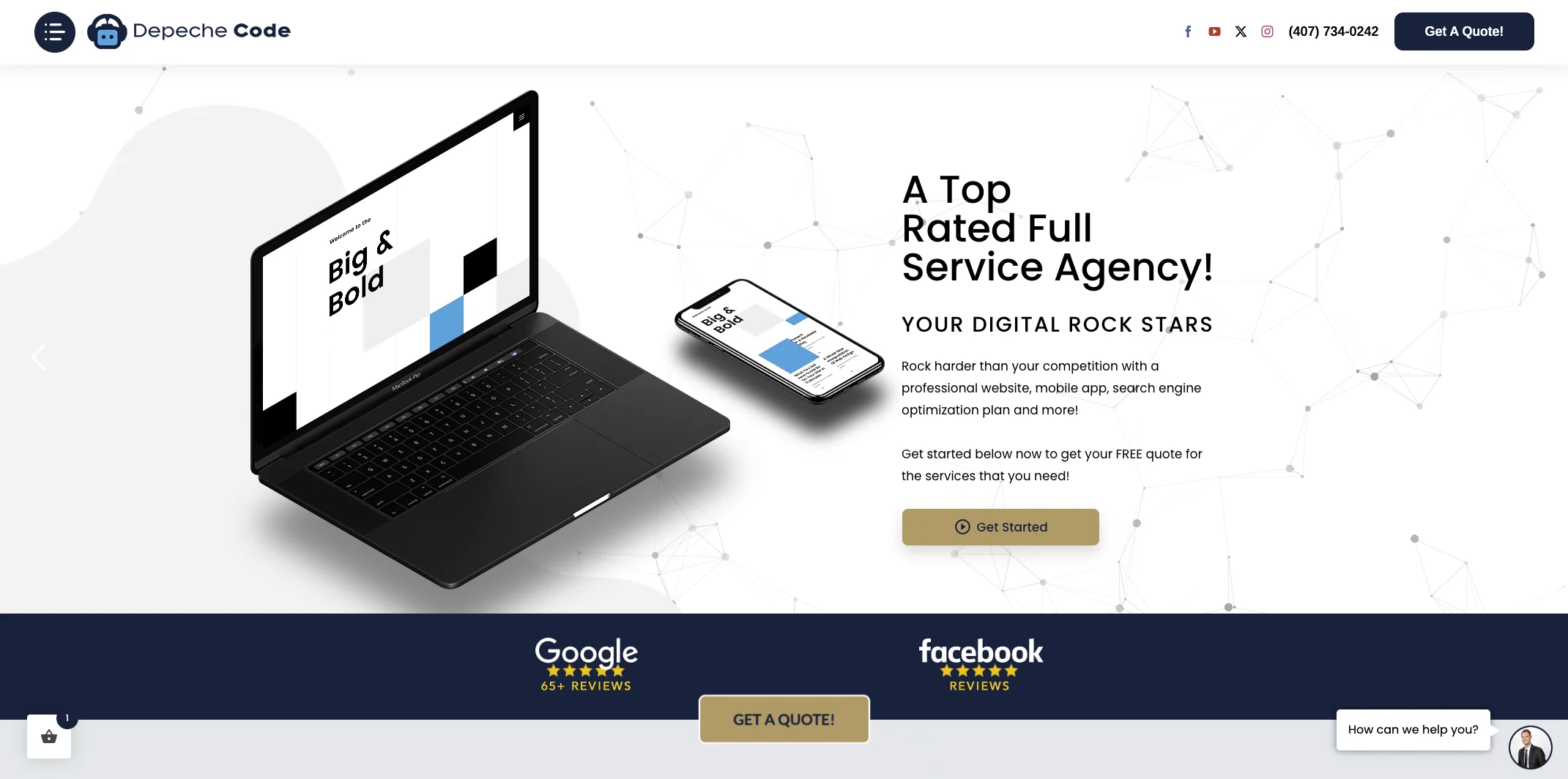
Depechecode delivers exactly that. The agency’s website design and development service covers custom design, WordPress builds, managed hosting, and local SEO in a single engagement. For businesses watching their budget, the free development option removes the upfront cost barrier entirely. Add AI chatbot integration or a social media management plan and you have a complete digital presence managed by one team.
Request a free consultation today. Depechecode’s team will scope your project, outline a realistic timeline, and return an estimate fast so you can make a decision without waiting weeks for a proposal.
Useful sources
- Depechecode Website Design & Development — Depechecode’s primary service page; request a consultation or quote directly.
- Depechecode Free Website Development — Details on the free development option for qualifying businesses.
- Thumbtack: Web Developers Near Me — Marketplace listings with reviews, hire counts, and free estimate offers for local providers.
- Thumbtack: WordPress Developers Near Me — Filtered listings for WordPress-specific developers with profile details and availability.
- Websites: A Federal Marketing Must — Partner article on why a professional website matters for government-facing and federal marketing businesses.
- Depechecode Chicago’s Best Website Developers — Example of Depechecode’s city-level developer coverage and local case studies.
FAQ
How much does it cost to hire a website developer?
Most small-business websites built by a professional agency or freelancer in the U.S. fall in a mid-to-high price range for a custom build; e-commerce and custom integrations push higher. Depechecode also offers a free development option for qualifying businesses.
How long does a typical website project take?
A standard brochure site takes 6–10 weeks from discovery to launch; e-commerce builds or sites with custom integrations typically add 4–6 weeks. Timelines shorten when the client delivers brand assets and feedback promptly.
What is the 3-second rule in website design?
The 3-second rule refers to the widely cited benchmark that visitors decide whether to stay or leave a site within roughly three seconds of landing. Fast load times, a clear headline, and an obvious next step are the three elements that most influence that snap judgment.
Is web design still worth it in 2026?
Yes. A professionally built site with local SEO, mobile optimization, and clear conversion paths consistently outperforms DIY builders for businesses that depend on local search traffic and lead generation. The gap between a well-built site and a template site has widened as Google’s ranking signals have grown more sophisticated.
Recommended
- Chicago’s Best Website Developers For 2024 • Depeche Code
- Top Website Development Trends Shaping Success For 2026
- Small Business Website Essentials: Top 10 For 2026
- Top 6 Buffalo Web Design Solutions 2026