

TL;DR:
- Full-service agencies like Depechecode manage website design, development, hosting, and ongoing support for business clients. They deliver measurable results and require clear scope, timeline, and handover procedures to ensure successful projects. Pricing varies based on project complexity, with maintenance and support included as ongoing services.
For business buyers, the best website builders for businesses aren’t software platforms you configure yourself. They’re full-service agencies that design, develop, host, and maintain your site — and hand you measurable results, not just a login. Depechecode is one such agency, built specifically for businesses that need a managed, scalable web presence with real SLAs and post-launch support.
Before your first discovery call, confirm three things:
- Must-have deliverables: source files, CMS admin access, documentation, and a post-launch bug-fix window
- Expected timeline: a several-week period depending on scope (more on that below)
- First question to ask: “Who is your nightmare client?” — the answer tells you more about working style than any portfolio
Table of Contents
- What do the best website development platforms actually deliver?
- How do you choose the right agency for your business website?
- What does an agency-built website cost, and how long does it take?
- What should you receive at project handover?
- What should ongoing maintenance and support include?
- How do you verify an agency’s claims before hiring?
- Key Takeaways
- What agencies wish you knew before signing
- Depechecode builds business websites that perform after launch
- FAQ
What do the best website development platforms actually deliver?
A full-service agency covers far more than design. The scope typically runs from initial discovery and strategy through UX design, front-end and back-end development, CMS setup, hosting infrastructure, and ongoing maintenance. Businesses should also expect must-have features like security practices, analytics configuration, and clear CMS user roles baked into the build, not bolted on later.
Beyond the core build, agencies handle third-party integrations — CRM connections, marketing automation, analytics platforms, and e-commerce layers. AI chatbot integration is increasingly standard, and mobile app development is available as an add-on when a project requires cross-platform reach.
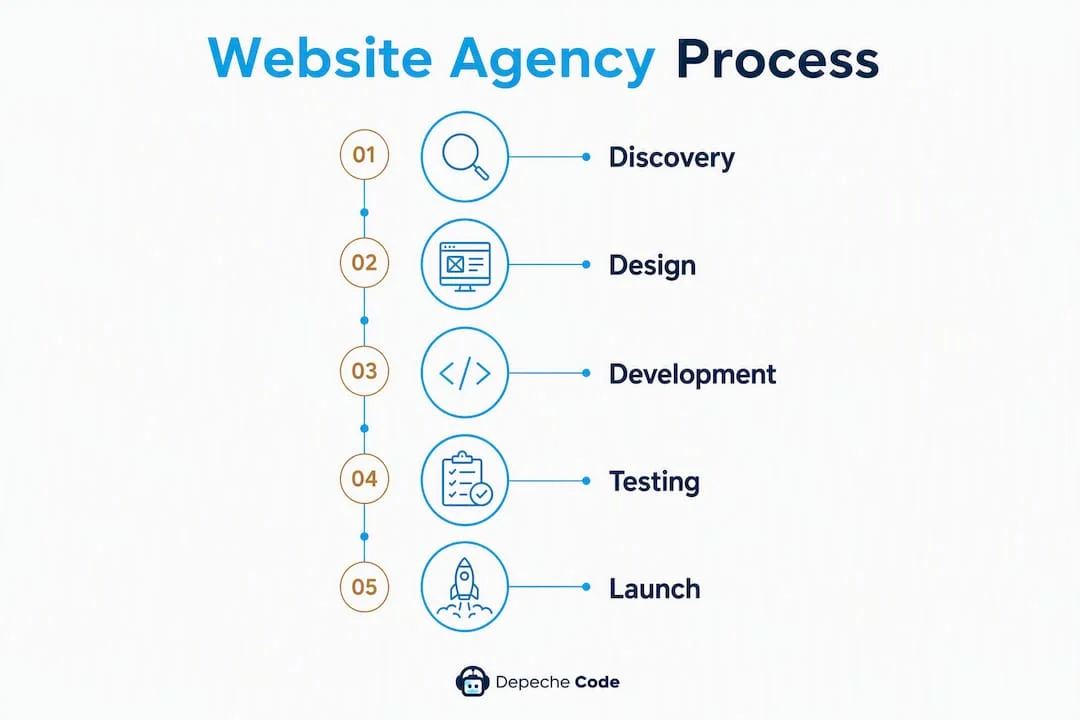
Responsibility boundaries matter here. The agency owns the code and infrastructure; you own the content. Third-party integrations (payment gateways, CRM APIs) require credentials and access from your side. A good agency documents these handoff points in the SOW before work begins, so neither party is guessing mid-project.
How do you choose the right agency for your business website?
Evaluation comes down to eight criteria: industry experience, full-stack capability (design through maintenance), documented processes, communication cadence, project management tooling, pricing model, SLA terms, and measurable outcomes. Forbes Communications Council recommends a curated set of 20 diagnostic questions — and the most revealing one is: “Who is your nightmare client?”
That question isn’t a trick. An agency that describes its nightmare client as someone who changes scope constantly, skips approvals, and disappears for weeks is telling you exactly what they need from you to succeed. It surfaces cultural fit faster than any portfolio review.
Other questions worth asking on a discovery call:
- “Can you show me a past project similar in scope and industry to mine?”
- “Who owns the source files and CMS access at project end?”
- “What is your change-control process when scope shifts mid-build?”
- “What does your SLA cover post-launch, and what’s the response window for critical issues?”
- “How do you handle security patching and backups?”
- “What analytics setup is included, and who configures it?”
HubSpot’s guidance on hiring developers reinforces asking for demonstrable experience on similar projects and asking how the agency measures success — not just what they built, but what happened after launch.
Red flags: vague answers on SLAs, a portfolio with no projects in your industry or of similar complexity, and no documented process for scope changes or content governance.
Pro Tip: Ask how the agency handles contingency. A team that builds a 10–15% cost buffer into estimates and names a single point of contact for approvals has done this before. One that doesn’t is setting you up for timeline slippage.
What does an agency-built website cost, and how long does it take?
Pricing shapes fall into four models: fixed project fee, phased billing, time-and-materials, and monthly retainers for ongoing support. Fixed fees work well for defined scopes; time-and-materials suits projects where requirements are still evolving. Retainers cover maintenance, SEO, and marketing after launch.

According to Vezert, corporate website projects typically ship in a multi-week timeframe, and AI-assisted workflows can accelerate phases like UX and QA. Portals and platforms with custom backends run longer.
| Project Type | Typical Timeline | Pricing Shape | Primary Cost Drivers |
|---|---|---|---|
| Marketing / brochure site | several weeks | Fixed project fee | Design complexity, content migration |
| Corporate site | several weeks | Fixed or phased billing | Custom integrations, CMS setup, SEO |
| E-commerce site | several weeks | Phased billing | Product catalog, payment gateway, UX |
| Portal / platform | extended timeline | Time-and-materials | Custom backend, user roles, APIs |
Example cost bands (not quotes — actual figures depend on scope): marketing sites often cost in the lower to mid-thousands; corporate sites with integrations typically cost more, with portal and platform projects higher still. Ongoing maintenance retainers vary based on SLA terms and scope.
A phased project plan — discovery, design, build, test, launch — reduces scope creep and keeps stakeholder communication centralized. Build a 10–15% contingency into your budget for unknowns.
What should you receive at project handover?
The handover is where agencies separate. Require every item below in your SOW before signing:
- Statement of work with acceptance criteria and a defined warranty period
- Source files and design assets (Figma files, layered PSDs, or equivalent)
- CMS admin accounts with documented user roles and permissions
- Hosting and control panel access with full credentials transfer
- Deployment instructions and rollback procedures
- Third-party integration credentials and API documentation
- Training sessions covering CMS editing, content updates, and basic admin tasks
- Bug-fix window of at least 30 days post-launch for defects found in QA
For the initial post-contract period, run through an onboarding checklist: confirm all accesses are live, complete analytics onboarding, agree on a content freeze window during QA, and set a weekly status cadence. Depechecode’s website development guidance covers these early-stage expectations in detail.
Insist on explicit code ownership language in the SOW. “Work for hire” clauses confirm you own the codebase outright — not just a license to use it.
What should ongoing maintenance and support include?
Post-launch support isn’t optional for a business site. Standard maintenance covers security patching, CMS and plugin updates, daily or weekly backups, uptime monitoring, incident response, performance monitoring, and scheduled optimization. SEO retainers and post-launch marketing are typically offered as add-ons and should be evaluated as part of the initial proposal, not as an afterthought.
SLA terms to consider:
- Response time for critical issues typically is within a few hours
- Resolution time for critical issues is expected within one to two days
- Uptime guarantee: very high availability
- Backup retention: maintained for a period suitable to your needs
- Escalation path: named contact and secondary escalation
Maintenance pricing usually runs as a monthly retainer. “Critical” work means site-down events, security breaches, and broken checkout flows. “Routine” work covers plugin updates, content edits, and performance tweaks. Know which bucket your SLA covers before you sign.
How do you verify an agency’s claims before hiring?
Case studies are only useful when they include measurable results: traffic lift, lead volume change, conversion rate improvement, and a clear timeline. Ask what the agency contributed versus what the client’s internal team handled. Reproducible patterns across multiple clients in similar industries carry more weight than one impressive outlier.
Reference-check questions worth asking past clients:
- Did the project ship on time and within budget?
- How did the agency handle scope changes?
- What was the communication cadence, and did it hold?
- Would you hire them again?
Trust signals to verify: published SLAs, team bios with named credentials, documented security practices, uptime guarantees, certifications or industry recognitions, and verified client reviews. An agency that publishes these openly is one that stands behind its work.
Key Takeaways
A full-service agency that delivers design, development, hosting, maintenance, and post-launch SEO is the right choice for business owners who need a managed, measurable web presence in 2026.
| Point | Details |
|---|---|
| Agency scope matters | Require design, development, hosting, maintenance, and analytics as a bundled offering. |
| Ask the hard questions | “Who is your nightmare client?” reveals working style faster than any portfolio review. |
| Budget with contingency | Build a 10–15% buffer into project estimates to absorb scope unknowns. |
| Require full handover | SOW, source files, CMS access, credentials, training, and a 30-day bug-fix window are non-negotiable. |
| Depechecode as a full-service option | Depechecode covers design, development, hosting, maintenance, SEO, and AI chatbot integration for business clients. |
What agencies wish you knew before signing
The most common procurement mistake isn’t choosing the wrong agency. It’s skipping discovery. Buyers who arrive with a fixed scope and a hard deadline, before any technical scoping has happened, almost always hit change orders within the first four weeks. Discovery isn’t overhead — it’s the phase that makes the fixed fee possible.
Content is the other underestimated variable. An agency can build a flawless CMS and hand it over on time, but if your team hasn’t prepared copy, images, and structured data, the launch slips. Assign a single internal stakeholder who owns content delivery and has sign-off authority. That one decision prevents more delays than any project management tool.
For the first 90 days, expect a tight feedback loop: weekly check-ins, versioned design approvals, and a documented sign-off at each phase gate. The agencies that deliver on time are the ones that enforce this cadence, not the ones that let revisions accumulate.
Depechecode builds business websites that perform after launch
Depechecode is a full-service digital agency based in Orlando, and for business owners who need a custom site built, hosted, and maintained without managing three separate vendors, it’s a direct answer to that problem. The agency covers the full stack: custom design, front-end and back-end development, WordPress hosting and maintenance, SEO, AI chatbot integration, and social media management — all under one contract.
What a starter engagement typically includes: discovery and strategy session, custom UX and visual design, CMS setup with training, hosting and infrastructure, a 30-day post-launch support window, and analytics configuration. Post-launch, SEO retainers and social media management are available to keep the site generating leads.
Ready to scope your project? Request a quote or book a discovery call with Depechecode and get a clear proposal before you commit to anything.
FAQ
What does a professional website agency actually build for a business?
A full-service agency delivers custom design, front-end and back-end development, CMS setup, hosting, and ongoing maintenance — plus optional SEO, AI chatbot integration, and marketing support.
How long does it take to build a business website with an agency?
Corporate sites typically ship in a several-week timeframe; AI-assisted workflows can accelerate phases like UX and QA. Portals and platforms with custom backends run longer.
What questions should I ask a web development agency before hiring?
Ask who owns the source files, how they handle scope changes, what their SLA covers post-launch, and — per Forbes Communications Council guidance — “Who is your nightmare client?”
How much does an agency-built business website cost?
Marketing sites often cost in the lower to mid-thousands; corporate sites with integrations typically cost more, with portal and platform projects higher still. Ongoing maintenance retainers vary based on SLA terms and scope.
Does Depechecode handle hosting and maintenance after launch?
Yes. Depechecode offers WordPress hosting, maintenance, security patching, and post-launch support as part of its full-service offering for business clients.