

To win voice queries, prioritize fast-loading, HTTPS-secured pages with concise question-and-answer content, a fully optimized Google Business Profile, and structured data where it fits. Backlinko’s analysis of 10,000 voice searches found that the average voice answer is concise, typically around a few dozen words, roughly 40.7% of voice answers come from featured snippets, and a large majority of voice-result pages use HTTPS. Those three facts alone tell you where to spend your first hour.
Immediate actions to take this week:
- Confirm your site runs on HTTPS (no exceptions)
- Run your key pages through PageSpeed Insights and target a load time under the average load time for voice-result pages
- Add a FAQ section to your top landing pages with 29-word direct answers
- Claim and fully complete your Google Business Profile, including hours, services, and photos
- Use AnswerThePublic to pull conversational question queries in your niche
- Add FAQ schema markup to pages that already answer common questions
Key Takeaways
Winning voice search comes down to three things done consistently: fast, secure pages; concise question-and-answer content; and an accurate, complete Google Business Profile.
| Point | Details |
|---|---|
| HTTPS is the entry ticket | Roughly 70.4% of voice-result pages use HTTPS; pages without it rarely appear in voice answers. |
| 29-word answers win snippets | Write a direct answer around 29 words immediately below each question heading to target featured snippets. |
| Speed is a ranking filter | Voice-result pages load in about 4.6 seconds on average; use PageSpeed Insights to close the gap. |
| GBP accuracy drives local voice | Keep hours, services, and descriptions current on Google Business Profile to capture local voice queries. |
| Depechecode covers the full stack | Depechecode handles technical fixes, content builds, schema, and GBP optimization as a managed SEO service. |
Table of Contents
- What is voice search and why does it matter for your business?
- How do you optimize for voice search? The core tactics
- How do you find the exact voice queries your customers use?
- A prioritized implementation checklist for your team
- How do you measure voice search performance?
- How Depechecode approaches voice search for clients
- How does site search optimization connect to voice search?
- The long game on voice: a perspective worth considering
- Depechecode can handle your voice search implementation
- Sources
- FAQ
What is voice search and why does it matter for your business?
Voice search is what happens when someone speaks a query to Google Assistant, Siri, Alexa, or a car’s built-in assistant instead of typing it. The query lands differently: typed searches tend to be short and fragmented (“best pizza Orlando”), while spoken ones are full sentences (“Hey Google, what’s the best pizza place near me open right now?”). That shift in phrasing changes everything about how you need to write and structure content.
The device spread matters too. Voice queries come from smartphones during a commute, smart speakers in the kitchen, in-car systems at a stoplight, and wearables on a run. Each context carries a different intent, but local discovery, quick how-tos, and product availability questions dominate across all of them. A user asking their phone “Is [your business] open on Sunday?” expects an instant, spoken answer, not a link to click.
Statista tracks ongoing adoption data showing consistent growth in both smart speaker shipments and U.S. voice assistant usage, which signals that the audience for voice-delivered answers is not shrinking. For businesses, the commercial intent behind many voice queries (“near me,” “open now,” “how much does X cost”) makes this channel worth treating as a first-class SEO priority, not an afterthought.
| Voice query type | Example | Primary device | Business opportunity |
|---|---|---|---|
| Local discovery | “Find a plumber near me” | Smartphone / smart speaker | Google Business Profile visibility |
| How-to / informational | “How do I unclog a drain?” | Smart speaker / phone | Featured snippet capture |
| Product / service info | “What does a website redesign cost?” | Smartphone | FAQ content and schema |
| Transactional | “Order flowers for delivery today” | Phone / smart speaker | Local pack + fast checkout |
How do you optimize for voice search? The core tactics
A 2024 machine-learning study published in Springer’s Artificial Intelligence Review tested voice-specific ranking features across 2,960 pages and ran a four-month longitudinal experiment on a live blog. The result: optimizing a defined feature set (speed, snippet formatting, schema signals, and question-word content) produced measurable ranking improvement. That is the closest thing to a controlled experiment the field has, and it validates the checklist below.
Conversational keywords and question phrases
Stop writing for how people type. Write for how they talk. Instead of targeting “voice search tips,” target “how do I optimize my website for voice search?” Tools like AnswerThePublic and AlsoAsked surface these natural question variants automatically. Drop them into H2 headings, FAQ blocks, and the opening sentence of answer paragraphs.
A simple template: “[Question phrase]? [Direct 29-word answer]. [One supporting sentence with a concrete detail or example].” That structure gives Google exactly what it needs to pull a featured snippet.
Featured snippets: your fastest path to voice answers
About two-fifths of voice answers come from featured snippets, which means winning position zero on desktop is often the same move as winning a voice answer. Format matters: a direct one-sentence answer immediately below the question heading, followed by a short bulleted list or numbered steps, is the pattern Google extracts most reliably.
Pro Tip: Write your answer first, then your explanation. Most writers do it backwards and bury the direct answer three paragraphs in, where Google cannot easily extract it.
Technical SEO: speed, mobile, and HTTPS
Voice-result pages load in about 4.6 seconds on average, compared to 8.8 seconds for the typical page. TTFB (time to first byte) for voice results averages around 0.54 seconds. Those are not aspirational benchmarks; they are the floor. Run PageSpeed Insights on your top five pages and fix whatever it flags first: image compression, render-blocking scripts, and server response time are the usual culprits. Pair that with mobile SEO best practices since the majority of voice queries happen on smartphones.
HTTPS is non-negotiable. Pages without it have near-zero chance of appearing in voice results. Check your SSL certificate, fix mixed-content warnings, and confirm redirects from HTTP to HTTPS are working correctly.
Structured data and speakable markup
Schema appears on around one-third of voice-result pages, but the same analysis found domain-level authority (relatively high) outweighs page-level schema as a ranking signal. That means schema is a supporting factor, not a silver bullet. Use LocalBusiness schema to reinforce your NAP (name, address, phone), FAQPage schema on pages with Q&A content, and Speakable markup on pages where you want Google Assistant to read specific passages aloud. Do not add schema to every page indiscriminately; prioritize pages that already rank in the top three for relevant queries.
Local SEO and Google Business Profile
Most commercial voice queries have local intent. Keeping your Google Business Profile accurate — hours, service descriptions, the “products and services” section, and recent photos — directly influences what voice assistants say when someone asks about your business. Respond to reviews, use local keywords in your business description, and make sure your address and phone number match exactly across every directory listing. “Near me” phrasing in your on-page content also reinforces local relevance signals.
Voice assistant platforms: Google, Alexa, and Siri
Google Assistant pulls answers from Google Search, so standard SEO work covers most of your exposure there. Alexa draws from Bing for general queries and from its own Alexa Skills store for app-like interactions. Siri uses a mix of Bing, Apple Maps, and Yelp for local results. For most businesses, the highest-leverage move is dominating Google’s featured snippet and local pack, which covers Google Assistant and partially covers Siri. Building a dedicated Alexa Skill makes sense only if your business has a repeatable, high-frequency interaction (a daily special, a booking flow, a FAQ) that users would genuinely invoke by voice.
Use Semrush’s Keyword Magic Tool to filter for question-based queries and check which ones already trigger featured snippets in Google Search. Those are your highest-priority targets.
How do you find the exact voice queries your customers use?
The goal is a list of conversational queries your customers actually speak, not the shorter typed variants you might assume they use. Here is a repeatable workflow:
- Start with a seed topic. Pick one service or product category (example: “website redesign for small businesses”).
- Generate question variants. Enter the seed into AnswerThePublic and AlsoAsked. Both tools map question phrasing by intent type (who, what, when, where, why, how). Export the full list.
- Filter for conversational phrasing. Keep questions that sound like something a person would say aloud. Drop anything that reads like a typed fragment.
- Validate with Google Search Console. In GSC, filter your query report by questions (queries containing “how,” “what,” “where,” “best,” “near me”). These are queries your site already appears for in some form.
- Check for featured snippet opportunities. Search each priority question in Google. If a featured snippet already exists, study its format and length. If none exists, that is an opening.
- Prioritize by intent. Commercial-intent questions (“how much does X cost,” “best X near me”) rank above purely informational ones for business impact.
Worked example: Seed topic is “AI chatbot for customer service.” AnswerThePublic returns “how does an AI chatbot work for customer service?” and “what is the best AI chatbot for small businesses?” GSC shows the second query already drives impressions. A Google search reveals no featured snippet. You write a 29-word direct answer at the top of a new FAQ section, add FAQPage schema, and target that page for a top-three desktop ranking. That is the full loop.
Pro Tip: AlsoAsked shows how questions branch from each other, which reveals the follow-up queries users ask after the first one. Those follow-up questions are often less competitive and easier to win quickly.
Tools summary for this workflow:
- AnswerThePublic for broad question mapping
- AlsoAsked for branching follow-up queries
- Semrush Keyword Magic Tool (filter: questions) for volume and difficulty data
- Google Search Console for real query data from your own site
- Google Search (manual) for featured snippet gap analysis
A prioritized implementation checklist for your team
Turn the tactics above into a schedule. The table below maps each action to a priority level, an owner, and a realistic time frame.
| Action | Priority | Owner | Duration |
|---|---|---|---|
| Confirm HTTPS and fix mixed-content errors | Critical | Developer | Week 1 |
| Run PageSpeed Insights; fix top 3 issues | Critical | Developer | Week 1–2 |
| Claim and fully complete Google Business Profile | Critical | Marketing | Week 1 |
| Add FAQ sections with 29-word answers to top 5 pages | High | Content | Week 2–3 |
| Add FAQPage and LocalBusiness schema | High | Developer | Week 3–4 |
| Research conversational queries (workflow above) | High | SEO / Marketing | Week 2–3 |
| Rewrite H2 headings as question phrases | Medium | Content | Week 3–5 |
| Add Speakable markup to priority pages | Medium | Developer | Week 4–6 |
| Build or update local landing pages with “near me” phrasing | Medium | Content | Week 5–7 |
| Evaluate Alexa Skill or Google Action need | Low | Strategy | Week 7–8 |
Quick wins (Weeks 1–2) are almost entirely technical and local: HTTPS, speed, and GBP. Content builds follow in Weeks 2–5. Voice-specific features like Speakable markup and voice app development are the last layer, and only worth the investment once the foundation is solid.
For teams handing this to an agency, the critical and high-priority rows are the audit deliverables to request in week one. Preserving these gains during any future site redesign requires documenting schema, redirect maps, and GBP connections before any migration begins.
How do you measure voice search performance?
Voice search does not have a dedicated report in Google Search Console. You measure it indirectly, through signals that correlate with voice traffic, and you interpret trends over 4–12 weeks per change.
KPIs to track:
- Featured snippet impressions and clicks (GSC Performance report, filter by “Search type: Web,” look for queries where your site appears at position 1 with a snippet)
- Conversational query impressions (GSC query filter: contains “how,” “what,” “where,” “best,” “near me”)
- Organic clicks from mobile (GSC filter by device: mobile)
- Local pack impressions (Google Business Profile Insights, “how customers find you” section)
- Core Web Vitals scores (PageSpeed Insights and GSC Core Web Vitals report)
Measurement workflow:
- Baseline all five KPIs before making changes.
- Implement one batch of changes (e.g., FAQ sections + schema on five pages).
- Wait four weeks minimum before evaluating movement.
- Compare featured snippet wins and conversational query impressions to baseline.
- Adjust content or technical fixes based on what moved and what did not.
- Repeat the cycle for the next batch.
Semrush’s rank tracking lets you monitor specific question-phrase keywords over time, which gives you a cleaner signal than GSC alone for tracking progress on targeted voice queries. Set up a project for your top 10–15 priority questions and check it monthly.
Realistic expectations: featured snippet wins can appear in as little as two weeks for low-competition queries. Local pack improvements from GBP updates often show within three to four weeks. Technical speed improvements register in Core Web Vitals reports within about 28 days of Google’s field data refresh cycle.
How Depechecode approaches voice search for clients
Depechecode’s workflow for voice search follows a four-phase loop that keeps work prioritized and measurable.
Phase 1 — Discovery audit:
- Crawl the site for HTTPS issues, page speed failures, and missing schema
- Pull GSC data to identify existing question-query impressions
- Audit Google Business Profile completeness
- Map the top 10 conversational queries the business should own
Phase 2 — Technical remediation:
- Fix HTTPS, compress images, eliminate render-blocking resources
- Implement LocalBusiness and FAQPage schema on priority pages
- Confirm mobile-first design across all key templates
Phase 3 — Content builds:
- Write FAQ sections with 29-word answer blocks for each priority query
- Rewrite H2 headings as question phrases
- Build or update local landing pages with “near me” and city-specific phrasing
- Add Speakable markup where Google Assistant read-aloud is a realistic use case
Phase 4 — Measurement loop:
- Set baseline KPIs (featured snippet impressions, conversational query clicks, local pack impressions)
- Track monthly with GSC, GBP Insights, and Semrush
- Report findings at 4-week and 12-week marks; adjust content or technical fixes accordingly
Pro Tip: When handing off voice search work to a developer, include a schema checklist with exact JSON-LD templates for each page type. Developers implement schema faster and more accurately when they have a copy-paste starting point rather than a general instruction.
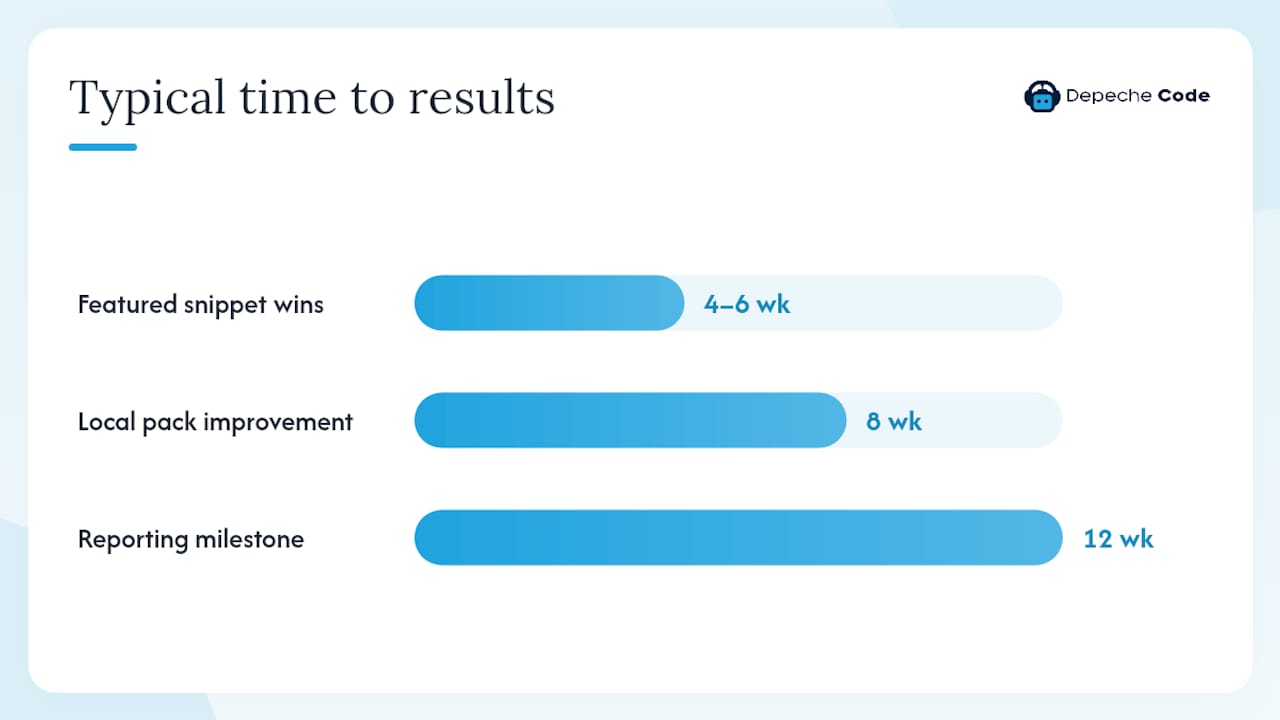
A typical client starting from scratch on voice optimization, with a solid existing domain authority, tends to see featured snippet wins on low-competition question queries within four to six weeks and measurable local pack improvement within eight weeks. The AI chatbot and conversational SEO strategies Depechecode integrates alongside voice work also reinforce on-site engagement signals that support broader ranking improvements.
How does site search optimization connect to voice search?
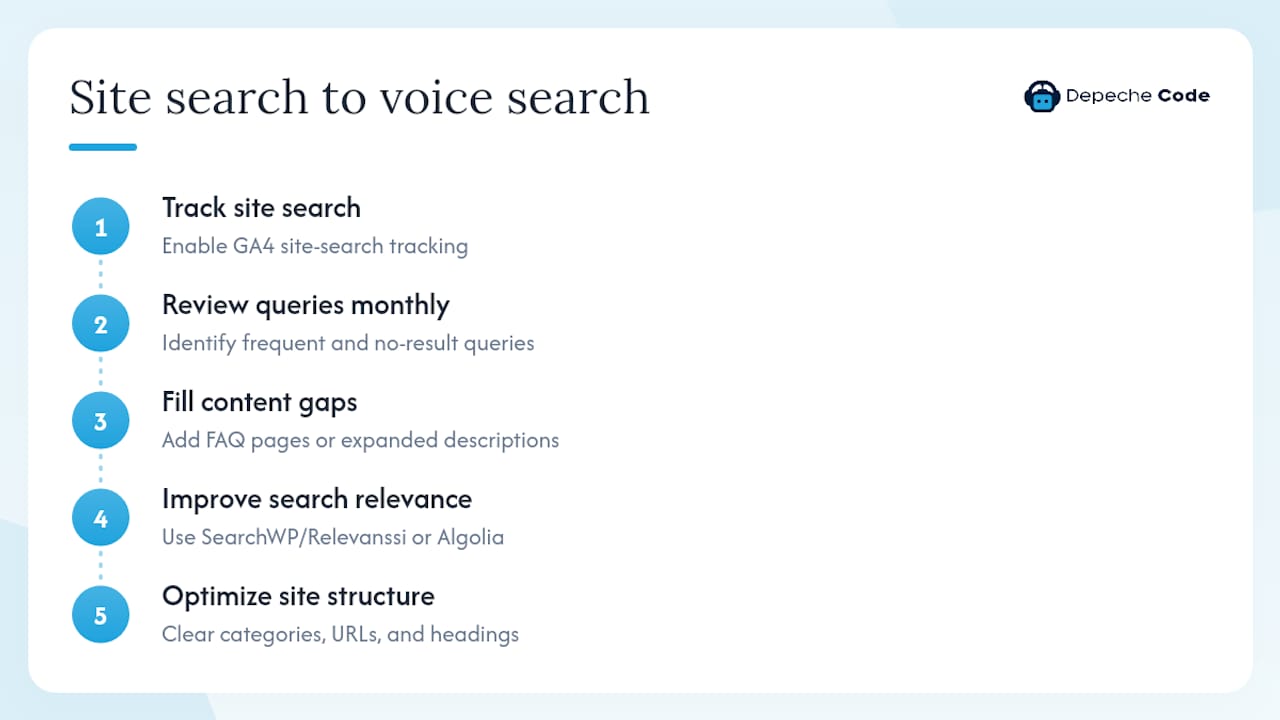
On-site search is the internal engine that lets visitors find content within your website, and it connects to voice search in a direct way: the queries people type into your site’s search bar are often the same conversational phrases they speak to a voice assistant. Mining that data is one of the most underused tactics in voice search research.
Enable Google Analytics 4’s site search tracking (or your platform’s equivalent) and review the query report monthly. Queries that appear frequently but return poor results, or no results, are gaps in your content. Fill those gaps with FAQ-style pages or expanded service descriptions, and you address both on-site search failures and voice query opportunities simultaneously.
Beyond content, the technical quality of your site search matters. A fast, accurate internal search that surfaces relevant results keeps users on the page longer, which sends positive engagement signals to Google. If your site runs on WordPress, plugins like SearchWP or Relevanssi improve result relevance significantly over the default search. For larger sites, Algolia provides enterprise-grade search with natural language processing that handles conversational phrasing the way a voice assistant would parse it.
The connection to voice assistant optimization runs deeper than content overlap. When Google indexes your site, it evaluates whether your content clearly answers the questions users ask. A well-structured internal search architecture, with clear category pages, descriptive URLs, and consistent heading hierarchies, makes it easier for Google’s crawlers to map your content to specific query intents. That same clarity is what gets a page selected as a voice answer.
The long game on voice: a perspective worth considering
Most businesses treat voice search as a separate channel to “set up” and then forget. That framing misses the point. Voice is the surface where all your other SEO work either pays off or falls flat. A page that loads slowly, answers questions vaguely, and has an incomplete Google Business Profile will fail on voice for the same reasons it underperforms on desktop search. The channel is different; the underlying quality requirements are identical.
What I find genuinely underappreciated is the multi-device consistency angle. A user might ask Google Assistant on their phone about your business, then follow up on a smart speaker at home, then check your site on a laptop. If your GBP hours differ from your website footer, or your FAQ answers contradict each other across pages, that inconsistency erodes trust at exactly the moment the user is closest to a decision. Voice just makes those inconsistencies more visible because the answer is read aloud with no visual context to soften the confusion.
There is also an accessibility dimension that rarely gets mentioned in SEO discussions. Optimizing for voice, specifically writing at a 9th-grade reading level, using clear question-and-answer structures, and keeping answers concise, makes your content more accessible to users with cognitive disabilities, low literacy, and non-native English speakers. That is a real benefit that extends well beyond search rankings.
Depechecode can handle your voice search implementation
Getting voice search right means fixing technical issues, rewriting content, updating schema, and keeping your Google Business Profile current — all at once, on a schedule that produces results before the next algorithm update reshuffles the deck.
Depechecode is a full-service digital agency based in Orlando that handles every layer of this work: website design and development for the technical foundation, and SEO plans that include voice-specific content builds, schema implementation, and GBP optimization. An initial audit covers your current HTTPS status, PageSpeed scores, featured snippet gaps, and GBP completeness, and produces a prioritized action list your team can act on immediately. For businesses that want local voice visibility specifically, Depechecode’s local SEO services target the “near me” and city-specific queries that drive foot traffic and phone calls. Schedule a consultation at Depechecode to get your audit started.
Sources
- Voice Search SEO Study: Results From 10k Voice Searches
- Exploring the impact of SEO-based ranking factors for voice queries through machine learning | Artificial Intelligence Review | Springer Nature Link
- Voice Search SEO: 8 Practical Tips For Businesses
- Study: 11 voice search ranking factors analyzed
FAQ
What is voice search optimization?
Voice search optimization is the process of structuring your website content, technical setup, and local signals so that voice assistants like Google Assistant, Siri, and Alexa select your pages as spoken answers. It centers on fast-loading HTTPS pages, concise Q&A content, and accurate local business data.
What is voice recognition in SEO?
In SEO, voice recognition refers to how voice assistants interpret spoken queries and match them to web content. Because spoken queries are longer and more conversational than typed ones, SEO for voice requires targeting question-phrase keywords and formatting answers in short, direct blocks that search engines can extract and read aloud.
Is voice search the future of SEO?
Voice search is an established and growing channel, not a future trend. With smart speakers, in-car systems, and smartphone assistants already handling billions of queries, the businesses that optimize for conversational queries and featured snippets now hold a measurable advantage over those that do not.