

Technical SEO audit cost ranges from free automated reports to $30,000+ enterprise engagements, with most businesses paying $500 to $7,500 for a proper audit with strategy attached. The decision rule matters more than the number: pick the quote with an itemized, prioritized, developer-ready roadmap over the cheapest option on the table, because a low price usually means a raw crawl export instead of an actual analysis.
TL;DR:
- Automated tool reports cost between $49 and $99 and provide basic site health checks, but lack prioritization or actionable insights.
- Freelancers charge $1,200 to $3,500 for small sites under 1,000 pages, offering prioritized fixes and a full report, providing good value for SEO expertise.
- Mid-sized site audits from agencies typically range from $2,000 to $7,500, giving detailed analysis, project management, and specialized workstreams.
- Large enterprise audits exceeding $10,000 focus on log file analysis, JavaScript rendering, and multi-domain SEO for sites over 10,000 pages or with international requirements.
- The true cost includes post-audit implementation, which often doubles or triples the initial expense, emphasizing the importance of clear, actionable fix lists.
Table of Contents
- What Does a Technical SEO Audit Cost by Provider Type?
- What’s Actually Included in a Comprehensive Audit?
- What Factors Push the Price Up or Down?
- How Long Does an Audit Take and What Comes After?
- How Do You Compare Competing Audit Quotes?
- How Does Depechecode Scope and Price Technical Audits?
- The Real Cost Question Isn’t the Number on the Invoice
- Get an Audit That Comes With a Fix List, Not Just a Diagnosis
- Sources
- FAQ
What Does a Technical SEO Audit Cost by Provider Type?
Price bands in technical SEO audit pricing break down cleanly by who is doing the work and how much interpretation goes into it. A free crawler export tells you almost nothing about priority. A $6,000 agency engagement tells you exactly what to fix first and how long it will take a developer to do it.
At the bottom sit automated tool reports. Platforms like Screaming Frog, Sitebulb, or various cloud crawlers can spit out a technical health report for $49 to $99 as a one-time fee, sometimes free with a trial account. These reports flag broken links, missing meta tags, and duplicate content. They do not tell you which of those 400 issues to fix first, whether your JavaScript framework is hiding content from Googlebot, or how your crawl budget is being wasted on faceted navigation. Treat this band as a starting point, not a deliverable you can hand to a developer.
Freelancers and boutique consultants occupy the next tier. A senior freelance SEO working solo on a site under 1,000 URLs commonly charges $1,200 to $3,500 for a full audit with a written report and prioritized fixes. This is where most small businesses land, and it’s often the best value tier because you’re paying directly for expertise rather than agency overhead.
Full-service agencies charge more for comparable scope, generally landing in the $2,000 to $7,500 range for mid-sized sites. Some of that premium buys real value: project management, quality control, access to a broader toolset, and often a specialist for each workstream (crawl analysis, Core Web Vitals, structured data). Some of it just pays for the sales deck and the kickoff call. Agencies frequently charge two to five times more than a freelancer for the same technical scope, largely because of internal coordination costs rather than deeper analysis.
Enterprise audits for sites with 10,000 or more indexed pages, multiple subdomains, or international hreflang requirements routinely exceed $10,000 and can climb past $30,000. At that scale you’re not paying for a bigger version of the same report. You’re paying for log file analysis across months of server data, JavaScript rendering audits across multiple templates, and a team that can coordinate with your in-house developers, not just hand you a PDF.
| Provider type | Typical cost | Best fit |
|---|---|---|
| Automated tool export | $0 to $99 | DIY diagnostic, not a strategy document |
| Freelancer / solo consultant | $500 to $3,500 | Sites under 1,000 pages, tight budgets |
| Full-service agency | $2,000 to $7,500 | Mid-market sites, 1,000 to 10,000 pages |
| Enterprise engagement | $5,000 to $30,000+ | 10,000+ pages, multi-domain, international SEO |
A quick way to sanity-check where you should land: a 100-page brochure site rarely justifies more than a freelancer-tier audit. A 1,000-page ecommerce catalog with faceted filtering starts pushing into agency territory because of the crawl budget analysis alone. A 10,000-page site with a headless CMS and three language versions is an enterprise problem no matter who you hire, because the JavaScript rendering checks and hreflang validation take real hours regardless of provider size.
The gap between a $79 tool export and a $4,000 agency audit isn’t really about data collection. Both processes usually crawl the same site with similar software. The difference is interpretation: someone deciding that your 404 pages matter less than your canonical tag conflicts, and telling your developer exactly which template file to fix first.
What’s Actually Included in a Comprehensive Audit?
A real technical SEO audit produces a document you can hand to a developer and start working from the same day, not a spreadsheet of raw errors. If your quote doesn’t specify these components, you’re likely buying a tool export with a cover letter.
Crawl configuration and results come first. This means a full site crawl, using something like Screaming Frog or Sitebulb, configured to render JavaScript, respect (or deliberately ignore) robots.txt, and simulate both desktop and mobile bots. The output should show exactly which URLs got crawled, which got blocked, and why.

Indexing and canonicalization analysis follows. This checks whether Google is indexing the pages you want indexed, whether canonical tags point where they should, and whether you have duplicate content bleeding link equity across near-identical URLs. This is often where the biggest wins hide, since misconfigured canonicals can silently suppress an entire product category from search.
Core Web Vitals gets both a field data pull (from the Chrome User Experience Report) and lab testing (via Lighthouse or WebPageTest), because the two data sets frequently disagree and both matter. JavaScript rendering checks confirm what Googlebot actually sees when your React or Vue app loads content client-side. Structured data validation catches schema markup errors that quietly cost you rich snippets in the search results.
Larger audits add server log file analysis, which reveals how Googlebot is actually spending its crawl budget on your domain rather than how you assume it is. This single deliverable often separates a $1,500 audit from a $5,000 one, since it requires raw server access and hours of pattern analysis that no automated tool provides out of the box.
Every legitimate audit should end with:
- A prioritized fix list ranked by impact, usually labeled P0 (critical), P1 (high), and P2 (medium)
- Estimated developer hours per fix, so you can budget implementation realistically
- A walkthrough call to explain findings, not just a PDF dropped in your inbox
- Screenshots or annotated examples for each issue category, not generic descriptions
Search visibility itself carries real financial weight here. Data from a widely cited Search Engine Watch study found the top organic result captures roughly a third of all search clicks for a given query, which is exactly why technical fixes that move you from position 8 to position 2 justify spending real money on diagnosis.
Pro Tip: Ask any vendor to show you a sample fix list from a past audit, redacted for client confidentiality. If every item reads like “improve page speed” with no specific URL, template, or estimated hours attached, that’s not a deliverable. That’s a summary.
What Factors Push the Price Up or Down?
Six variables explain almost all of the spread between a $600 audit and a $12,000 one. Understanding them lets you anticipate your own band before a single vendor call.
- Page and URL count. A 200-page site crawls in minutes. A 50,000-page ecommerce catalog with faceted navigation can generate millions of crawlable URL combinations, and someone has to configure the crawler to sample intelligently rather than choke on infinite filter permutations.
- JavaScript framework and rendering complexity. Server-side rendered (SSR) sites are relatively straightforward to audit. Client-side rendered (CSR) React or Angular apps require rendering simulation to see what Googlebot actually indexes, which adds hours and specialized tooling. Headless CMS setups sit somewhere in between depending on how they hydrate content.
- Multi-domain, multi-language, or hreflang requirements. Every additional country or language version multiplies the canonical and hreflang validation work. A single-market English site is a fraction of the effort of a five-market operation with regional subdomains.
- Log file access and analytics availability. If you can hand over raw server logs and Google Search Console access on day one, the audit moves faster and costs less. If a vendor has to request access from your hosting provider and wait a week, that delay and friction shows up in the invoice.
- Delivery speed and reporting format. A rushed 48-hour turnaround costs more than a standard two-week timeline, the same way any professional service charges a premium for expedited work. A polished, branded report with executive summaries also takes longer to produce than a working document.
- Whether implementation is bundled in. Audit-only engagements price differently than audit-plus-fix packages, and vendors sometimes bury the implementation cost inside a vague “ongoing support” line item instead of breaking it out clearly, which is exactly what pricing guides for technical SEO audits tend to flag as the biggest source of budget confusion.
Faceted navigation deserves a special mention. Ecommerce filters (size, color, price range) can each generate a unique crawlable URL, and Googlebot will waste crawl budget on thousands of near-duplicate filter combinations if nobody’s configured proper faceted navigation rules. Auditing this properly takes real time, and it’s one of the most common reasons a “simple” ecommerce site audit costs more than a business owner expects.
How Long Does an Audit Take and What Comes After?
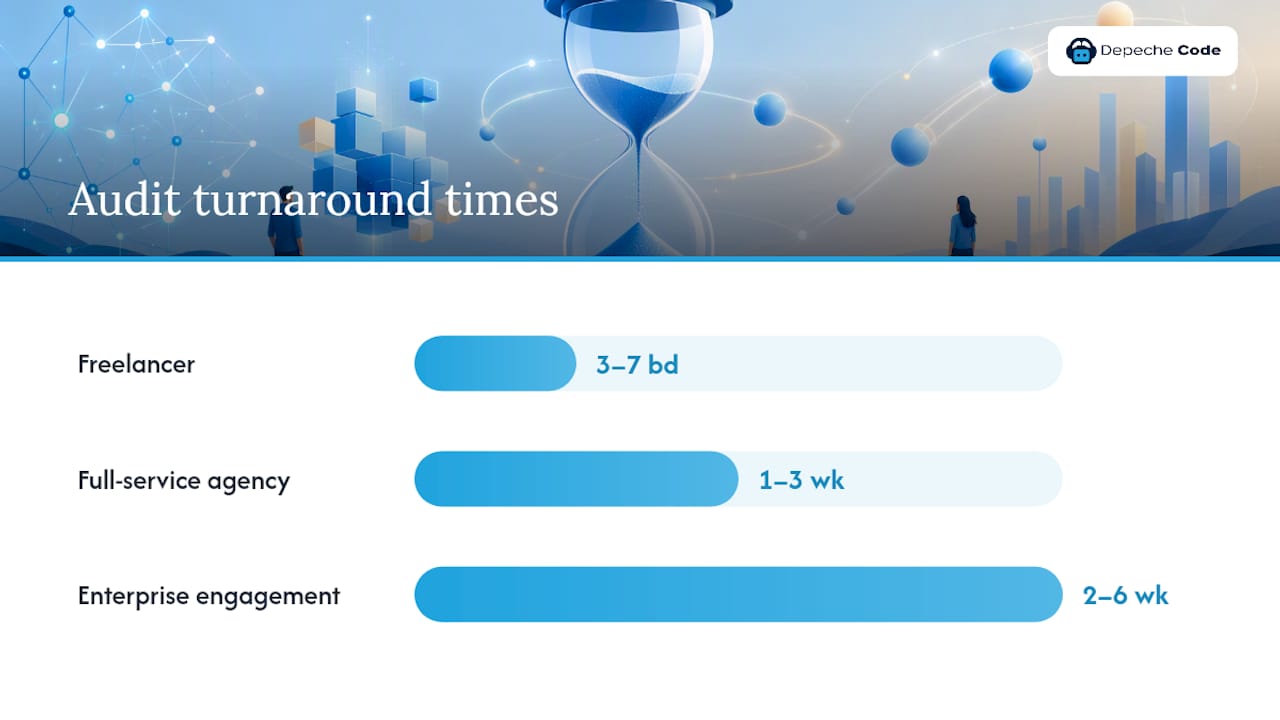
Turnaround scales with the same complexity factors that drive price. A freelancer auditing a sub-1,000-page site typically delivers in three to seven business days. A full-service agency handling a mid-market site usually needs one to three weeks to account for internal review and quality control. Enterprise engagements involving log file analysis, multiple markets, or JavaScript rendering across dozens of templates commonly run two to six weeks.
The audit fee is only the first invoice. Budget separately for what happens after the report lands, because most quotes only cover diagnosis, not the fix.
- Set aside roughly 1.5 to 2 times the audit cost for implementing P0 and P1 fixes in year one, a rule of thumb echoed across technical SEO pricing guides because remediation almost always takes longer than the diagnosis itself.
- Plan for a verification follow-up, typically priced at 15 to 25% of the original audit fee, to confirm fixes actually resolved the issues and didn’t introduce new ones.
- Decide upfront whether you need a one-off audit or an ongoing monitoring retainer. Sites with frequent CMS changes, seasonal content pushes, or active development teams benefit more from a retainer than a single snapshot audit.
A useful budgeting anchor: if your audit costs $3,000, plan for roughly $4,500 to $6,000 in developer implementation time and another $450 to $750 for verification testing once the fixes ship. Total first-year technical SEO investment often runs two and a half to three times the sticker price of the audit alone.
How Do You Compare Competing Audit Quotes?
Comparing quotes on price alone is how businesses end up paying $4,000 for a report that’s functionally identical to a $79 crawler export. Use a short checklist instead.
- Request an itemized scope. Ask exactly which checks are included, how many pages or URLs are covered, and which data sources (Search Console, server logs, analytics) the audit will pull from.
- Ask for hours per workstream. A vendor who can tell you “12 hours on crawl analysis, 8 hours on Core Web Vitals, 6 hours on structured data” is pricing based on real effort. A vendor who quotes a flat number with no breakdown is guessing, or padding.
- Request sample priority fixes with dev hour estimates. A real audit proposal includes at least one or two example P0 or P1 issues with an estimated fix time, even before the engagement starts.
- Verify tooling and licensing. Ask which crawler, log analyzer, and rank tracker the vendor uses, and whether licensing costs are baked into the quote or billed separately later.
- Watch for red flags. Common warning signs include raw tool exports with no interpretation, missing implementation cost estimates, opaque “platform fees” with no explanation, and vague deliverable language like “comprehensive technical review” with no specifics attached.
Pro Tip: Before signing anything, ask for a short discovery crawl or an excerpt from a past client report, with identifying details removed. A vendor unwilling to show you a sample of their actual output, even redacted, is telling you something about what you’re about to receive.
How Does Depechecode Scope and Price Technical Audits?
Depechecode structures every technical SEO audit around the same principle covered above: a client should never receive a report they can’t act on immediately. That means every engagement produces a prioritized, developer-ready fix list with estimated implementation hours attached, not a raw crawl dump relabeled as strategy.
For small businesses running a single-domain site under roughly 1,000 pages, audits typically focus on crawl configuration, indexing health, Core Web Vitals, and structured data. Mid-market clients with larger catalogs, multiple subdomains, or JavaScript-heavy platforms get the fuller workup, including log file review and crawl budget analysis, because that’s where the real technical debt tends to hide at scale.
What differs from many independent freelancers is what happens after the report. Depechecode offers audit-plus-implementation packages alongside standalone audits, which matters given that implementation typically costs 1.5 to 2 times the audit fee on its own.
- Audit-only fits businesses with an in-house developer who just needs a prioritized to-do list.
- Audit-plus-implementation fits businesses without dedicated technical staff who need someone to execute the fixes, not just diagnose them.
- Either path should include a walkthrough call and a step-by-step process for turning findings into shipped changes.
Readers wanting the underlying technical vocabulary before requesting a quote can review what technical SEO actually covers to ask sharper questions during vendor calls.
The Real Cost Question Isn’t the Number on the Invoice
Most guidance on this topic obsesses over the price tag and skips the part that actually determines value: what happens to the report after you receive it. A $600 audit that gets implemented within a month beats a $6,000 audit that sits in a shared drive because nobody translated the findings into developer tickets.
The conventional advice to “get three quotes and compare” falls short because it assumes the quotes are comparable. They rarely are. One vendor’s $2,000 audit includes log file analysis and a fix list with hour estimates. Another vendor’s $2,000 audit is a Screaming Frog export with a summary paragraph. Comparing those numbers side by side tells you nothing useful.
Prioritize the implementation conversation before you sign anything. Ask who fixes the issues, on what timeline, and whether that’s included or separate. The audit is the diagnosis. The fix list execution is the actual return on investment, and it deserves at least as much scrutiny as the audit price itself.
— Donovan
Get an Audit That Comes With a Fix List, Not Just a Diagnosis
Depechecode builds technical SEO audits around one rule: every finding ships with a prioritized fix and an estimated developer hour count, so you’re never left guessing what to do with the report. That’s the gap between a cheap crawl export and an audit that actually moves your rankings, and it’s the difference this article has been making the case for from the top.

For businesses that want the audit and the implementation handled by the same team, Depechecode’s SEO options and plans page breaks down packages by scope and budget, including entry-level options for smaller sites and growth plans for larger catalogs. If you already have a developer on staff and just need the prioritized roadmap, request a scoped quote and mention your page count and CMS platform upfront. That single detail speeds up an accurate estimate more than anything else you can share on a first call.
Sources
- How Much Does an SEO Audit Cost in 2026? Pricing by Site Size + 4-Way Breakdown | CrawlRaven
- Technical SEO Services Cost in 2026: Real Numbers
FAQ
How much does an SEO audit cost?
Most quality audits cost between $500 to $7,500, depending on site size and whether a freelancer or agency handles the work. Enterprise audits for large or international sites can exceed $10,000.
Can ChatGPT do an SEO audit?
ChatGPT can explain SEO concepts and help draft checklists, but it cannot crawl your site, analyze server logs, or render JavaScript the way Googlebot does, so it can’t replace a real technical audit. It’s useful for research, not for diagnosing actual site-specific issues.
What is a technical SEO audit?
A technical SEO audit is a systematic review of a site’s crawlability, indexing, page speed, structured data, and server behavior, delivered as a prioritized, developer-ready list of fixes rather than a raw error report. Depechecode structures its audits around exactly that standard, pairing findings with estimated implementation hours.
Is a freelancer or agency better for a technical SEO audit?
Freelancers often deliver comparable technical depth for less money on smaller sites, since agencies charge more for the same scope due to project management and internal review. Agencies tend to make more sense for larger, multi-team engagements requiring coordinated specialists across crawl analysis, log files, and international SEO.