

A reasonable B2B website conversion rate sits between 2% and 5% sitewide, with a median around 2.9%, though some benchmark sets put the median closer to 2.23% depending on the industry mix. Dedicated landing pages routinely beat that. Your real number depends on what you count as a conversion, where your traffic comes from, and how big your average deal is. Before comparing yourself to any of those figures, check three things: visitor to lead percentage, lead quality once it hits the pipeline, and how long conversion actually takes.
TL;DR:
- Conversion rates vary significantly by traffic channel, with direct and referral traffic averaging around 3.3%, while paid campaigns often convert at about 1.5%.
- High-value enterprise deals can have lower visitor-to-lead percentages but generate more revenue, making their lower rates still advantageous.
- Fixing friction points such as message mismatch, form length, page speed, and trust signals can substantially improve conversion rates quickly.
- Properly measuring and attributing conversions through CRM integration, offline tracking, and accurate KPIs ensures growth efforts target actual pipeline value.
- Regularly benchmark and audit your site, especially AI-referred traffic, while implementing prioritized, impact-focused improvements for measurable results.
Table of Contents
- B2B Website Conversion Benchmarks: Median, Range, and How to Read Them
- How to Define and Calculate B2B Conversion Rate Correctly
- How Channels and Industry Verticals Change What “Good” Looks Like
- High-Impact CRO Tactics: Landing Pages, Forms, Speed, UX, and Trust
- Measurement and Attribution: Close the Loop So Conversions Mean Pipeline
- Prioritize Fixes and Run Valid Tests
- 7 Quick Actions to Improve Conversion This Week
- Depechecode’s Practitioner Perspective and Proof Points
- Where B2B Conversion Is Headed Next
- How Depechecode Turns This Playbook Into Results
- Sources
- FAQ
B2B Website Conversion Benchmarks: Median, Range, and How to Read Them
Numbers without context are useless, and B2B conversion benchmarks are full of context that gets stripped out the moment someone turns them into a headline stat. The two most cited benchmark sets land close but not identical: a median of roughly 2.9% sitewide, and a more conservative 2.23% median drawn from a 2024 dataset spanning multiple industries. Both are right. They’re measuring slightly different mixes of company size, traffic source, and conversion definition.
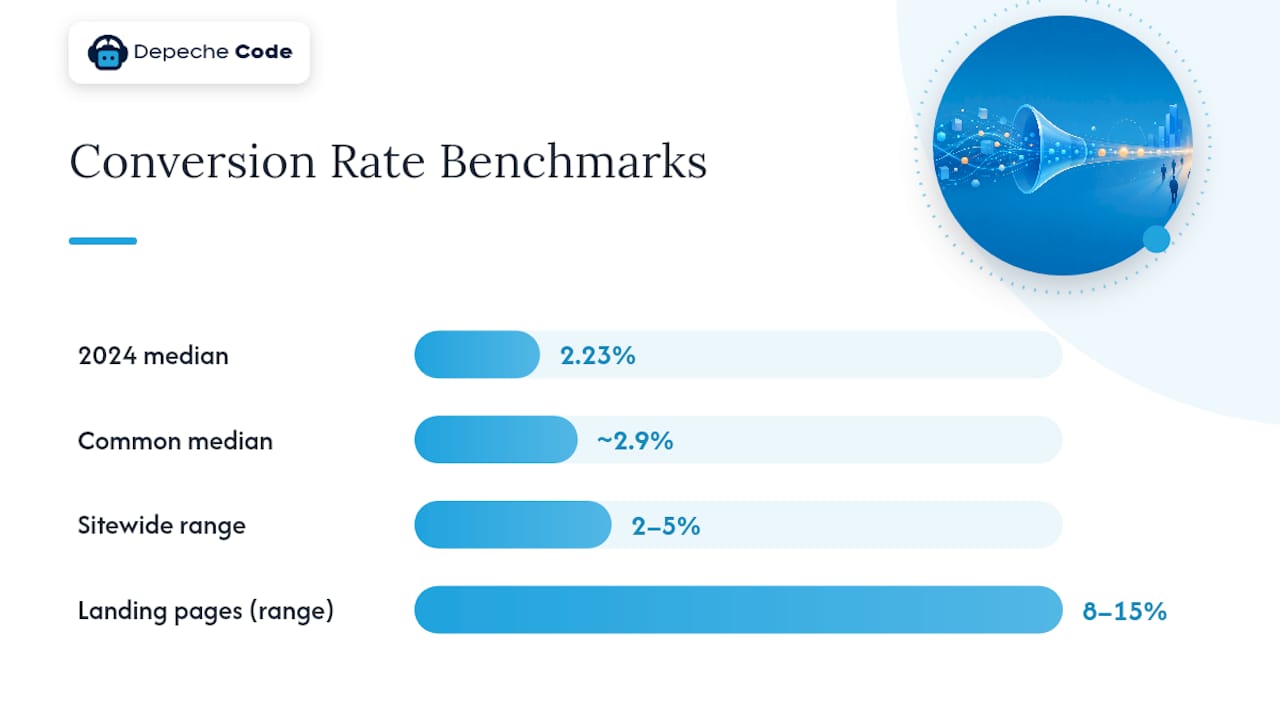
Top-quartile performers pull well ahead of the median. Dedicated, well-optimized landing pages can reach 8% to 15%, which is why sitewide averages and landing-page averages should never sit on the same chart. A homepage converting at 2% and a campaign landing page converting at 10% aren’t contradictory. They’re doing different jobs.
Deal size reshapes the entire picture. A few patterns worth internalizing:
- Transactional/self-serve products (low ACV, short sales cycle) tend to convert highest on-site because the buying decision needs less internal buy-in.
- Mid-market deals sit closer to the median, since a form fill usually kicks off a sales conversation rather than a purchase.
- Enterprise deals often show lower visitor-to-lead percentages, but each lead carries far more pipeline value, so a “worse” conversion rate can still outperform in revenue terms.
That last point matters more than most benchmark tables admit. Conversion rate and pipeline value need to be reported side by side, not treated as the same signal, because a lower rate on a high-ACV site can easily beat a higher rate on a low-ACV one.
How to Define and Calculate B2B Conversion Rate Correctly
Most B2B teams compare conversion rates that were never measuring the same thing. Fix the definition before you touch the tactics.
- Set the numerator and denominator explicitly. If 4,000 people visited your site last month and 92 submitted a demo request, form fill, or qualified content download, your conversion rate is 92 divided by 4,000, or 2.3%. That’s straightforward. The trouble starts when teams mix “any form submission” with “sales-qualified lead” in the same metric.
- Decide what counts as a conversion. A newsletter signup and a demo request are not the same event and should never share a conversion rate unless you’re explicitly measuring engagement rather than lead generation.
- Find the leaks in your tracking. Phone calls that never get logged, leads imported manually from a trade show, and cross-device sessions where someone researches on mobile and converts on desktop all quietly deflate your real number.
- Track supporting KPIs alongside the headline rate. Pipeline value generated, MQL-to-SQL percentage, and average time-to-conversion tell you whether the leads you’re generating are worth chasing at all.
A site with a low visitor-to-lead rate but a high MQL-to-SQL rate is often healthier than one with the reverse.
How Channels and Industry Verticals Change What “Good” Looks Like
Applying one benchmark number across every traffic source is the single fastest way to misread your own performance. Channels behave nothing alike.
- Direct traffic converts best, often around 3.3%, because visitors typing your URL directly already know who you are.
- Referral traffic performs close behind direct, since it arrives with a built-in trust signal from whoever sent it.
- Organic search sits in the middle, carrying research-stage intent that hasn’t fully matured into buying intent.
- Paid search typically lags, often near 1.5%, largely because paid campaigns capture more top-of-funnel curiosity than bottom-of-funnel readiness.
- Email varies widely by list quality, but tends to convert well when the list is genuinely opted in and segmented.
Industry adds another layer. SaaS companies often report lower on-site conversion because buyers evaluate multiple tools before ever filling out a form. Professional services firms tend to convert higher, since the buying trigger is usually a specific, urgent problem rather than an open-ended evaluation.
One shift worth watching closely: traffic referred from AI answer engines and chat assistants is starting to show notably higher conversion behavior than average organic search, likely because the visitor arrives already pre-qualified by the AI’s own explanation. If your analytics can isolate that segment, do it now rather than later.
High-Impact CRO Tactics: Landing Pages, Forms, Speed, UX, and Trust
Benchmarks tell you where you stand. This is how you move the number.
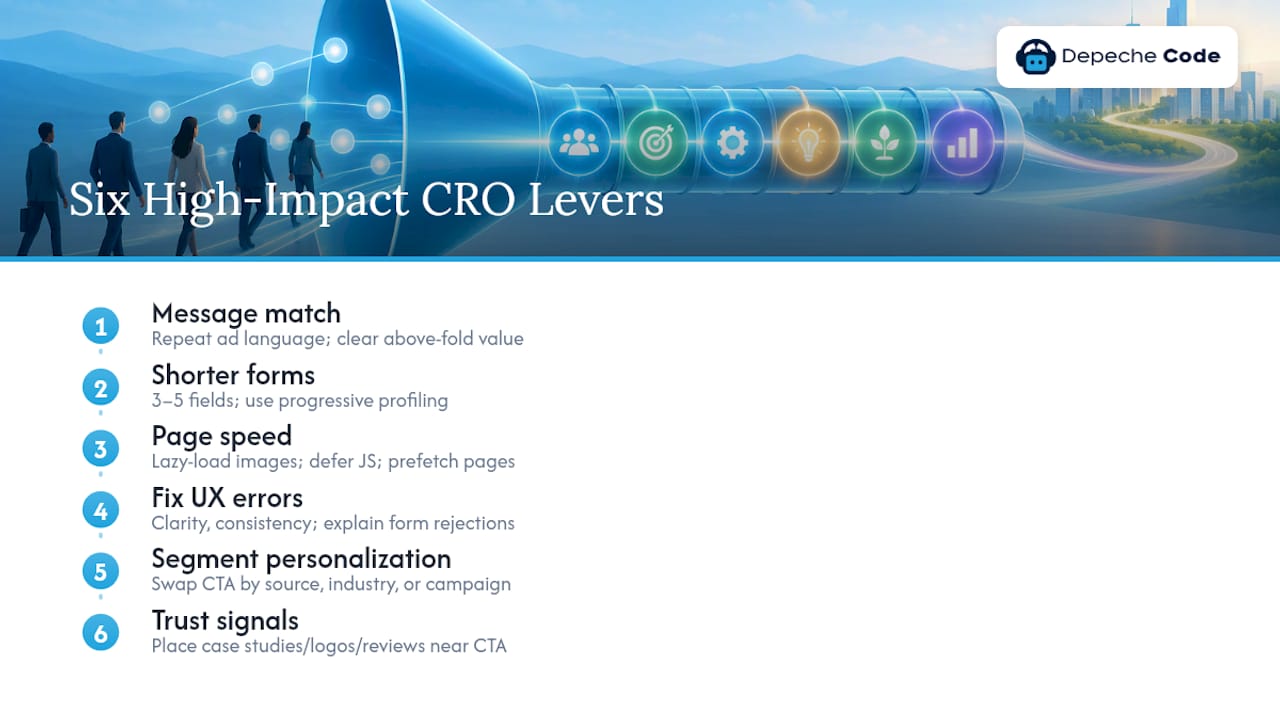
Message match first. A visitor who clicked an ad about “SOC 2 compliance software” and lands on a generic homepage will bounce. Build a dedicated landing page per campaign or audience segment that repeats the exact language that got the click, with one clear value proposition above the fold. A guide on building landing pages that convert walks through this pattern in more detail.
Cut your forms down. High-intent forms should ask for three to five fields, not fifteen. Every additional field is a small tax on completion. Where you genuinely need more data, use progressive profiling to collect it across multiple touches instead of one intimidating form, and enable autofill wherever the browser supports it. Autofill alone measurably reduces form abandonment because it removes the friction of retyping information the browser already has.
Fix speed before you fix design. Lazy-loading images, deferring nonessential JavaScript, and using prefetch or prerender for likely next pages are proven techniques for cutting real and perceived load time. A slow page punishes every other optimization you make, because visitors abandon before they ever see your improved copy.
Treat UX errors as revenue leaks. Clarity, consistency, and error prevention aren’t nice-to-haves. Confusing navigation, inconsistent button styles, and forms that reject input without explaining why all quietly drive people away, and Google’s own research on conversion design treats this as a core lever, not a polish step.
Personalize the obvious segments. You don’t need a machine-learning engine to start. Swap your above-the-fold CTA based on traffic source, industry parameter, or campaign, even with simple rules-based logic.
Put trust signals where the decision actually happens. Case studies, client logos, and third-party review scores belong near the CTA, not buried on a separate “About” page. A breakdown of establishing website trust covers where these signals earn the most credibility.
Pro Tip: Run a five-minute audit right now: open your top landing page on a phone with a throttled connection. If the CTA isn’t visible within three seconds, you’re losing visitors before your message ever lands.
Measurement and Attribution: Close the Loop So Conversions Mean Pipeline
A conversion count means nothing until you know what it’s worth. Closing that loop takes three specific steps.
- Link your CRM to your ad platforms. Feeding closed-won and closed-lost outcomes back into Google Ads or LinkedIn Campaign Manager lets bidding algorithms optimize toward leads that actually become revenue, not just leads that fill a form.
- Assign monetary values to each funnel stage. An MQL might be worth $50 in modeled value, an SQL $500, and a closed deal its full contract value. This step is what turns lead volume into lead value inside your bidding strategy.
- Use GCLID tracking and Enhanced Conversions for Leads. These recover attribution that gets lost to browser privacy restrictions, and B2B teams that implement them have reported meaningful increases in measured conversions simply because the platform can finally see what happened after the click.
- Import offline conversions. Phone calls, in-person meetings, and trade show leads all need to flow back into the same system, or you’ll keep optimizing for the wrong signal.
Prioritize Fixes and Run Valid Tests
Not every fix deserves the same attention, and not every test deserves to run the same way.
- Score every idea on impact times effort. A form-field reduction is high impact, low effort, and should ship this week. A full site redesign is high impact but high effort, and belongs on a quarterly roadmap, not a sprint.
- Check your sample size before trusting a result. Low-traffic pages need weeks, not days, to reach a valid read, and segmenting by traffic source matters because AI-referral, organic, and paid visitors often react differently to the same page change.
- Run a simple four-week test cycle. Week one, launch a form-length test. Week two, layer in a landing-page headline test. Weeks three and four, let both run to significance before touching anything else.
7 Quick Actions to Improve Conversion This Week
- Add one unmistakable CTA above the fold on your highest-traffic page (marketing owns it, roughly 30 minutes, medium lift).
- Cut your primary lead form to five fields or fewer (marketing plus dev, half a day, high lift).
- Turn on browser autofill support across all lead forms (dev, under an hour, medium lift).
- Compress your three largest hero images (dev, one afternoon, medium lift).
- Add one client logo or testimonial near your main CTA (marketing, one hour, low to medium lift).
- Audit your thank-you page for a clear next step instead of a dead end (marketing, one hour, low lift).
- Confirm phone call conversions are actually logged in your CRM (sales ops, one afternoon, high lift on measurement accuracy).
Depechecode’s Practitioner Perspective and Proof Points
An agency approach centers around a simple diagnostic sequence: measure what’s actually happening, fix the highest-leverage friction points, and then confirm the lift before moving to the next fix. Core services map directly onto that sequence, from website design and redesign to search engine optimization, WordPress hosting and maintenance, and AI chatbot integration.
A typical engagement starts with a conversion and speed audit, moves to a prioritized fix list ranked by impact and effort, and ends with a measurement checkpoint to confirm the changes actually moved pipeline, not just page views.
Where B2B Conversion Is Headed Next
AI-referral traffic is converting at rates that deserve their own tracking category, and privacy-driven measurement changes are making closed-loop CRM data more valuable than ever. Benchmark your rate quarterly, not annually. If you only fix one thing before the next redesign, fix your measurement first. A beautiful new site built on broken attribution just produces prettier guesses.
— Donovan Wells – Founder and CEO
How Depechecode Turns This Playbook Into Results
This approach is an alternative to hiring a patchwork of freelancers for conversion fixes. Instead of one person handling speed, another handling forms, and a third guessing at attribution, you get a single team that treats website design, SEO, and hosting as one connected system built for lead generation, not just page views.
If your site needs a message-match overhaul, the website design and redesign service rebuilds landing pages around the exact playbook covered above. If speed or uptime is the bottleneck, WordPress hosting and maintenance starts from $39 per month and keeps the technical side from undoing your CRO work. And if you want to capture leads around the clock without adding headcount, the AI Chat Bot Starter plan begins at $49 per month with a one-time $299 setup and integration fee. For a broader look at third-party tactical checklists, Baby Love Growth’s conversion optimization guide is a solid companion read.
Start with a site audit through Depechecode’s full services page and get a prioritized list of fixes ranked by impact, the same way this article ranked them.
Sources
- B2B Website Conversion Rates: 2026 Benchmarks by Channel & Deal Size | Grey Matter
- B2B Marketing Benchmarks 2025 | The Starr Conspiracy
- Cracking the conversion code: 3 design secrets that make people hit buy | Google Business
- 4 steps to maximize lead value instead of lead volume | Invoca
- Web
FAQ
What is a good conversion rate for a B2B website?
A good sitewide rate falls between 2% and 5%, with a median around 2.9%.
What is the rule of 7 in B2B?
The rule of 7 is a marketing principle stating that a prospect typically needs around seven meaningful interactions with your brand before they’re ready to convert. In practice, this means your website conversion strategy should account for buyers who visit multiple times through different channels before ever filling out a form, which is exactly why direct and referral traffic convert higher than first-touch paid clicks.
Is B2B business still good in 2026?
Yes. B2B buyers continue to research and purchase online, and they increasingly expect fast, accurate, omnichannel experiences from vendor websites. Businesses that measure conversion correctly and fix friction points systematically continue to generate reliable pipeline from their sites.
Is 2.5% a good conversion rate?
A 2.5% sitewide conversion rate sits right at the median range reported across recent benchmarks, so it’s solidly average, neither alarming nor exceptional. Whether it’s “good” for your business depends on your deal size and lead quality; a 2.5% rate feeding high-value enterprise pipeline can outperform a 5% rate feeding low-value leads that never close.
How does Depechecode help improve B2B website conversion?
Depechecode audits site speed, form design, and messaging, then prioritizes fixes by impact and effort before rebuilding pages through its website design and redesign service. Ongoing SEO and hosting plans help sustain those gains once the initial fixes are live.