

Featured snippets optimization means writing and structuring a page so Google can lift a clear, direct answer from it and show it above the regular results. You can’t flip a switch to get one. Google selects featured snippets automatically, so the work is making your best pages the easiest ones to quote. This guide covers seven tactics that do that, what has changed since AI Overviews arrived, and when a snippet is worth chasing at all.
TL;DR
- No tag, schema or file forces a featured snippet. Google picks them by how well a page answers the query.
- The seven tactics below are all about structure: a direct answer under a question-style heading, then depth, in the right format (paragraph, list or table).
- Snippets are showing up less often as AI Overviews grow, so treat them as a bonus of good content, not a standalone strategy.
- Target question-based, high-intent queries where you already rank on page one.
- Track which pages win snippets, and don’t be surprised if some lose clicks as the answer is shown in full.
Table of Contents
- What a featured snippet is and what you control
- Are featured snippets still worth chasing in 2026?
- 7 tactics for featured snippets optimization in 2026
- What not to do
- Featured snippets, voice search and AI Overviews
- Our perspective on snippets
- A quick snippet audit you can run this week
- Need help turning answers into leads?
- FAQ
- Sources
What a featured snippet is and what you control
A featured snippet is a box where Google reverses the usual result layout: the descriptive excerpt comes first, then the page title and link. It can also appear inside a “People also ask” group. Google’s own documentation is clear that the systems generate these automatically, and Search Console’s help page lists featured snippets among the features applied by Google without any action by the page owner.
That shapes the whole job. You control three things:
- Whether your page ranks well enough to be considered.
- Whether the page contains a short, quotable answer to a specific question.
- Whether the format matches what the query needs.
You don’t control the final selection. Anyone who sells a “guaranteed snippet” is selling something Google doesn’t offer. Fake Q&A pages and heavy structured data added just to look like an answer tend to backfire, and Google warns that sites repeatedly violating its snippet policies can be penalized.
Are featured snippets still worth chasing in 2026?
Yes, selectively. The honest picture has two sides.
They’re less common. An Ahrefs analysis of SERP features found that featured snippet appearances fell by roughly 64% between January and mid-2025, a drop that tracks the rise of AI Overviews. Practitioner commentary in the same piece points toward building broad authority and scannable content rather than chasing individual positions.
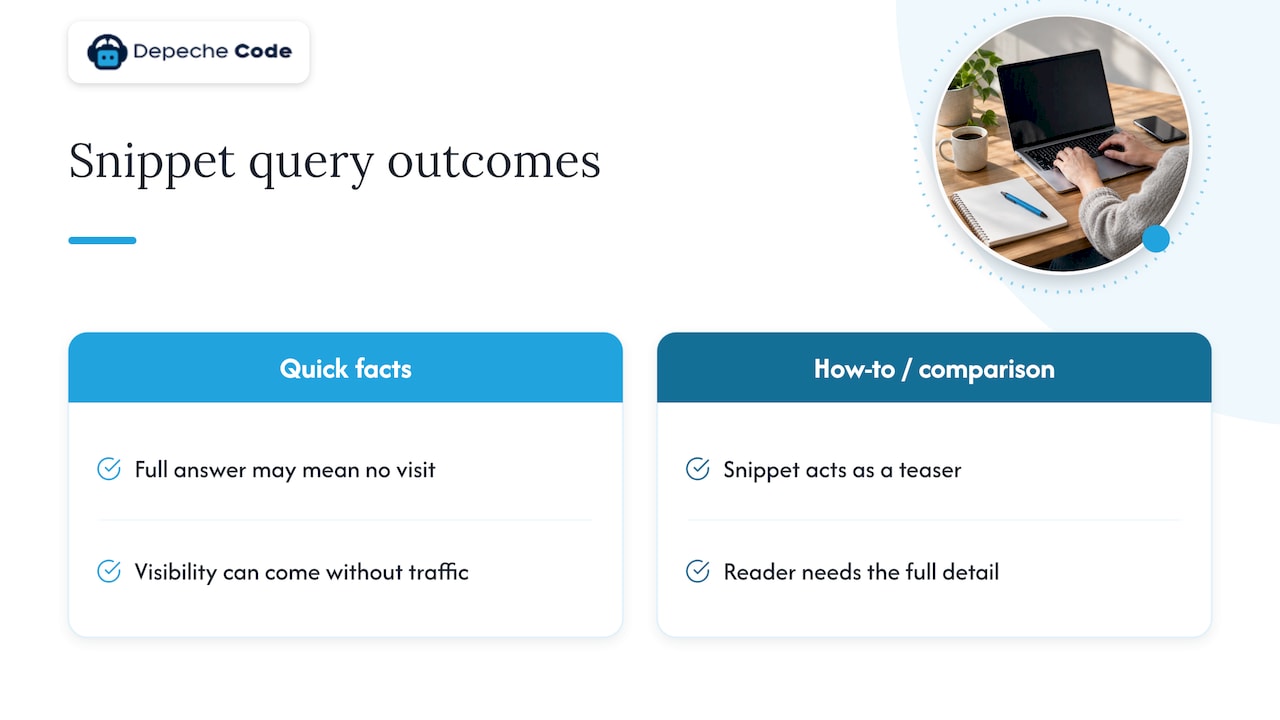
They don’t always send clicks. When the snippet fully answers a simple question, some readers never visit. For definitions and quick facts, that can mean visibility without traffic. For “how to” and comparison queries, where the reader needs the full detail, the snippet works more like a teaser.
So the question isn’t “how do we win every snippet?” It’s “which queries deserve a snippet-ready answer?” A practitioner analysis of snippet acquisition frames this as a query-class problem: not every query is meant to produce one, so focus on question-based searches with clear intent.
7 tactics for featured snippets optimization in 2026
1. Pick queries you already rank for
Snippets generally come from pages already visible in the results. Start in Search Console: filter queries that begin with who, what, why, how, when, can, does or best, and sort by pages sitting in positions 2 to 10. Those pages are closest to a win, and improving them costs far less than building from zero.
A practical filter for a small business:
- The query has a clear, single answer or a clear set of steps.
- The searcher is plausibly a buyer or a future buyer, not a student.
- Your page already ranks on page one.
If a query fails the third test, fix your core SEO first. Our SEO optimization guide covers that groundwork.
2. Put the question in a heading and answer it right below
This is the single most useful habit. Use a heading that mirrors how people phrase the question, then answer in the first sentence or two beneath it, before any context. A common practitioner guideline is to keep the direct answer short, around 40 to 60 words. That’s a rule of thumb, not a Google requirement, but it forces the clarity that snippet selection rewards.
Compare two openings under the heading “How long does a website redesign take?”:
- Weak: “Every project is different, and many factors play into timelines. Before we get into it, let’s talk about discovery.”
- Snippet-ready: “A typical small business redesign takes six to twelve weeks, depending on page count, content readiness and integrations. Larger sites or custom functionality can take longer.”
The second can be lifted whole. The first can’t. (Check any timeline against your own real projects before publishing it.)
3. Match the format to the query
Google displays different snippet shapes, and the right one depends on what the searcher wants.
| Query type | Snippet format | How to write it |
|---|---|---|
| “What is…”, “why does…” | Paragraph | One tight definition, 40 to 60 words |
| “How to…”, “steps to…” | Numbered list | Clear steps, each under its own subheading or list item |
| “Best…”, “types of…” | Bulleted list | Short, parallel items with the key term first |
| “X vs Y”, “cost by…”, “specs” | Table | Real column headers, one fact per cell |
Use real HTML lists and tables, not images of them or lines of text with manual dashes. Search systems read the markup.
4. Write the answer first, then earn the click
Because a snippet can satisfy the reader on the spot, give people a reason to click through. After the short answer, add what a summary can’t carry: a worked example, a checklist, a template, a comparison, your own data. Google’s guidance for the AI era makes the same point about creating non-commodity content with a unique perspective or first-hand experience. Original material is your protection against a snippet that gives everything away.
5. Cover the question cluster, not one keyword
Pages that win snippets often answer a handful of related questions. If you’re writing about snippets, readers also ask what they are, whether they help SEO, and how voice search uses them. Answer those on the same page or on tightly linked sibling pages. A hub-and-spoke setup makes this easier, and our guide to topic clusters for SEO explains how to link those pages so both people and crawlers can follow the thread.
6. Keep page basics clean
Snippet optimization sits on top of ordinary technical health:
- Fast, mobile-friendly pages that pass Core Web Vitals checks.
- Descriptive headings in a logical H2/H3 order.
- Content in crawlable text, not locked in tabs that never load or in images.
- Clear authorship and trust signals, which we cover in our E-E-A-T guide.
Structured data can help Google understand a page, but Google notes it describes the content already on the page. It is not a snippet trigger. Mark up what’s visible, and nothing else.
7. Measure, refresh, and let some go
Track the queries where you hold a snippet, along with clicks and conversions from them. Snippets move: a competitor reformats an answer, Google reshuffles, and yours disappears. Refresh the page with a clearer answer and current facts. If a snippet gives you impressions but no leads for a query that never converts, don’t fight for it.
If you want to opt a page out, the nosnippet rule is the only guaranteed way. A low max-snippet value may discourage a snippet but isn’t a hard guarantee.
What not to do
Most bad snippet advice comes from treating a ranking outcome like a technical switch.
- Don’t create thin Q&A pages whose only purpose is to hold a snippet answer. They add no value and can look manipulative.
- Don’t chop every page into tiny chunks. Google says that special formats like llms.txt or breaking content into small chunks aren’t needed for generative AI features. Write for people in clear sections, not for a parser.
- Don’t over-apply FAQ markup to content that isn’t a real set of questions and answers.
- Don’t copy the current snippet holder. Match its clarity, then beat it with a better, more complete answer.
Featured snippets, voice search and AI Overviews
Voice assistants often read short, direct answers, which is why snippet-style writing overlaps with voice optimization. Search Engine Land’s voice search guide adds a useful caveat: voice isn’t right for every kind of content, and long-form guides or in-depth explainers perform better when typed and read. Use conversational question headings for quick-answer topics, not for everything.
AI Overviews and AI Mode are the bigger shift. Google states that the best practices for SEO remain relevant for these AI features, with no extra requirements or special optimizations. In practice, the same habits serve every surface: clear answers, sound structure, trustworthy authorship and useful depth. If you want the wider picture, our AI search optimization playbook and SEO trends for 2026 go further.
Our perspective on snippets
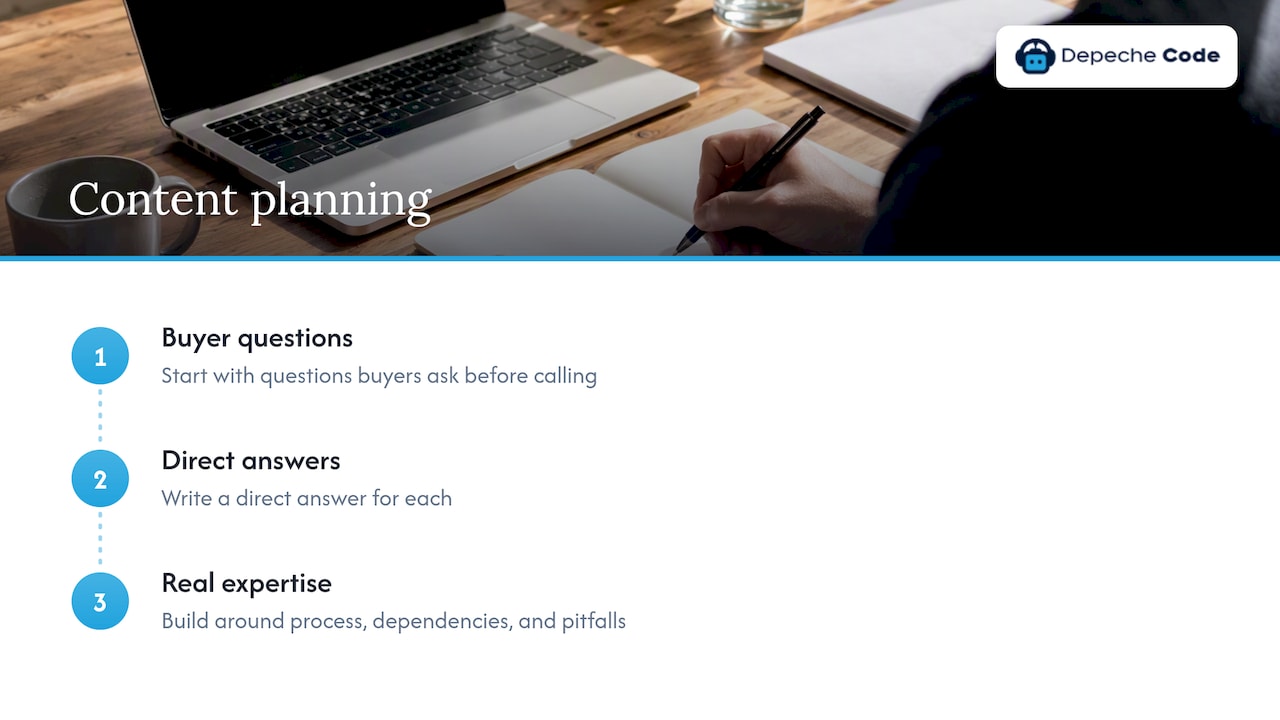
We treat featured snippets as a signal that a page is doing its job, not as a goal on its own. When we plan content for a client, we start with the questions their buyers ask before they call, write a direct answer for each, and then build the page around real expertise: how the work gets done, what it depends on, where it goes wrong. That is the part a snippet can’t replace, and the part that turns a visit into an inquiry.
Our approach to SEO is built on measurable technical performance, including Google PageSpeed and SEO scores, and on clear ownership of every deliverable. Snippet-ready structure fits naturally inside that: clean headings, fast pages, and content a reader can scan in seconds. We’d rather see a client hold ten pages with strong answers and real conversions than chase fifty snippets that bring impressions and nothing else.
One more point from experience: with AI-driven results growing, the brands that stay visible are the ones whose pages say something specific. Generic answers are interchangeable. Yours shouldn’t be.
— Donovan Wells – Founder and CEO
A quick snippet audit you can run this week
You can do this in an afternoon with Search Console and a spreadsheet.
- Export queries with impressions for the last three months.
- Filter for question-style queries and for average positions between 2 and 10.
- Pick the ten with the clearest buying intent.
- For each, search it yourself and note who holds the snippet and in which format.
- Add or rewrite a direct answer under a matching heading on your page, in that same format.
- Re-check in four to six weeks and log what moved.
This is slow, unglamorous work, and it’s the same work that improves your regular rankings. That’s the point.
Need help turning answers into leads?
If you’d rather have a team handle the audit, content structure and technical side, we offer SEO plans built around your market, including organic and local approaches. See our SEO services or compare the SEO options and plans. Our guide on the role of content in SEO shows how we think about the content side.
FAQ
How do you optimize for featured snippets?
Find question-based queries where you already rank on page one, put the question in a heading, and answer it directly in the first sentences beneath it. Use a paragraph, list or table to match the query. Then add depth below so readers have a reason to click.
Are featured snippets good for SEO?
They can be. They raise visibility and signal that your page answers a query well. But they can also reduce clicks when the box answers a simple question completely, so judge them by leads and conversions, not impressions alone.
Can you force Google to show your page as a featured snippet?
No. Google generates featured snippets automatically from pages that help answer the query, and there is no markup or file that guarantees one. You can only improve how clearly and completely your page answers the question.
Are featured snippets going away because of AI Overviews?
They’re appearing less often. Ahrefs measured a sharp decline in 2025 as AI Overviews expanded. Google hasn’t said they’re gone, and the same clear, well-structured content helps in both places.
Sources
- Featured snippets and your website, Google Search Central
- Google’s guide to optimizing for generative AI features on Search
- AI features and your website, Google Search Central
- Intro to how structured data markup works, Google Search Central
- Missing features in Google Search results, Search Console Help
- How Google’s featured snippets work, Google Search Help
- How SERP features have evolved in the AI era, Ahrefs
- Featured snippet acquisition, Product Philosophy
- Voice search SEO guide, Search Engine Land