

Local link building means earning backlinks and citations from websites tied to your city, region, or industry community, such as chambers of commerce, local news outlets, and neighboring businesses. Start today by claiming your Chamber of Commerce listing if you haven’t already, or spend twenty minutes searching your business name in quotes on Google to find unlinked mentions you can turn into live links.
Here’s what to expect once you start:
- Directory and chamber listings often go live within days
- Editorial links from local press or guest posts typically take 2 to 6 weeks to land
- Meaningful ranking movement in local organic results usually shows up in 30 to 90 days of consistent outreach
Pro Tip: Before chasing new links, run a quick reverse image search or brand search to find sites that already mention you by name without a link. Those are the fastest wins on your list.
Key Takeaways
Local link building succeeds when businesses prioritize relevant, high-quality links over directory volume and follow a repeatable monthly outreach cadence.
| Point | Details |
|---|---|
| Start with reclamation | Search your business name for unlinked mentions and request a link; it’s the fastest win available. |
| Prioritize relevance over volume | Five to ten quality local links per month beat dozens of generic directory submissions. |
| Expect 30 to 90 days | Initial ranking movement typically appears within one to three months of consistent activity. |
| Track the right fields | Log pitch status, placement type, anchor text, and value estimate for every prospect. |
| Consider managed help | Depechecode’s Local SEO Prime bundles link building with citation audits and Google Business Profile optimization. |
Table of Contents
- What Is Local Link Building, Exactly?
- Why Do Local Links Matter for Rankings?
- What Are the Best Local Link Building Tactics?
- What Tools and Workflow Actually Get This Done?
- How Do You Measure the Impact of Local Link Building?
- What Mistakes Should You Avoid in Local Link Building?
- How Does Depeche Code Approach Local Link Building?
- What the Data Actually Tells You to Prioritize
- Get Managed Local Link Building Without the Learning Curve
- Sources
- FAQ
What Is Local Link Building, Exactly?
Local link building is the practice of getting other websites, particularly ones with genuine ties to your city or region, to link back to your site. It differs from general link building in one key way: relevance to place matters as much as relevance to topic.
Three types of local mentions show up constantly in this work, and they are not interchangeable:
- Directory citation: your business name, address, and phone number listed on a site like a chamber directory or industry association page, sometimes without a clickable link
- Linked unstructured citation: a mention of your business (in a blog post, news article, or community roundup) that includes your NAP details and a live hyperlink back to your site
- Editorial backlink: a link earned through coverage, a guest article, or a partnership, often without any citation-style formatting at all
Linked unstructured citations are the strongest of the three because they combine citation verification with backlink authority in one placement. A link from the Orlando Regional Chamber’s member directory carries more local weight than a generic business directory with no geographic filter, because relevance and prominence both factor into how search engines value the link.
Why Do Local Links Matter for Rankings?
Local links carry real, measurable weight, and the split between ranking systems is worth knowing before you spend a single hour on outreach. Practitioners estimate link signals account for roughly 24% of local organic ranking weight, compared to about 8% for the Local Pack. That gap tells you something important: if you’re optimizing purely for the three-pack map results, links matter less than your Google Business Profile signals. If you’re chasing broader organic visibility, links matter a lot more.
Local links do double duty. They pass authority, and they build prominence, which is Google’s word for how well-known and cited your business is within its community.
- A mention from a respected local newsroom signals credibility that a generic directory listing cannot
- Editorial links tend to stick around longer than paid placements or self-submitted citations
- Consistent link acquisition compounds; a handful of quality links each month outperforms a one-time bulk purchase
Most businesses see the first ranking movement within a few weeks to a few months of steady link-building activity, assuming they’re pairing it with basic on-page and Google Business Profile optimization.
What Are the Best Local Link Building Tactics?
This is the working list. Not every tactic fits every business, so treat it as a menu, not a checklist you have to clear top to bottom.
-
Join your Chamber of Commerce and relevant trade associations. Most chambers include a member directory with a linked listing for a modest annual fee. Fill out your profile completely, including a description with your city name and services, and check whether the chamber runs a members’ blog or news page where you can contribute.
-
Sponsor a local event, team, or nonprofit. Youth sports leagues, 5K races, school fundraisers, and community festivals almost always list sponsors on their websites. Costs typically range from around $100 for a small local event to $1,000 or more for larger sponsorships. Most organizers will link your business name if you simply ask when you sign the sponsorship agreement.
-
Build reciprocal relationships with complementary (non-competing) local businesses. A landscaper and a fencing company, a bakery and a coffee roaster, a dentist and an orthodontist: these pairs refer customers to each other naturally, and a “recommended partners” page is a normal, non-spammy place for a mutual link. Reach out with something like: “We refer clients to each other already. Would you be open to a partner page link exchange?”
-
Create genuinely useful local content. A neighborhood guide, an annual “best of” list, a local event calendar, or a small original data report tied to your city tends to attract natural links because other local sites want to reference something concrete. A plumbing company publishing a guide to local water hardness by zip code will get cited by real estate blogs and homeowner forums in ways a generic service page never will.
-
Pitch guest posts, op-eds, and local press. Local news sites, regional magazines, and business journals often accept contributed pieces from business owners with a relevant angle. Pitch a specific, timely story (a hiring trend, a local supply issue, an event recap) rather than a generic “why our industry matters” piece, and always ask for a linked author bio.
-
Reclaim unlinked brand mentions. Search your exact business name, plus common misspellings, in quotes. When you find a mention without a link, email the site with a short, friendly note: “Thanks for mentioning us! Would you mind adding a link to [page] so readers can find us easily?” This is often the single fastest tactic on this list because you’re not asking anyone to create new content, just add one line of code.
-
Audit and prioritize your directory and vertical citations. Not every directory deserves your time. Backlink value depends far more on geographic and topical relevance than on raw domain metrics, so a niche industry directory beats a generic nationwide listing site almost every time. Run a NAP audit first (confirm your name, address, and phone number are identical everywhere), then prioritize directories that are either hyperlocal or specific to your industry.
-
Pursue podcast, local radio, and community leader collaborations. Being a guest on a local business podcast or a morning radio segment almost always comes with a show-notes link. Reach out to hosts covering your industry or your metro area with a specific expertise angle, not a generic “have me on your show” pitch.
-
Offer a scholarship, host a meetup, or take a speaking slot. A modest local scholarship tied to a .edu domain, hosting a small business meetup, or speaking at a regional conference all generate natural links from event pages, university financial aid pages, and conference agendas.
The tactics that consistently produce results across practitioner reports are reclaiming mentions, creating locally relevant content, partnering with nearby businesses, and guesting on local publications. None of these require a media budget. They require time and a willingness to ask.
If you operate more than one location, treat each location page as its own link target rather than funneling everything to your homepage. A community sponsorship in your second city should link to that city’s specific page, not your main domain.
What Tools and Workflow Actually Get This Done?
You don’t need an expensive platform to run this well, but you do need a system, because ad hoc outreach dies within a month.
For prospecting, a combination of manual search operators (site:.edu, “your city” + “sponsors”, “your industry” + directory) and a mention-tracking tool like Google Alerts catches new opportunities as they appear. For tracking outreach, even a shared spreadsheet works, as long as it has the right columns.
Track these fields for every prospect:
- Website and contact name/email
- Pitch status (not contacted, emailed, follow-up sent, secured, declined)
- Placement type (directory, editorial, sponsorship, guest post)
- Anchor text used
- Rough value estimate (is this a hyperlocal, high-relevance site or a generic one?)
A repeatable monthly cadence beats sporadic bursts of activity, and it breaks down cleanly into four weeks:
- Week 1, research: find 15 to 20 new prospects using search operators, competitor backlink checks, and local event calendars
- Week 2, outreach: send personalized pitches to your top 10 prospects and follow up on last month’s unanswered emails
- Week 3, content and follow-up: draft or finalize any guest post, local guide, or press pitch in progress; send a second follow-up round
- Week 4, tracking and reporting: log new placements, update your spreadsheet, and check which links went live
When you’re deciding what to prioritize, editorial context and real local readership matter more than a domain’s overall authority score. A small local newsroom with a modest audience is often worth more than a national site with a high authority score and zero connection to your city. Understanding how a competitor earned its local links also helps you spot patterns worth repeating; a competitor backlink analysis can reveal which local sites are already open to linking within your industry.
How Do You Measure the Impact of Local Link Building?
Four numbers tell you almost everything you need to know: local organic traffic, rankings for your priority local keywords, Google Business Profile impressions, and conversions from referral traffic on the links you’ve earned.
Attribution doesn’t have to be complicated. Tag every outreach link with a UTM parameter before you request it, so referral traffic shows up cleanly in your analytics instead of getting lumped into generic referral data. Set a Search Console alert for your target landing pages so you notice ranking shifts as they happen rather than three months later.
- Small and medium competition niches typically see initial ranking movement within 30 to 90 days of consistent link activity
- A consistent monthly acquisition of quality local links over time produces stronger and more durable results than one large batch of links acquired all at once
- Referral traffic from local links tends to convert at a higher rate than broad organic traffic, since the visitor arrived through a trusted local source
Track landing pages individually rather than only watching domain-wide traffic; a single strong chamber or press link can move one page’s rankings noticeably even when the overall site trend looks flat.
What Mistakes Should You Avoid in Local Link Building?
Mass-submitting your business to fifty generic directories in an afternoon feels productive and rarely moves rankings, because relevance and quality outperform raw volume every time. Buying links or using link farms risks a Google penalty and can undo months of legitimate work in one algorithm update; sponsorships and real partnerships carry zero of that risk.
Chasing high domain-rating sites while ignoring local relevance is another common misallocation. A high-authority national blog with no tie to your city or industry does less for local rankings than a modest local news site.
- Don’t ignore nofollow links or linkless brand mentions; they still build awareness and sometimes convert into linked mentions later if you ask
- Don’t treat citation building as “done” after one audit; NAP consistency needs periodic rechecking
- Don’t skip the ask; most webmasters will add a link to an unlinked mention if you request it politely
How Does Depeche Code Approach Local Link Building?
Depeche Code treats local link building as one piece of a broader local SEO plan, not a standalone favor. Chamber listings, citation cleanup, and outreach for editorial mentions typically get bundled alongside Google Business Profile optimization and on-page local signals so the pieces reinforce each other instead of working in isolation.
- Citation audits catch NAP inconsistencies before they undermine new link-building work
- Outreach campaigns target relevance first, prioritizing local press and community sites over generic directories
- Progress gets tracked against the same KPIs covered above: local rankings, GBP impressions, and referral conversions
Pro Tip: If you have the time and a genuine local network, DIY link building works fine for a single-location business. Multi-location businesses, or owners who simply don’t have five extra hours a month, tend to get better return on hiring it out.
Readers weighing that decision can find more detail in Depeche Code’s local SEO growth package or a broader breakdown in this guide to hiring a local SEO firm.
What the Data Actually Tells You to Prioritize
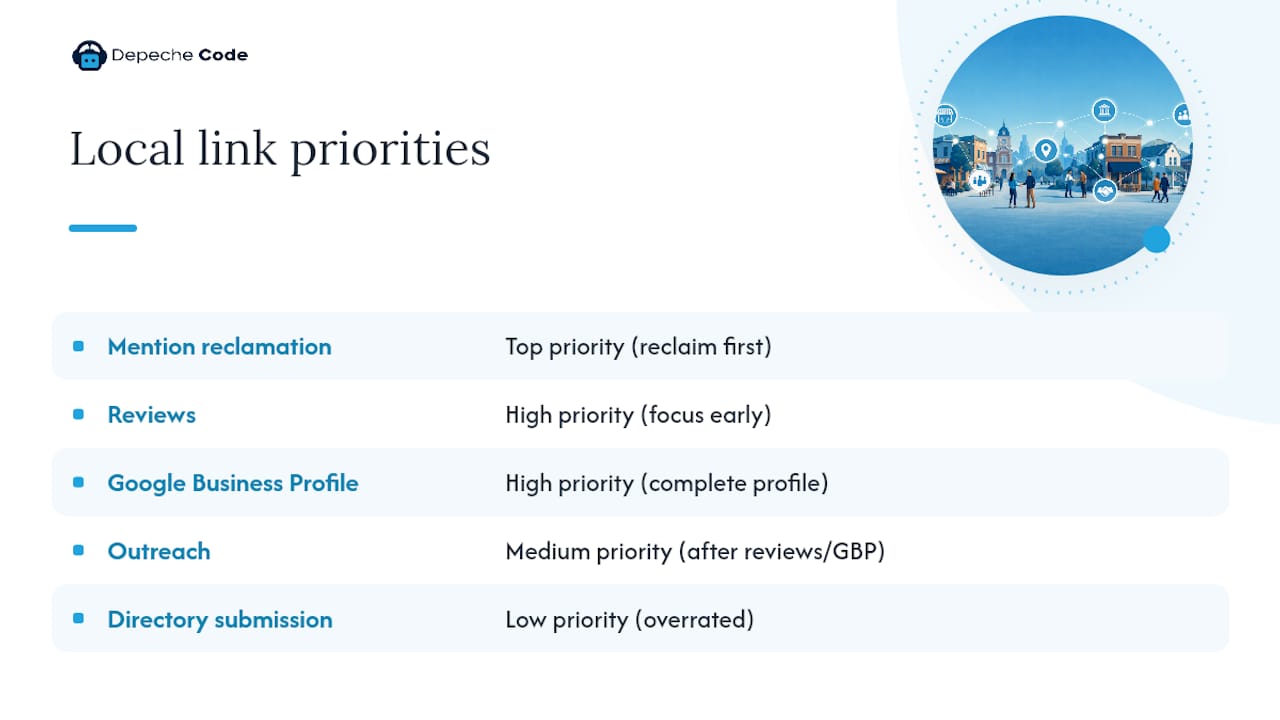
Most advice on local link building treats every tactic as equally worthwhile, and that’s the part I’d push back on. If your business lives and dies by the map pack, your time is better spent on reviews and Google Business Profile completeness before you touch outreach.
The overrated tactic is directory submission. It gets recommended constantly because it’s easy to explain and easy to sell, not because it moves rankings much on its own. The underrated one is mention reclamation. It costs almost nothing, takes an afternoon, and produces links from sites that already know who you are.
If you do only one thing this month, reclaim your unlinked mentions first. Everything else on this list takes longer to pay off.
— Donovan
Get Managed Local Link Building Without the Learning Curve
Depechecode is the alternative to hiring an outreach specialist or agonizing over spreadsheets yourself: a managed local SEO plan that folds link building, citation cleanup, and Google Business Profile work into one coordinated effort instead of leaving you to juggle chamber applications, press pitches, and NAP audits solo.
Depechecode’s Local SEO Prime package is built for business owners who want the tactics covered in this guide, sponsorships, partnerships, citation audits, and editorial outreach, executed and tracked by people who do it daily. It suits owners running one location or several, especially anyone who read the workflow above and realized they don’t have four extra hours a month to spare. For a broader look at pricing tiers and what each plan covers, check Depechecode’s SEO options and plans. If you’re ready to see what a managed plan would look like for your business, request a quote and get a specific recommendation based on your city, industry, and current link profile.
Sources
- Local SEO Link Building: 11 Tactics That Work in 2026
- 13 local link building tactics to boost your visibility
- 9 Easy Local Link Building Tactics
- Local outreach and link building (Moz)
FAQ
What Is Local Link Building in SEO?
Local link building is the process of earning backlinks and citations from websites connected to your city, region, or local industry community, such as chambers of commerce, local news sites, and community organizations.
How Much Should I Pay for Local Link Building?
Costs vary widely; sponsorships alone typically range from around $100 for small local events to $1,000 or more for larger ones, while managed agency plans bundle link building with broader local SEO work at a monthly rate.
What Is Meant by Link Building?
Link building means earning hyperlinks from other websites back to your own, which search engines use as a signal of trust, relevance, and authority when ranking pages.
Is Doing Local SEO Worth It?
Yes for most brick-and-mortar and service-area businesses; link signals alone account for roughly 24% of local organic ranking weight, and pairing that with Google Business Profile optimization typically shows measurable results within 30 to 90 days.
How Many Local Links Do I Need Each Month?
Most practitioners recommend a modest number of quality local links each month, sustained over several months, rather than one large batch acquired all at once.