

TL;DR:
- A website redesign involves a comprehensive overhaul of structure, user experience, content, and functionality.
- It aims to improve conversions, SEO, and business growth, unlike surface-level updates or refreshes.
- Successful redesigns require strategic planning, collaboration, and alignment with business goals.
Most business owners assume a website redesign means picking new colors, swapping out photos, and calling it done. That assumption costs real money. A comprehensive overhaul touches your site’s structure, visuals, content, navigation, and functionality all at once. It’s a strategic move, not a cosmetic one. When done right, it aligns everything your website does with what your business actually needs to grow. This guide breaks down what redesign really means, why businesses invest in it, how it differs from a simple refresh, and how to plan one that delivers measurable results.
Table of Contents
- What website redesign really means
- Common reasons businesses invest in website redesign
- Website redesign vs. refresh: A comparison
- How to plan an effective website redesign
- Why most website redesigns fail: The overlooked factor
- Unlock your business potential with professional website redesign
- Frequently asked questions
Key Takeaways
| Point | Details |
|---|---|
| Redesign vs. refresh | A website redesign transforms both structure and functionality, while a refresh only updates visuals. |
| Business value | Strategic redesign can directly boost sales, leads, and customer trust. |
| Planning essentials | Successful redesigns require clear goals, user feedback, and ongoing measurement. |
| Common pitfalls | Ignoring business objectives and user needs leads most redesigns to underperform. |
What website redesign really means
Let’s clear something up right away. A website redesign is not the same as updating your homepage banner or changing your font. It’s a structured, strategic process that rebuilds how your site works from the inside out.
A full redesign overhaul covers structure, navigation, visual identity, and core functionality. That means rethinking how users move through your site, how pages load, how content is organized, and how every element supports your business goals. It’s a significant investment of time and resources, but it pays off when done with purpose.
Here’s what a real redesign typically includes:
- Information architecture: Restructuring how pages connect and how users find what they need
- Visual identity: Updating branding, typography, color systems, and imagery to reflect your current positioning
- User experience (UX): Redesigning navigation flows, calls to action, and page layouts for better engagement
- Technical performance: Improving load speed, mobile responsiveness, and backend stability
- Content strategy: Rewriting or reorganizing copy to match your audience and SEO goals
- Conversion optimization: Adjusting page elements to turn more visitors into leads or customers
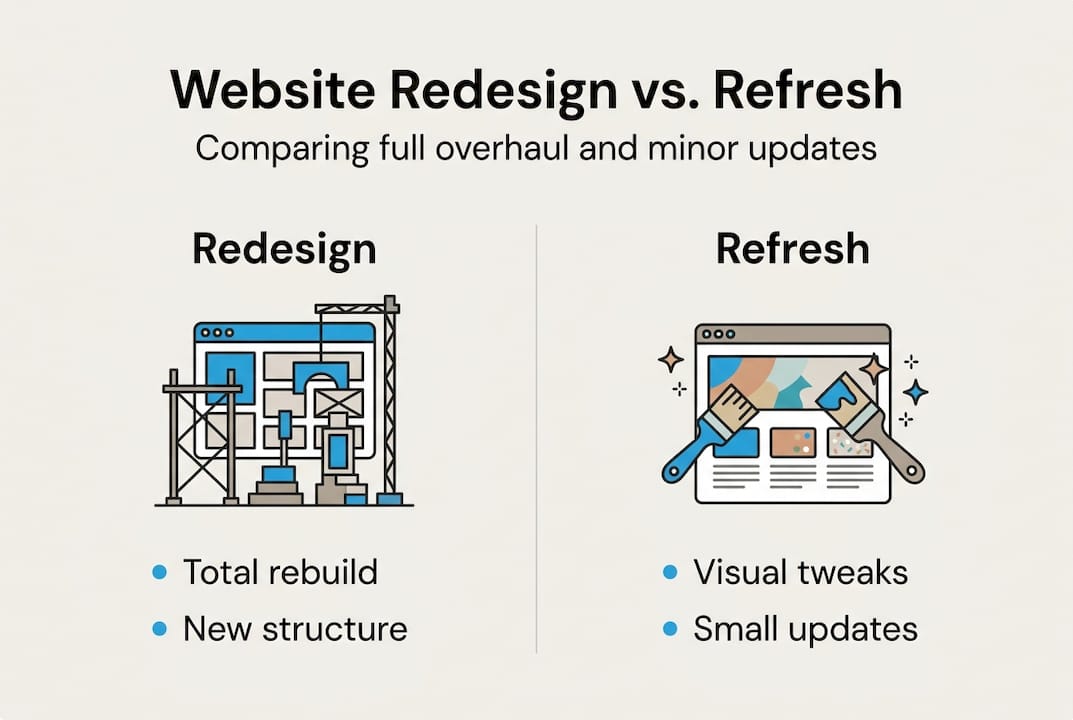
A minor refresh, by contrast, only touches surface elements. New photos, a color tweak, maybe a new header. It looks a little fresher, but nothing underneath changes. Your bounce rate stays the same. Your conversion rate doesn’t move. Your rankings don’t improve.
“A redesign isn’t just about looking better. It’s about working better for your business and your customers.”
If you’re unsure whether your site needs a full overhaul or just a touch-up, ask yourself this: Is your site actively helping you generate leads, build credibility, and serve your customers? If the answer is no, you’re probably past the refresh stage. Check out is it time to redesign your website to evaluate where you stand.
The strategic value of a redesign is real. It’s not about vanity. It’s about building a digital asset that works as hard as you do.
Common reasons businesses invest in website redesign
Knowing the scope of redesign is one thing. Knowing when to pull the trigger is another. Businesses invest in redesigns for a variety of reasons, and most of them come down to one core truth: your website is falling short of what your business needs.
Here are the most common reasons businesses choose to redesign:
- Poor user experience: Visitors can’t find what they’re looking for, navigation is confusing, or the site feels clunky on mobile devices.
- Slow load times: Pages that take more than three seconds to load lose visitors fast. Speed is both a UX and SEO factor.
- Outdated visual design: A site that looks like it was built a decade ago signals to customers that your business might be behind the times.
- Mobile responsiveness issues: With most web traffic now coming from phones, a site that doesn’t work on mobile is a serious liability.
- Misalignment with new business goals: You’ve launched new products, entered new markets, or repositioned your brand. Your site hasn’t caught up.
- Weak SEO performance: Poor site structure, missing metadata, and slow speeds all drag down your search rankings.
- Security vulnerabilities: Outdated platforms and plugins create risk for both your business and your customers.
- Low conversion rates: Traffic is coming in, but visitors aren’t taking action. That’s a design and strategy problem.
A redesign aligned with goals addresses user expectations and business priorities at the same time, not separately.
Pro Tip: Before starting a redesign, run a quick audit of your top five pages using Google Analytics. Look at bounce rate, time on page, and conversion events. These numbers tell you exactly where your site is losing people, and that data should drive every redesign decision.
If you want to avoid common mistakes, review these website redesign tips before you begin. And if you’re looking for a trusted design redesign company to handle the work, partnering with experts who understand your industry makes a measurable difference.
Website redesign vs. refresh: A comparison
The difference between a redesign and a refresh isn’t just about effort. It’s about outcomes. One changes how your site performs. The other changes how it looks.
A redesign addresses structure and functionality at a deep level, while a refresh stays on the surface. Here’s a side-by-side look at what each approach actually delivers:

| Factor | Website redesign | Website refresh |
|---|---|---|
| Scope | Full overhaul of structure, UX, content, and code | Surface updates to visuals only |
| Business impact | Improves conversions, SEO, and user retention | Minimal measurable impact |
| Time required | 1 to 3 months depending on complexity | Days to a few weeks |
| Cost | Higher investment, higher return | Lower cost, lower return |
| SEO effect | Can significantly improve rankings when planned correctly | Little to no SEO impact |
| User experience | Rebuilt from the ground up | Unchanged beneath the surface |
| Best for | Businesses with clear growth goals | Sites that are performing well but look dated |
The table makes it clear: if your business has performance problems, a refresh won’t fix them. You need the structural work that only a redesign provides.
Here’s what a redesign specifically targets that a refresh never touches:
- Conversion rate optimization: Rethinking button placement, form design, and page flow to drive more action
- Site architecture: Rebuilding how pages link together for better crawlability and user navigation
- Technical SEO foundation: Fixing speed, schema, metadata, and mobile performance at the code level
- Brand storytelling: Restructuring content so your value proposition is clear within seconds of landing on any page
For a deeper look at how these two approaches compare in practice, the redesign and optimize guide walks through real-world scenarios and what each path delivers.
How to plan an effective website redesign
Planning is where most redesigns either succeed or fall apart. A holistic redesign process requires both strategy and execution working together from day one.
Here’s a step-by-step approach that works:
- Define your goals: Start with the business outcomes you want. More leads? Better brand perception? Higher e-commerce sales? Every decision flows from here.
- Audit your current site: Use tools like Google Search Console, PageSpeed Insights, and heatmaps to identify what’s working and what’s not. Don’t guess.
- Research your audience: Talk to customers. Review support tickets. Look at what questions people ask before buying. Your redesign should solve real problems, not imagined ones.
- Set your budget and timeline: Be realistic. A quality redesign takes time. Rushing it creates new problems.
- Choose the right partner: Look for an agency or developer with a portfolio that includes your industry and a clear process for collaboration.
- Build your roadmap: Break the project into phases: discovery, wireframing, design, development, testing, and launch.
- Measure and iterate: Set KPIs (key performance indicators) before launch so you can track impact after.
Pro Tip: Don’t skip the post-launch review. Set a 30, 60, and 90-day check-in to measure how the new site performs against your original goals. Redesigns often need small adjustments after launch to hit their full potential.
Here’s a realistic look at timeline and impact by project scope:
| Project scope | Estimated timeline | Key impact areas |
|---|---|---|
| Small business site (5-10 pages) | 4 to 6 weeks | Branding, UX, mobile performance |
| Mid-size site (10-30 pages) | 6 to 10 weeks | SEO, conversions, content strategy |
| Large site (30+ pages or e-commerce) | 10 to 16 weeks | Full UX overhaul, technical SEO, integrations |
For a detailed planning resource, use this website redesign checklist to make sure nothing gets missed. And if SEO is a priority, read up on enhancing redesign with SEO to protect your rankings through the transition.
Why most website redesigns fail: The overlooked factor
Here’s what we’ve seen after working with dozens of businesses on redesign projects: the technical work rarely fails. What fails is alignment.
Business owners hand off a redesign to a design team and step back, assuming the experts will figure it out. But a design team can’t read your mind. They don’t know that your biggest revenue driver is a product buried three clicks deep. They don’t know that your best customers are 55-year-old contractors who distrust flashy animations. That context has to come from you.
Most articles focus on the tactical steps. What they miss is that you are the most important variable in a redesign. Your clarity about goals, your feedback during the process, and your willingness to prioritize function over aesthetics directly determine the outcome.
The businesses that get the best results treat redesign as a collaboration, not a handoff. They bring analytics, customer feedback, and clear KPIs to every meeting. They push back when something looks good but doesn’t serve the user. These design principles insights reinforce why strategic thinking always outperforms visual instinct in a redesign.
Unlock your business potential with professional website redesign
Your website is your most important sales tool, and it should be working for you around the clock. If it’s not generating leads, building trust, or converting visitors, a strategic redesign is the fix.
At Depeche Code, we build and redesign websites that are affordable, custom, and built around your specific business goals. Whether you’re starting from scratch or overhauling an existing site, our team handles everything from design to technical SEO. Explore our professional website design packages or check out our free website development offer to get started with zero upfront cost. We also bundle in SEO options and plans so your new site gets found from day one.
Frequently asked questions
How does website redesign differ from a website refresh?
A redesign is a comprehensive overhaul of structure, visuals, and functionality, while a refresh only updates surface elements like colors and images without changing how the site performs.
What are the main goals of a website redesign?
The main goals are to improve user experience, boost business performance, and align with evolving goals as your brand, audience, and offerings change over time.
How long does a typical website redesign take?
Most redesigns take between one and three months depending on the size of the site, the complexity of the project, and how quickly decisions get made.
Do I need an SEO strategy for website redesign?
Absolutely. SEO preservation measures must be built into the redesign plan from the start to protect existing rankings and capture new traffic after launch.
Can I update my website without a full redesign?
Yes, a refresh can update colors or images quickly, but minor refreshes update surface elements only and won’t fix performance, conversion, or SEO problems that require structural work.