

TL;DR:
- User experience design involves shaping interactions to be logical, efficient, and satisfying, not just visual appeal.
- Early and iterative UX testing saves costs, improves user retention, and positively impacts business metrics.
User experience design is one of the most misunderstood disciplines in digital product development, and the confusion costs real money. Most people assume UX is about making things look attractive. It’s not. What is user experience design, really? It’s the practice of shaping every interaction a person has with a product so that those interactions feel logical, efficient, and satisfying. A tiny UX improvement — like shaving 0.1 seconds off load time — can increase retail conversions by 8.4%. That’s not a visual change. That’s a structural, strategic decision.
Table of Contents
- Key takeaways
- What is user experience design, defined
- UX design vs. UI design
- The UX design process and methodologies
- Why UX design directly impacts business results
- My take on where UX is actually heading
- Ready to build a better user experience?
- FAQ
Key takeaways
| Point | Details |
|---|---|
| UX is not UI | UX covers the entire user journey and logic; UI handles the visual layer on top. |
| ISO standards define UX broadly | UX includes user perceptions and responses before, during, and after product use. |
| Testing early saves money | Fixing design errors post-launch can cost up to 100 times more than catching them during design. |
| Small UX changes drive big results | A 0.1-second load time improvement can increase conversions by over 8%. |
| Journey-centric design is the future | Effective UX now spans multiple channels and the full customer lifecycle, not just screens. |
What is user experience design, defined
The clearest starting point is the international standard. ISO 9241-210 defines UX as a person’s perceptions and responses that result from using or anticipating the use of a product, system, or service. That “anticipating” part matters more than most people realize. UX begins before anyone opens your app or visits your website. It starts the moment someone forms an expectation about your brand.
The definition of user experience goes far beyond interface design. It’s the product of usability, psychology, information architecture, content strategy, and interaction design working together. Peter Morville, one of the field’s foundational thinkers, described UX through seven qualities: useful, usable, desirable, findable, accessible, credible, and valuable. Strip any one of those out and the experience degrades.
Core UX design principles include:
- User-centricity: Design decisions start with the user’s goals, not the business’s preferences.
- Clarity: Every element should communicate its purpose without requiring explanation.
- Consistency: Repeated patterns and behaviors reduce the cognitive load on users.
- Feedback: Users should always know what’s happening. A loading spinner, a confirmation message, an error alert. All of it counts.
- Accessibility: Products that exclude users with disabilities are not just ethically flawed; they are commercially limited.
- Error prevention: The best UX doesn’t just recover from mistakes gracefully. It stops them from happening in the first place.
Good UX improves task completion, satisfaction, and retention while reducing support requests. That’s the business case for UX in a single sentence.
Pro Tip: When evaluating your own product’s UX, start by watching five real users try to complete one core task without guidance. What they struggle with will tell you more than any analytics dashboard.
UX design vs. UI design
This is where most non-designers get tripped up. UI design and UX design are not the same thing, and treating them as interchangeable creates expensive problems.
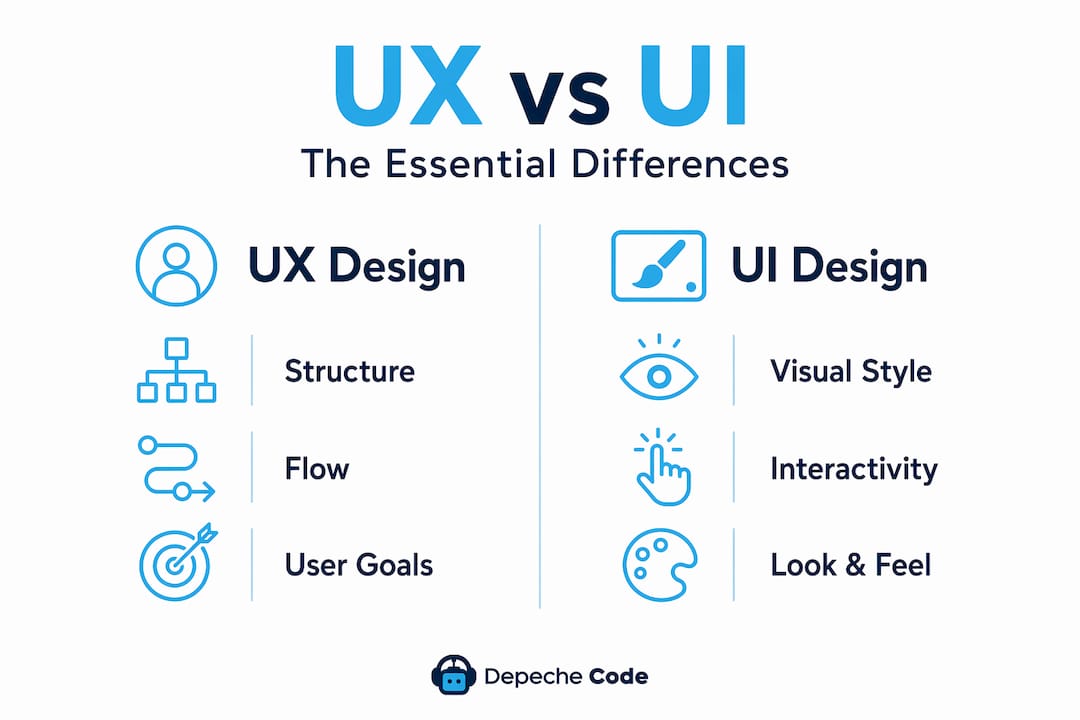
Think of it this way: if a product were a house, UX design is the architectural blueprint. It determines room placement, traffic flow, where the doors go, and how occupants move through the space. UI design is the interior decoration. It decides paint colors, furniture style, and where the light fixtures hang. Both matter enormously. But you cannot decorate a house that has no floor plan.

UI design covers the visual and interactive elements users see and touch: buttons, icons, typography, color palettes, and layout grids. UX design covers the underlying structure, logic, and flow that determines whether users can actually accomplish what they came to do.
| Dimension | UX design | UI design |
|---|---|---|
| Focus | Structure, flow, and user logic | Visual style and interactive elements |
| Tools used | Wireframes, journey maps, user research | Mockups, style guides, prototyping tools |
| Comes first? | Yes. UX always precedes UI | No. UI is built on top of UX structure |
| Measured by | Task success rate, error rate, satisfaction | Visual appeal, brand consistency |
| Risks if skipped | Users get lost, frustrated, and leave | Product works but looks unprofessional |
UX always precedes UI. Validating structure and flow before adding visual polish prevents costly redesigns down the road. Many teams make the mistake of starting with how something looks before establishing whether the logic underneath actually serves the user.
Pro Tip: Before any UI design begins, complete at least one round of low-fidelity wireframe testing with real users. You’ll catch structural problems when they cost almost nothing to fix.
The UX design process and methodologies
One of the biggest misconceptions about what UX methodology looks like is that it’s linear. You research, you design, you launch. Done. That’s not how it works. UX is highly iterative and cyclical. Revisiting earlier phases as you learn more is not a sign that something went wrong. It’s how good design actually happens.
Here’s how a standard UX process flows in practice:
- Discovery and research. Talk to real users. Run interviews, surveys, and contextual inquiries. Build personas based on actual behaviors, not assumptions. Identify the problems worth solving before generating solutions.
- Define and synthesize. Translate research into clear problem statements. Map user journeys to visualize where friction exists across the full experience.
- Ideate and design. Generate solutions through sketching and wireframing. Focus on structure and flow first. Visual design comes later.
- Prototype. Build a testable version of the experience. It can be as simple as clickable screens or as detailed as a near-functional app.
- Test with users. Observe real people using the prototype. The goal is to learn, not validate.
- Iterate. Use what you learned to revise the design. Loop back through earlier stages as needed.
You do not need a large group to make testing productive. Testing with 5 to 8 users uncovers the majority of major usability issues when done early and repeated across iterations. Large sample sizes matter for statistical research. For usability testing, small and frequent beats big and rare.
The financial logic is hard to argue with. Fixing design errors post-launch can cost up to 100 times more than catching them during the design phase. Early investment in UX validation is not an expense. It’s cost avoidance.
Pro Tip: Record your usability sessions whenever participants consent. Watching a 10-minute clip of a user struggling with your checkout flow is more persuasive to stakeholders than any written report.
Why UX design directly impacts business results
The importance of UX design is not a matter of taste. It’s measurable. And in 2026, the data is clear enough that treating UX as optional is simply a bad business decision.
Start with the cost of poor onboarding. 25% of mobile apps are downloaded once and never reopened, largely because of UX friction in the first minutes of use. That’s not a marketing failure. That’s a UX failure. You can spend a fortune acquiring users and lose all of it in the first session.
Speed is another often-underestimated UX factor. Retail businesses lose $2.6 billion annually due to slow-loading pages. Users don’t wait. They leave. And they rarely come back.
Here’s a snapshot of how UX investment compares across key business metrics:
| Metric | Poor UX impact | Strong UX impact |
|---|---|---|
| Conversion rate | Drops sharply with every second of delay | Increases 8%+ with 0.1s load time improvement |
| App retention | 25% of apps opened only once | High retention with clear, low-friction onboarding |
| Support costs | High volume of user confusion tickets | Fewer tickets when UI is self-explanatory |
| Revenue growth | Stagnation or churn | Design-led companies grow revenue 32% faster |
“Journey-centric UX enables innovations that improve business outcomes through a strategic big-picture view of customer interactions across channels.” — Nielsen Norman Group
That quote reflects where best practices in user experience design are heading. The most forward-thinking UX teams are no longer thinking just about individual screens. They’re mapping the full customer lifecycle across every touchpoint, from the first social media impression to a post-purchase support call. That’s what it means to know how to improve user experience at scale. Understanding how UX drives conversions is the starting point for any serious digital strategy.
My take on where UX is actually heading
I’ve spent years watching companies confuse UX with cosmetics, and the pattern is exhausting. A business decides their product isn’t converting, so they hire someone to make it “look better.” The designer changes colors and fonts. Nothing improves. Then they wonder why.
What I’ve learned is that the best UX work is invisible. When a product works well, users don’t notice the design. They just accomplish what they came to do and leave with a positive feeling they can’t quite articulate. The moment users start noticing the interface, something has gone wrong.
In my experience, the biggest gap in most organizations isn’t design talent. It’s design timing. Teams bring in UX thinking too late, after the architecture is set and the development sprint is almost done. At that point, fixing anything meaningful is expensive and politically difficult. The research is clear: catch it early or pay for it later.
The shift toward journey-centric UX is the most important structural change in the field right now. Products don’t live in isolation. A user’s experience of your mobile app is shaped by the email they got before opening it, the support chat they had last month, and the review they read before downloading. If your UX team is only thinking about screens, they’re thinking too small.
My honest advice: treat UX as a continuous practice, not a project phase. The companies getting this right in 2026 are running small, frequent user tests as part of their normal product rhythm. Not because they have bigger budgets. Because they’ve learned it’s cheaper than the alternative.
— Donovan
Ready to build a better user experience?
Understanding UX design principles is only half the equation. Translating them into a product that actually works for your users is where expertise makes the difference.
At Depechecode, we build websites and apps with UX thinking at the core, not bolted on afterward. Whether you’re starting from scratch or overhauling an underperforming digital product, our team handles the architecture, the flow, and the fine details. Check out our website design services to see how we approach builds that convert and retain users. If mobile is your priority, our app development team applies the same UX-first process to create experiences users actually return to. When UX is done right from day one, the results show up in your metrics.
FAQ
What is user experience design in simple terms?
User experience design is the practice of planning and shaping how a person interacts with a product so those interactions are clear, efficient, and satisfying. It covers structure, flow, accessibility, and the full emotional arc of using a product.
How is UX design different from UI design?
UX design defines the underlying structure, logic, and user flow of a product. UI design adds the visual layer on top, including buttons, colors, and typography. UX always comes first because it determines whether the product makes sense before anyone thinks about how it looks.
Why does UX design matter for business?
Poor UX directly costs money. Slow load times alone cost retail businesses $2.6 billion annually, and design-led companies grow revenue 32% faster than peers with weak UX practices.
How many users do you need for UX testing?
You don’t need a large group. Testing with 5 to 8 users is enough to uncover the majority of significant usability issues, especially when testing is done early and repeated through each iteration.
What are the most important UX design principles?
The core principles are user-centricity, clarity, consistency, feedback, accessibility, and error prevention. Applied together, these principles reduce friction, improve task completion, and build the kind of trust that brings users back.