

TL;DR:
- Most businesses neglect SEO, and as a result, they receive little to no organic website traffic from Google. Investing in SEO is essential for long-term growth, lower costs, and building authoritative brand presence that paid ads cannot replicate. Proper SEO involves focusing on content quality, technical health, authority, and adapting strategies to include AI visibility for sustainable results.
Most businesses spend months building a website and then wonder why no one visits it. The answer is almost always the same: no SEO. 96.55% of web pages receive zero organic traffic from Google, which means the majority of content online simply does not exist to potential customers. If you are a business owner or marketing professional asking why invest in SEO, the short answer is survival. The long answer covers compounding returns, lower customer acquisition costs, and a brand presence that paid ads simply cannot replicate.
Table of Contents
- Key Takeaways
- Why investing in SEO drives real business growth
- Common SEO pitfalls that kill your investment before it pays off
- How SEO works in 2026: content, technical health, and authority
- How to maximize your SEO investment and measure ROI
- My take on why SEO still wins in 2026
- Ready to build SEO that actually delivers?
- FAQ
Key Takeaways
| Point | Details |
|---|---|
| SEO drives the most traffic | Organic search accounts for over half of all website traffic, making it the highest-volume channel available. |
| ROI compounds over time | Unlike paid ads, SEO builds on itself so that rankings and traffic grow without proportional cost increases. |
| Fundamentals beat shortcuts | Technical health, content quality, and authority building consistently outperform hacks or quick fixes. |
| Measurement needs a modern lens | Track branded search volume, qualified traffic, and conversions, not just raw clicks. |
| 2026 SEO includes AI visibility | Optimizing for AI-driven search results is now part of any serious SEO strategy, not an optional add-on. |
Why investing in SEO drives real business growth
The case for SEO is not philosophical. It is mathematical. Organic search drives 53% of all website traffic across industries, making it the single largest traffic channel most businesses can access. Yet 63% of businesses say generating traffic is their biggest marketing challenge. That gap exists because most companies treat SEO as an afterthought rather than a foundational investment.
Here is what separates SEO from other marketing channels:
- No per-click cost. Once you rank, traffic is free. A paid search campaign stops the moment the budget runs out. An optimized page keeps pulling in visitors for months or years without additional spend.
- Qualified intent. People searching on Google are actively looking for solutions. That intent makes organic visitors far more likely to convert than audiences reached through interruption-based advertising.
- Brand authority. Appearing at the top of search results signals credibility. Users trust search engines, and by extension, they trust the businesses those engines surface first.
- Compounding returns. A sustainable ranking flywheel develops over time: better rankings attract more backlinks, which strengthen rankings further, creating growth that accelerates without proportional cost increases.
When you compare SEO to paid advertising head-to-head, the differences become even clearer.
| Factor | SEO | Paid Advertising |
|---|---|---|
| Traffic cost after ranking | Minimal ongoing cost | Cost per click, every click |
| Longevity | Sustains with maintenance | Stops when budget stops |
| Trust signal | High (organic placement) | Lower (labeled as ad) |
| Time to results | 3 to 6 months typically | Immediate |
| Scalability | High with compounding effect | Linear with budget |
Pro Tip: If you are early in your SEO investment, use paid search to cover short-term traffic needs while SEO builds. The two are not competitors. They work well together during the ramp-up phase.
A practical example worth considering: a 1% conversion rate improvement can generate a 10% revenue increase for many businesses. SEO does not just bring traffic. It brings the right traffic, and better traffic converts at higher rates.
Common SEO pitfalls that kill your investment before it pays off
Many businesses try SEO, see disappointing results, and conclude it does not work. In most cases, the problem is not SEO itself. It is the approach.
The fundamentals drive SEO success, not hacks or shortcuts. Buying cheap backlinks, stuffing keywords, or publishing dozens of thin articles will not get you to page one in 2026. Google’s systems have become sophisticated enough to recognize and penalize these tactics.
Here are the most common pitfalls to avoid:
- Ignoring technical SEO. If Google cannot crawl and index your site properly, your content does not matter. Site speed, mobile responsiveness, proper redirect structures, and clean URL hierarchies are prerequisites, not bonuses.
- Publishing without a strategy. More content does not equal more traffic. Pruning underperforming pages and refreshing valuable assets improves overall site authority by concentrating crawl budget on pages that actually perform.
- Neglecting user intent. A page optimized for a keyword that does not match what searchers actually want will never rank well, regardless of how technically perfect it is. Matching content to intent is non-negotiable.
- Setting and forgetting. SEO requires ongoing attention. Algorithm updates, competitor moves, and content decay all erode rankings over time if you are not maintaining your investment.
Pro Tip: Run a content audit before creating anything new. Identify pages with thin content, duplicate topics, or declining traffic. Fixing what you already have often delivers faster results than adding more pages.
The businesses that struggle with SEO returns are almost always the ones that skipped the foundation. Technical issues left unresolved create a ceiling that no amount of content production can break through. For a practical look at what a structured approach looks like, the SEO optimization strategies outlined by Depeche Code walk through exactly what foundational work looks like in practice.

How SEO works in 2026: content, technical health, and authority
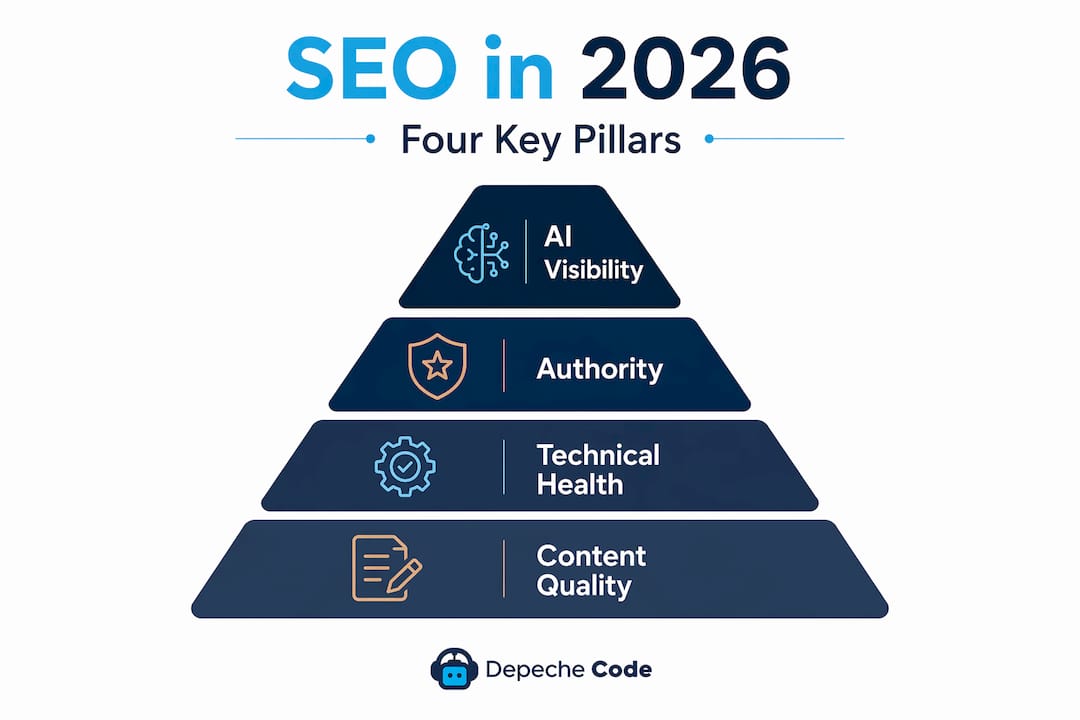
SEO in 2026 rests on three interdependent pillars. Neglect any one of them and the other two underperform. Understanding how they connect helps you allocate time and budget far more effectively.
-
Content quality and relevance. Google prioritizes helpful, problem-solving content aligned with what users are genuinely searching for. That means writing to answer real questions with depth, not stuffing paragraphs with keywords. Businesses that win in 2026 are building comprehensive topic clusters rather than chasing isolated keywords. A cluster approach builds topical authority across a subject area, signaling to Google that your site is the go-to resource on a given topic.
-
Technical excellence. Page load speed affects bounce rates. Sites with intrusive ads, poor mobile experiences, or broken internal links lose rankings regardless of content quality. Google’s systems directly measure user experience signals. A technically sound site is a prerequisite for everything else.
-
Authority through backlinks. Backlinks are the 3rd most important Google ranking factor. Their weight shifted from 15% to 13% of the algorithm, but they remain essential. What changed is the emphasis on quality. A single link from a high-traffic, topically relevant site delivers more value than 50 links from irrelevant directories. Editorial links from trafficked pages pass the most equity and accelerate rankings most reliably.
The fourth pillar, still emerging but critical, is AI visibility. Optimizing for AI-driven search results, sometimes called GEO (Generative Engine Optimization), is becoming part of every serious SEO strategy. When AI tools summarize answers, they pull from authoritative, well-structured sources. Being that source requires the same fundamentals that drive traditional SEO, but with added emphasis on clear structure, factual accuracy, and brand signals.
| SEO Pillar | Core Actions | Business Impact |
|---|---|---|
| Content quality | Topic clusters, intent matching, depth | Ranks for broader keyword sets |
| Technical health | Speed, mobile, crawlability | Reduces lost rankings from UX issues |
| Authority building | Quality backlinks, brand mentions | Sustains rankings under algorithm changes |
| AI visibility (GEO) | Clear structure, factual accuracy, brand signals | Captures AI citation traffic |
How to maximize your SEO investment and measure ROI
Investing in SEO without a measurement framework is like running a store with no register. You might be busy, but you have no idea if you are profitable.
Start with a content audit. Pull your current pages and identify three groups: pages performing well that deserve more investment, pages with potential that need refreshing, and pages dragging your site authority down that should be pruned or consolidated. Refreshing old content can boost organic traffic by over 100% within six months. That is often faster and cheaper than creating entirely new material.
Next, shift your keyword research toward semantic search and user intent. Long-tail queries with clear intent (someone searching “best CRM for a five-person sales team” versus just “CRM”) convert at higher rates and face less competition. Building content around these queries produces traffic that matters.
For ongoing content creation, depth beats frequency. One thorough, well-researched article that covers a topic completely will outperform ten shallow posts targeting the same keyword. Publish consistently, but never at the expense of quality.
Measuring SEO return on investment in 2026 requires a broader framework than clicks alone. 80% of searches end without a click because users get their answers from featured snippets or AI summaries. That does not mean your SEO failed. It means brand impressions, visibility, and qualified traffic are metrics worth tracking alongside conversions. Watch these indicators:
- Organic traffic from qualified audiences, not just total volume
- Branded search growth over time, showing increasing awareness
- Conversion rate from organic visitors versus other channels
- Rankings for target keywords and topic clusters
- Time to rank for new content
Pro Tip: Set up a simple monthly reporting dashboard that tracks organic sessions, branded search impressions, and goal completions from organic traffic. It takes 30 minutes to build and gives you the data you need to defend and grow your SEO budget.
For professional services firms, specialized content strategy plays an outsized role in SEO performance because trust is part of the conversion process. The same logic applies across industries: the more your content demonstrates expertise, the harder it is for competitors to displace you.
The detailed breakdown of SEO ROI for businesses compiled by Depeche Code shows how these metrics translate into real revenue outcomes for companies across multiple industries.
My take on why SEO still wins in 2026
I’ve had conversations with business owners who have written off SEO entirely after a bad experience with an agency that chased rankings with cheap tactics. What I’ve consistently found is that the problem was never SEO. It was a lack of foundational work paired with unrealistic timelines.
In my experience, the businesses that see the strongest returns treat SEO as a business system rather than a marketing experiment. They fix technical issues first. They take content seriously. They build authority through genuine relationships and earned links, not purchased ones. And they measure what matters instead of obsessing over rankings alone.
What I’ve learned from watching sites succeed and fail over time is that patience is not passive. It means making smart, consistent moves every month. A site that committed to solid SEO fundamentals 18 months ago is pulling in traffic today that its competitors are paying per click to access.
The search ecosystem is changing faster than ever, with AI reshaping how results are served and consumed. But the businesses that built real authority are the ones getting cited by those AI systems. The fundamentals did not become less important. They became the entry ticket.
If you are sitting on the fence about SEO, ask yourself what your competitors are doing. The answer to that question is usually enough.
— Donovan
Ready to build SEO that actually delivers?
If you recognize your business in any part of this article — good content with no visibility, technical issues holding back rankings, or an SEO investment that stalled without results — Depeche Code can help you move forward with a clear plan.
As a full-service digital agency based in Orlando, Depeche Code works with businesses of all sizes to build SEO strategies grounded in fundamentals, not guesswork. From technical audits and content strategy to local SEO solutions and AI-assisted organic growth, every service is built around measurable business outcomes. The SEO plans and options are structured to fit where your business actually is, whether you are starting from scratch or scaling an existing presence. Pair that with Depeche Code’s website design services and your technical SEO foundation is solid from day one.
FAQ
Why should a business invest in SEO instead of paid ads?
SEO delivers traffic that does not stop when a budget runs out, while paid ads require continuous spend for results. Over time, organic rankings provide a significantly lower cost per acquisition than pay-per-click campaigns.
How long does it take to see SEO results?
Most businesses see meaningful organic traffic growth within three to six months of consistent, foundational SEO work. Highly competitive industries may require 9 to 12 months for significant ranking gains.
Is SEO worth the cost for small businesses?
Yes. Small businesses often benefit most from SEO because they can target local and long-tail queries where competition is lower and conversion intent is higher. The return on investment scales well with consistent effort.
What is the biggest mistake businesses make with SEO?
Skipping technical SEO fundamentals is the most common and costly mistake. Without proper crawlability, site speed, and mobile optimization, even excellent content will struggle to rank regardless of how well it is written.
How do you measure SEO return on investment in 2026?
Measure organic traffic quality, branded search growth, and conversions from organic visitors alongside rankings. With over 80% of searches ending without a click, brand visibility metrics are now as important as raw traffic numbers.