

TL;DR:
- Search visibility in 2026 depends on frequent citations within AI-generated answers, not just traditional rankings.
- Building topical authority through content clusters and structured data is essential for optimizing AI extraction and trust signals.
SEO trends in 2026 are defined by a single structural shift: search visibility now depends on being cited inside AI-generated answers, not just ranking on a results page. The global SEO market is projected to reach USD 83.98 billion in 2026, up from USD 74.9 billion in 2025. That growth reflects how seriously businesses are investing to stay visible as Google AI Overviews, ChatGPT, and Perplexity reshape how people discover information. Two new disciplines, Generative Engine Optimization (GEO) and Answer Engine Optimization (AEO), have moved from experimental to mandatory. And E-E-A-T (Experience, Expertise, Authoritativeness, Trustworthiness) is no longer a quality checkbox. It is the primary filter AI systems use to decide whose content gets synthesized and cited.
How AI is reshaping SEO fundamentals and search visibility in 2026
The most disruptive SEO trend in 2026 is not a new algorithm update. It is the replacement of the ranked blue-link page with synthesized AI answers as the dominant search format. Google AI Overviews appear in 89% of brand-related search results, and zero-click searches now account for nearly 60% of all Google queries. That means the majority of searchers get their answer without ever visiting a website.

This changes the core success metric. An Adobe study confirms that visibility now depends on citation frequency within AI-generated answers, not page position. The practical implication: a brand cited in position three of an AI Overview reaches more users than a brand ranking number one in traditional results that the AI ignores entirely.
The upside is real. AI referral traffic shows 12% more pages per visit and 23% lower bounce rates compared to traditional organic traffic. Users arriving from AI-generated answers are more engaged and more commercially motivated, which makes AI citation a higher-quality traffic source, not just a higher-volume one.
To capture that traffic, content must be engineered for three properties: extractability, verifiability, and contextual clarity. AI systems need to parse your content quickly, confirm its accuracy against other sources, and understand the context of every claim. Vague, padded content fails all three tests.
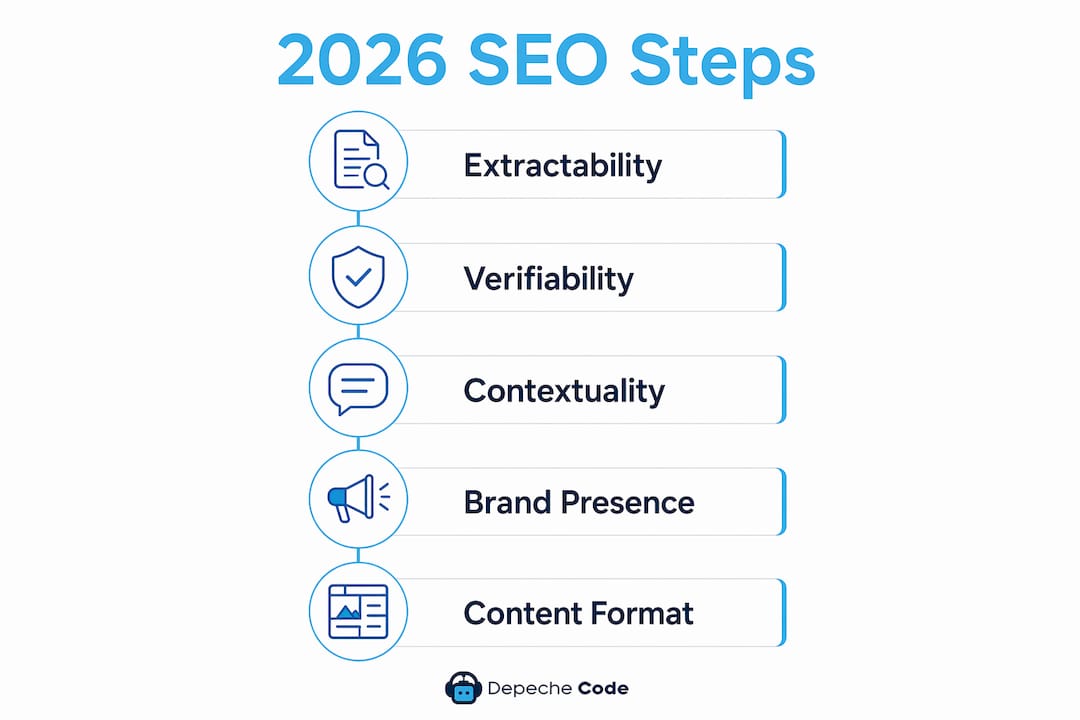
Pro Tip: Audit your top 20 pages for extractability right now. Ask: can an AI system pull a clean, accurate answer from the first 60 words of each section? If not, restructure those sections before any other optimization work.
Key operational shifts for marketing leaders to act on:
- Measure brand citation frequency across Google AI Overviews, ChatGPT, and Perplexity monthly
- Treat share of model as a core KPI alongside traditional organic traffic
- Prioritize content that answers specific, high-intent questions with verifiable facts
- Build structured metadata that makes brand information machine-readable
- Coordinate SEO with PR and digital authority-building teams, since citations follow credibility
What are GEO and AEO, and why do they matter in 2026?
GEO and AEO are distinct yet complementary disciplines that sit alongside traditional SEO as a three-layer visibility stack. Understanding how they differ is the starting point for building a 2026 search strategy that actually works.
Generative Engine Optimization (GEO) focuses on brand presence within AI-generated responses across multiple platforms. The goal is to make your brand the entity that AI systems reach for when synthesizing answers in your category. This requires consistent brand signals across the web, strong digital PR, authoritative backlinks, and structured data that clearly identifies who you are and what you do.
Answer Engine Optimization (AEO) focuses on formatting and structuring individual pieces of content so they directly answer specific user questions. AEO content uses clear question-and-answer structures, concise definitions, and schema markup to make it easy for AI systems to extract and display your answer verbatim.
| Discipline | Primary goal | Core tactics |
|---|---|---|
| Traditional SEO | Rank URLs on search results pages | Keywords, backlinks, technical health |
| GEO | Appear as a cited brand in AI-generated answers | Digital PR, entity building, authority signals |
| AEO | Have specific content extracted as a direct answer | Q&A formatting, schema markup, concise definitions |
The three layers reinforce each other. Strong traditional SEO builds the crawlable foundation. GEO builds the brand authority that makes AI systems trust you. AEO structures the content so AI systems can actually use it. Skipping any layer creates gaps that competitors will fill.
Pro Tip: For AEO, write a direct one-sentence answer to the target question within the first two sentences of every section. AI systems extract the clearest, most direct answer available. Give them one they cannot ignore.
Digital PR is the most underused lever in this stack. Every time a credible publication mentions your brand in context, that mention becomes a data point AI systems use to calibrate your authority. A single feature in a recognized industry publication can increase your AI citation rate more than dozens of on-page optimizations.
How to adapt SEO operations and measurement for an AI-first search landscape
The continuous operation model is the defining operational shift in 2026 SEO. The old campaign mindset, where you optimize a site, publish content, and wait for results, is structurally incompatible with how AI search works. AI systems re-crawl, re-synthesize, and re-rank content constantly. Your SEO must match that cadence.
Here is a practical framework for running SEO as an ongoing operation:
- Weekly crawl audits. Use tools like Screaming Frog or Sitebulb to catch technical issues before they compound. Broken internal links and crawl errors directly reduce AI extractability.
- Monthly content refreshes. Update statistics, add new examples, and sharpen the first 60 words of high-priority pages. Freshness signals matter to both traditional algorithms and AI synthesis engines.
- Quarterly authority reviews. Audit your backlink profile, identify gaps in topical coverage, and plan digital PR campaigns to fill them. Authority is the input AI systems weight most heavily.
- Ongoing AI citation monitoring. Manually query Google AI Overviews, ChatGPT, and Perplexity for your core topics monthly. Track which competitors appear and what content they are using.
- robots.txt governance. Robots.txt files now function as policy signals for AI models, controlling which content is available for synthesis. Review and update your directives to protect proprietary content while keeping high-value pages accessible.
Measurement is the hardest part of 2026 SEO. Standard tools like Google Search Console do not capture AI citation frequency or zero-click impressions accurately. You need a parallel measurement layer that tracks AI visibility separately from traditional organic performance. Attribution is genuinely complex when a user discovers your brand in an AI Overview, searches your name directly, and converts three days later. Build that multi-touch model before you try to optimize for it.
Key practical SEO strategies for 2026: content quality and topical authority
The most durable 2026 SEO technique is building genuine topical authority. Content clusters with structured internal linking improve both traditional rankings and AI citation rates, because they signal comprehensive expertise on a subject rather than isolated keyword targeting.
AI systems use a process called query fan-out, issuing multiple sub-queries internally to fully answer a single user question. A site that covers a topic from ten angles beats a site with one definitive post, because the AI can draw on multiple pages to build a richer answer. This makes content clusters a direct AI visibility strategy, not just an SEO best practice.
Practical strategies that deliver results in 2026:
- Optimize section openings. Write a direct answer to the section’s core question within the first 40 to 60 words. This is the primary extraction zone for AI systems.
- Use structured data aggressively. Schema markup for FAQPage, HowTo, Article, and Organization helps AI systems categorize and trust your content. Google’s Structured Data Testing Tool confirms implementation accuracy.
- Build E-E-A-T signals into every page. Author bios with credentials, first-hand experience statements, and citations to primary sources all strengthen the trust signals AI systems evaluate.
- Diversify discovery channels. Zero-click behavior means organic traffic from Google alone is no longer a reliable growth channel. Invest in email lists, social media presence, and direct brand search volume as parallel channels.
- Support multimodal search. Voice queries and visual search are growing. Use descriptive alt text, structured captions, and conversational phrasing in headers to capture these query types.
| Strategy | Primary benefit | 2026 relevance |
|---|---|---|
| Content clusters | Topical authority signals | High: supports query fan-out coverage |
| Schema markup | AI extractability | High: direct citation enabler |
| E-E-A-T optimization | Trust and authority | Critical: primary AI filter |
| Channel diversification | Resilience to zero-click | High: protects traffic base |
The role of content in SEO has shifted from keyword density to demonstrated expertise. Human-edited content with original insights, named authors, and verifiable claims consistently outperforms AI-generated content in both traditional rankings and AI citation rates. That gap will widen as AI systems get better at detecting synthetic content.
Why I think most SEO teams are still solving the wrong problem
The teams I see struggling most in 2026 are not the ones with bad content or weak technical SEO. They are the ones still optimizing for a metric that no longer drives the outcome they want. Ranking number one on a page that 60% of users never scroll past is a hollow win. The real competition is happening inside the AI answer box, and most teams are not even tracking whether they appear there.
What I have found actually works is treating AI citation as a brand reputation problem, not a technical SEO problem. The brands that appear most consistently in Google AI Overviews and Perplexity answers are the ones with the strongest off-page authority signals, the clearest content structures, and the most consistent entity presence across the web. That is a PR and content strategy problem as much as it is an SEO problem.
The measurement complexity is real and it is not going away. Zero-click attribution, agentic AI traffic where AI assistants act on behalf of users before any site visit occurs, and multi-platform discovery all make clean attribution nearly impossible with current tools. My advice: stop waiting for a perfect measurement framework and start building directional signals now. Track AI citation manually, monitor branded search volume, and watch engagement metrics from AI referral sources. Imperfect data acted on beats perfect data waited for.
The opportunity here is significant for teams willing to move. Most competitors are still running 2022 SEO playbooks. The window to build AI citation authority before the space gets crowded is open right now, but it will not stay open long.
— Donovan
How Depechecode helps you win in 2026’s AI-driven search environment
The SEO strategies that work in 2026 require a different kind of partner, one that understands both traditional optimization and the emerging demands of GEO and AEO.
Depechecode, based in Orlando, builds AI-enhanced organic SEO strategies that address all three layers of the 2026 visibility stack: technical SEO foundations, generative engine optimization for brand citation, and answer engine optimization for direct AI extraction. Every engagement includes continuous operational support, not one-time fixes. If you are ready to stop guessing and start measuring AI visibility alongside traditional performance, explore Depechecode’s SEO options and plans to find the right fit for your business size and goals.
FAQ
What are the biggest SEO trends in 2026?
The defining trends are AI-powered search formats like Google AI Overviews, the rise of GEO and AEO as optimization disciplines, and the shift from ranking-based to citation-based visibility measurement. Zero-click searches now account for nearly 60% of Google queries, making brand presence in AI answers more important than page position.
What is Generative Engine Optimization (GEO)?
GEO is the practice of optimizing brand presence within AI-generated responses across platforms like Google, ChatGPT, and Perplexity. It focuses on authority building, entity consistency, and digital PR rather than traditional keyword targeting.
How do you measure SEO success in an AI-first search environment?
Standard tools like Google Search Console are insufficient for full AI visibility. Effective measurement in 2026 requires tracking AI citation frequency, share of model across generative platforms, and engagement metrics from AI referral traffic alongside traditional organic data.
How does E-E-A-T affect AI search visibility?
E-E-A-T (Experience, Expertise, Authoritativeness, Trustworthiness) is the primary filter AI systems use to evaluate which content to synthesize and cite. Pages with named authors, verifiable credentials, primary source citations, and first-hand experience signals consistently earn higher AI citation rates.
Is traditional SEO still worth investing in for 2026?
Traditional SEO remains the technical foundation that makes AI citation possible. Crawlability, site speed, internal linking, and structured data all directly affect whether AI systems can access and trust your content. The shift is not away from traditional SEO but toward layering GEO and AEO on top of it.
Key takeaways
SEO in 2026 requires a three-layer strategy combining traditional optimization, GEO, and AEO to capture visibility across both ranked results and AI-generated answers.
| Point | Details |
|---|---|
| AI citation over rankings | Visibility now depends on being cited in AI answers, not just ranking on results pages. |
| GEO and AEO are mandatory | Both disciplines must layer on top of traditional SEO to cover all discovery surfaces. |
| Continuous operations model | SEO must run as an ongoing workflow with weekly audits, monthly refreshes, and quarterly authority reviews. |
| New measurement required | Track AI citation frequency and share of model alongside Google Search Console data. |
| Topical authority wins | Content clusters covering a subject from multiple angles outperform single-page keyword targeting in AI synthesis. |