

The best way to choose social media platforms is to pick the one or two where your customers already spend time and where your team can post consistently. Audience size is only half the question. In 2026, YouTube, Facebook and Instagram have the biggest US reach, but the right platform for a plumber, a law firm and a SaaS startup are three different answers.
This guide gives you the current US numbers, a shortlist of six platforms with who each one suits, and a four-step method for deciding. It also covers the mistake we see most often: choosing a platform your team cannot feed.
TL;DR
- YouTube, Facebook and Instagram have the largest US audiences, with TikTok growing fastest among the big four.
- Match the platform to where your buyers are, not to where you personally scroll.
- Choose based on the content you can produce every week, not the content you wish you could produce.
- Start with one or two channels, prove you can keep the rhythm, then add a third.
- B2B companies usually start with LinkedIn, local service businesses with Facebook and Instagram, and product brands with Instagram, TikTok and YouTube.
Table of Contents
- What US audiences actually use in 2026
- Six platforms compared
- A four-step method to choose
- Which platforms fit which business type
- Common mistakes when picking platforms
- How to keep going once you’ve chosen
- Our perspective
- When to hand it to a team
- FAQ
- Sources
What US audiences actually use in 2026
Start with the numbers, because gut feeling about platforms is often a few years out of date.
According to DataReportal’s Digital 2026 report for the United States, YouTube reaches roughly 253 to 254 million people in the US, about 73% of the population. Facebook follows at about 198 million, and Instagram at about 182 million. TikTok reports about 153 million users aged 18 and over in late 2025, an increase of 11% on the year before.
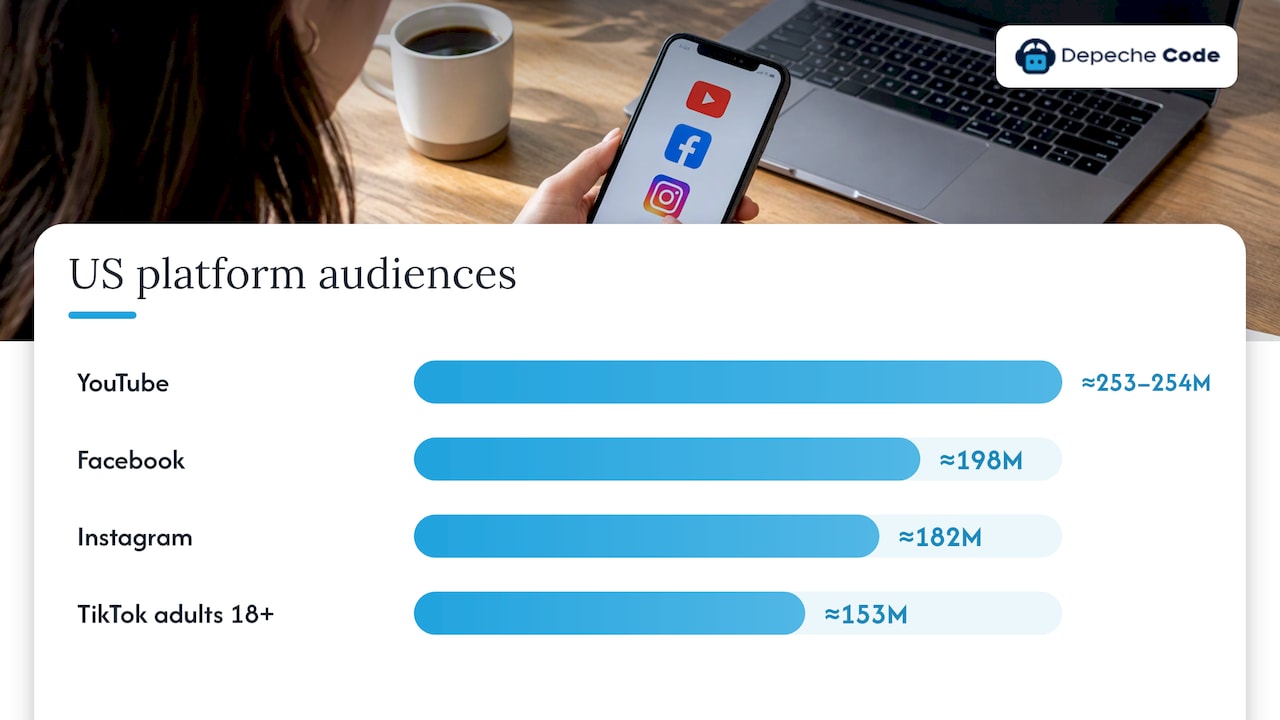
Survey data tells a slightly different, useful story about everyday use. Pew Research Center’s 2025 survey found that 50% of US adults use Instagram and 37% use TikTok. Around 30% use LinkedIn, 28% use Pinterest and 22% use X. YouTube and Facebook lead overall adoption.
Two things follow from this:
- Reach is concentrated. Three or four platforms cover most of the American adult population. You rarely need to look beyond them to find your customers.
- Smaller platforms can still win. LinkedIn’s 30% looks small, but if your buyers are procurement managers or founders, that 30% is the right 30%.
Six platforms compared
Here is how the main options compare for a US business. Audience figures come from the sources above. The “best for” column is our own judgment from working with small and mid-sized business clients.
| Platform | US adult use (Pew 2025) | Best for | Content it demands |
|---|---|---|---|
| YouTube | Most-used overall | Education, demos, local expertise, long-term search traffic | Video, planned and edited |
| Among the most-used overall | Local businesses, communities, events, paid ads to broad audiences | Short posts, photos, community replies | |
| 50% | Visual products, food, beauty, fitness, lifestyle, creators | Photos, Reels, Stories, fast iteration | |
| TikTok | 37% | Brand discovery, younger audiences, entertaining short video | Frequent, informal short video |
| About 30% | B2B services, hiring, consultants, professional advice | Text posts, opinion, case studies | |
| About 28% | Home, design, weddings, recipes, products people plan to buy | Vertical images, evergreen pins |
X sits at about 22% of US adults. It can suit news-driven or tech-heavy brands, but for most small businesses it is a later addition, not a starting point.
YouTube
YouTube has the largest reach in the US, and its videos keep working long after you post them. If you can explain something your customers search for, such as how to choose a roof or how to prepare for a tax meeting, a single good video can bring in viewers for years. The cost is production effort. You do not need a studio, but you need a plan and a way to edit.
Facebook still reaches about seven in ten US adults, according to DataReportal’s figures. It is the practical default for local businesses: you can post offers, answer messages, collect reviews and run targeted ads in one place. Organic reach is limited, so plan on a modest ad budget if you want to be seen beyond your followers.
Instagram suits businesses with something worth looking at. Restaurants, salons, boutiques, fitness studios and home-service companies with strong before and after photos do well. It rewards frequent posting and quick testing of formats, so it needs someone who enjoys the rhythm.
TikTok
TikTok has grown quickly, with 153 million US adult users reported in late 2025. It is strongest for reaching people who do not yet know your brand. It is also the platform most hostile to polished, corporate content. If your team is comfortable on camera and can post often, it can be a strong discovery channel. If not, skip it for now.
For B2B companies, LinkedIn is often the first platform to try. The format rewards clear opinions, lessons from real projects and thoughtful commentary, which takes editorial effort rather than video equipment. That is easier to sustain for many service firms than daily video.
Pinterest behaves more like a visual search engine than a social feed. People use it to plan purchases, so businesses in home, wedding, food and design categories can get steady traffic from pins that stay relevant for months.
A four-step method to choose
Step 1: Define who you want to reach
Write down your best five customers. Note their age range, job or situation, and where they look for answers. A 28-year-old buying skincare and a 52-year-old operations director buying software do not share a feed.
If you have analytics, check which sites already send you visitors. If you have a customer list, ask a handful of people where they follow brands. Ten honest answers beat any generic persona template.
Step 2: Match the goal to the platform
Different goals point to different places:
- Be found by people searching for help: YouTube and Pinterest.
- Win local customers: Facebook and Instagram, plus your Google Business Profile.
- Build authority with business buyers: LinkedIn and YouTube.
- Reach new, younger audiences: TikTok and Instagram.
Pick one primary goal first. A channel trying to do everything usually does nothing well.
Step 3: Audit your capacity honestly
This is the step most guides skip. Salesforce’s small business guidance makes the same point: using one channel well beats managing five badly, and you should assess your team’s capacity for video, design and copywriting, plus the time community management takes.
A useful test is what a platform comparison from PostPreview calls content velocity. LinkedIn rewards consistent written opinion, which takes editorial effort. Instagram and TikTok require fast iteration. If your team cannot sustainably produce the format a platform demands, you will burn out and the account will go quiet.
Ask three questions:
- Who will create the content, and how many hours a week do they have?
- Can we produce the format (video, photo, text) at an acceptable quality?
- Who will reply to comments and messages within a day?
If you cannot name a person for each, narrow your list.
Step 4: Pilot, measure and decide
Run one or two platforms for 8 to 12 weeks with a fixed posting schedule. Track a few simple things: reach, engagement, website clicks and inquiries that mention social media. Our guide to testing your social media post frequency walks through how to compare rhythms over a few weeks so the decision rests on data, not mood.
After the pilot, keep what produces inquiries, drop what doesn’t, and only then consider a third channel.
Which platforms fit which business type
These are starting points, not rules.
Local service business (HVAC, dental, landscaping, restaurants). Start with Facebook and Instagram. Add a Google Business Profile. Use photos of real work, customer reviews and local offers.
B2B service firm or consultancy. Start with LinkedIn. Add YouTube if you can explain complex topics on camera. Publish case studies and practical opinions.
Ecommerce or product brand. Start with Instagram and TikTok for discovery, and add Pinterest if your products are visual and planned purchases. YouTube works for demonstrations and reviews.
Professional practice (law, accounting, finance). LinkedIn and Facebook are usually the right fit, with YouTube for educational explainers. Keep regulatory advertising rules for your profession in mind and check them with your own compliance contact before posting.
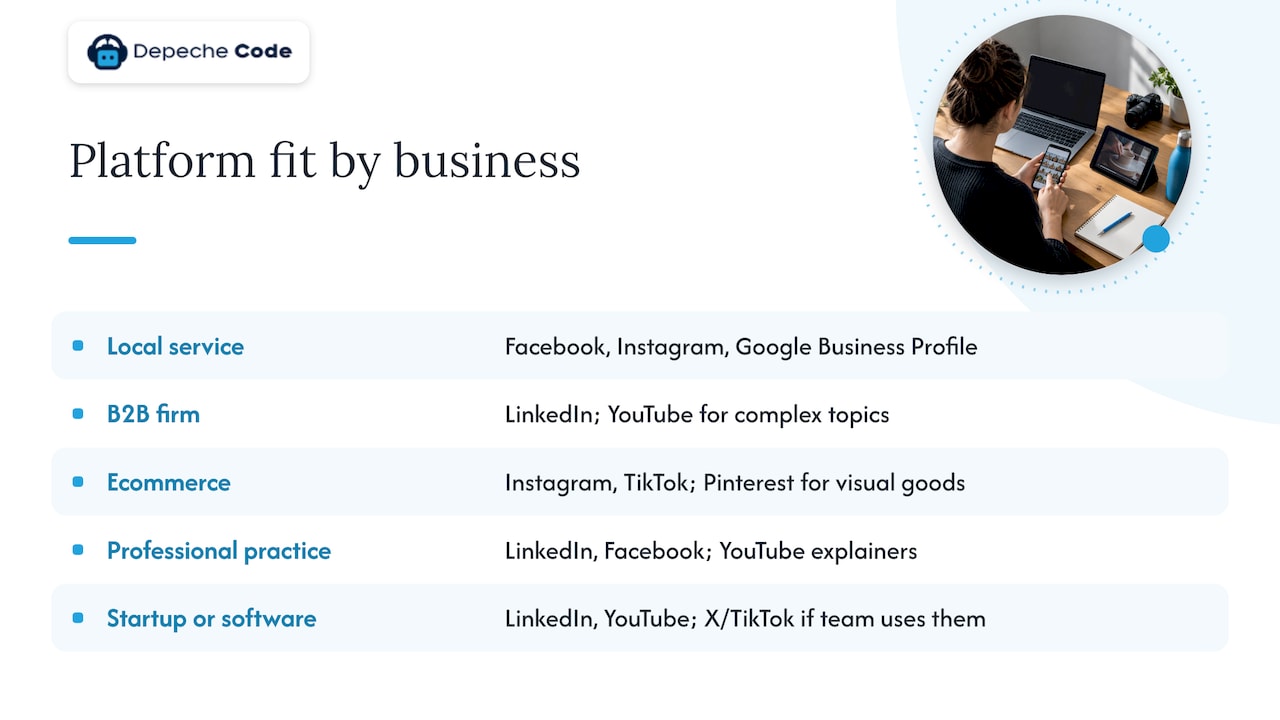
Startup or software company. LinkedIn for buyers and recruiting, YouTube for demos, and X or TikTok only if your team already lives there.
Common mistakes when picking platforms
- Following your own habits. The platform you love personally may not be where your buyers are.
- Chasing every new network. Being everywhere with thin content looks worse than being on two channels with steady, helpful posts.
- Copying one post across all channels. Each platform has its own format and tone. A LinkedIn text post and a TikTok clip are not interchangeable.
- Ignoring the audit. If no one owns the account, it will lapse. An abandoned page can hurt trust more than having no page.
- Measuring only likes. Likes feel good. Inquiries, calls and sales pay the bills.
How to keep going once you’ve chosen
Picking the platform is the easy part. Consistency decides the result.
Some experts recommend a light daily routine, sometimes called the 5-5-5 rule: five minutes checking metrics, five minutes engaging with commenters and mentions, and five minutes drafting or scheduling a post, as described in the PostPreview comparison. It is a heuristic, not a law, but it shows how small a sustainable habit can be.
Three practical supports:
- Build content pillars. Choose three recurring themes so you never stare at a blank page. Our guide to building three social media content pillars offers a 30/60/90 day plan.
- Plan ahead. A monthly calendar saves hours. See our social media content planning guide for a template approach.
- Audit what you already have. If you have accounts you have neglected, run through our social media audit checklist, which fits into 30 to 90 minutes.
If you want a fuller picture of what the work involves, read what social media management is and what it covers.
Our perspective
Most businesses that come to us are not short of ideas about which platform to try. They are short of hours. They sign up for four accounts, post enthusiastically for three weeks, and then everything goes silent while the real work of running the company takes over.
So we start the conversation with capacity, not trends. We ask who will answer the comments, how often a post can realistically go out, and what a good month looks like in terms of inquiries rather than followers. Often the answer is two platforms, a simple content calendar and a clear owner. That is a better plan than six profiles with no heartbeat.
We also push clients to treat social media as part of one system. Your website should be fast and clear enough to convert the visitors your posts send, and your search presence should support what you say on social. A strong channel pointing to a slow, confusing site wastes the effort.
Choose fewer platforms, show up every week, and judge the results on business outcomes. That approach works for a local shop and for a larger company alike.
— Donovan Wells – Founder and CEO
When to hand it to a team
If you have worked through the capacity audit and the honest answer is that nobody has the time, outsourcing is a sensible choice, not a failure. Our social media management service covers choosing the right channels for your audience, planning content and keeping the accounts active, so your presence stays consistent while you run the business. If you want to see the full range of what we offer around social, search and your website, start at our services overview.
FAQ
What is the best social media platform right now?
By US reach, YouTube leads, followed by Facebook and Instagram, according to DataReportal. But the best platform for you is the one where your customers are active and your team can post consistently. A B2B firm may do better on LinkedIn than on a platform with twice the audience.
How many social media platforms should a small business use?
Start with one or two. Salesforce’s guidance on growing businesses says it is better to use one channel well than to manage several poorly. Add a third only after you have kept a steady schedule for a couple of months and can see which channel produces results.
What is the 5-5-5 rule for social media?
It is a simple daily routine: five minutes reviewing metrics, five minutes engaging with commenters and mentions, and five minutes drafting or scheduling a post. It is described in the PostPreview platform comparison. It is a rule of thumb for building consistency, not an official standard.
Do I need to be on TikTok?
Not necessarily. TikTok reaches 37% of US adults, according to Pew Research Center, and it is useful for discovery. But it demands frequent, informal video. If your buyers are older professionals or your team cannot produce that content steadily, a channel like LinkedIn or Facebook will likely serve you better.
Sources
- DataReportal: Digital 2026, The United States of America
- Pew Research Center: Americans’ Social Media Use 2025
- Salesforce: Best Social Media Platforms for Growing Businesses
- PostPreview: Social Media Platform Comparison 2026