

A LinkedIn B2B strategy is an operating plan, not a posting calendar. It coordinates your Company Page, your people and any paid promotion so the right accounts get to know you before they need you, and so your sales team knows what to do when they raise a hand. This guide walks through that plan step by step, with the numbers and sources behind it.
TL;DR
- Set goals tied to qualified conversations and revenue, not impressions or follower counts.
- Define your audience by account and buying committee, then reach several people per account, not one senior title.
- Most buyers are not shopping today. Mix useful, memorable education with a smaller amount of direct offers.
- Treat the Page, employee profiles, paid ads and sales follow-up as one system.
- A LinkedIn lead is not yet an opportunity. Qualify it, then move it into your normal sales process.
Table of Contents
- Why LinkedIn works for B2B, and where it fails
- Step 1: Set goals that map to revenue
- Step 2: Define accounts and the buying committee
- Step 3: Fix your Page and your people’s profiles
- Step 4: Build a content mix that respects how buyers behave
- Step 5: Add paid promotion on purpose
- Step 6: Reach out with triggers, not volume
- Step 7: Turn engagement into qualified conversations
- Step 8: Measure and refine
- Our perspective: strategy before tactics
- Common mistakes to avoid
- Where we can help
- FAQ
- Sources
Why LinkedIn works for B2B, and where it fails
LinkedIn’s advantage is professional context. As Hootsuite’s 2026 strategy guide frames it, you can target by job title, industry, company, seniority and skills. That makes the platform a natural fit for account-based campaigns.
The catch is precision. If your audience definition is loose, you pay for reach among people who cannot influence the purchase. Most disappointing LinkedIn results trace back to one of three causes:
- Goals that measure activity (posts, likes, impressions) rather than pipeline.
- One surface optimized in isolation, usually the Page or the ads.
- No handoff to sales, so engagement never turns into a conversation.
The Factors.ai guide to LinkedIn B2B strategy describes the same failure: companies optimize the Page or the ads and never connect the employee voices, paid distribution and sales follow-up around them.
Step 1: Set goals that map to revenue
Hootsuite’s guide breaks an effective approach into five steps: set specific goals and metrics, research the audience, optimize the Company Page and executive profiles, develop valuable content, and analyze and refine. Start with the first one and be blunt about it.
A useful goal reads like a sales target, not a marketing one. Compare:
| Weak goal | Stronger goal |
|---|---|
| Grow followers | Get 15 target accounts to engage with us each quarter |
| Reach 100,000 impressions | Book a set number of qualified discovery calls from LinkedIn-sourced accounts |
| Post three times a week | Have two decision-makers per target account see our content monthly |
The numbers above are examples of the format, not benchmarks. Pick yours from your own close rates and average deal value.
Also decide what a LinkedIn-sourced opportunity means in your CRM before you start. If marketing and sales disagree on the definition, you will argue about results instead of improving them.
Step 2: Define accounts and the buying committee
B2B purchases rarely hinge on one person. Factors.ai reports that accounts with six or more engaged contacts had a 17.1-point higher win rate than accounts with one engaged contact. For deals of $250,000 or more, the gap was 24.5 points. The lesson is to multi-thread.
For each target account, list the roles that will touch the decision:
- Users: the people who live with the result day to day.
- Influencers and technical evaluators: the people who judge feasibility and quality.
- Finance and procurement: the people who test cost and terms.
- Security or compliance: the people who can veto.
- Executives: the people who sign.
Then build a list of named accounts and the two to five roles you want to reach in each. This list drives your content topics, your ad audiences and your outreach. If it is vague, everything downstream is vague.
Step 3: Fix your Page and your people’s profiles
Your Company Page is the proof point people check after something catches their eye. It should say plainly who you serve, what you do and what to do next. Treat it as a landing page, not a brochure.
The bigger gain is usually in individual profiles. Factors.ai describes a system where Page content provides consistency, employee and executive voices provide credibility, paid distribution provides account reach, and sales uses engagement context for follow-up. Each of those depends on people who look credible when a prospect clicks through.
A short checklist for founders, sales leads and subject-matter experts:
- A headline that states who you help and with what, not just a job title.
- A featured section linking to your best case study or a page where a prospect can start a conversation.
- A banner that carries one clear message.
- An About section written in first person, in plain language.
Because the Page often sends visitors to your website, check that the destination is ready. If traffic lands on a page that converts poorly, even the best LinkedIn work leaks. Our piece on B2B website conversion covers how a small sitewide conversion rate turns into pipeline.
Step 4: Build a content mix that respects how buyers behave
The most important idea in B2B content is the 95:5 principle. A briefing on the 95:5 rule argues that B2B marketers should spend less effort convincing out-of-market buyers to purchase and more effort making every buyer remember the brand when they do need the product or service.
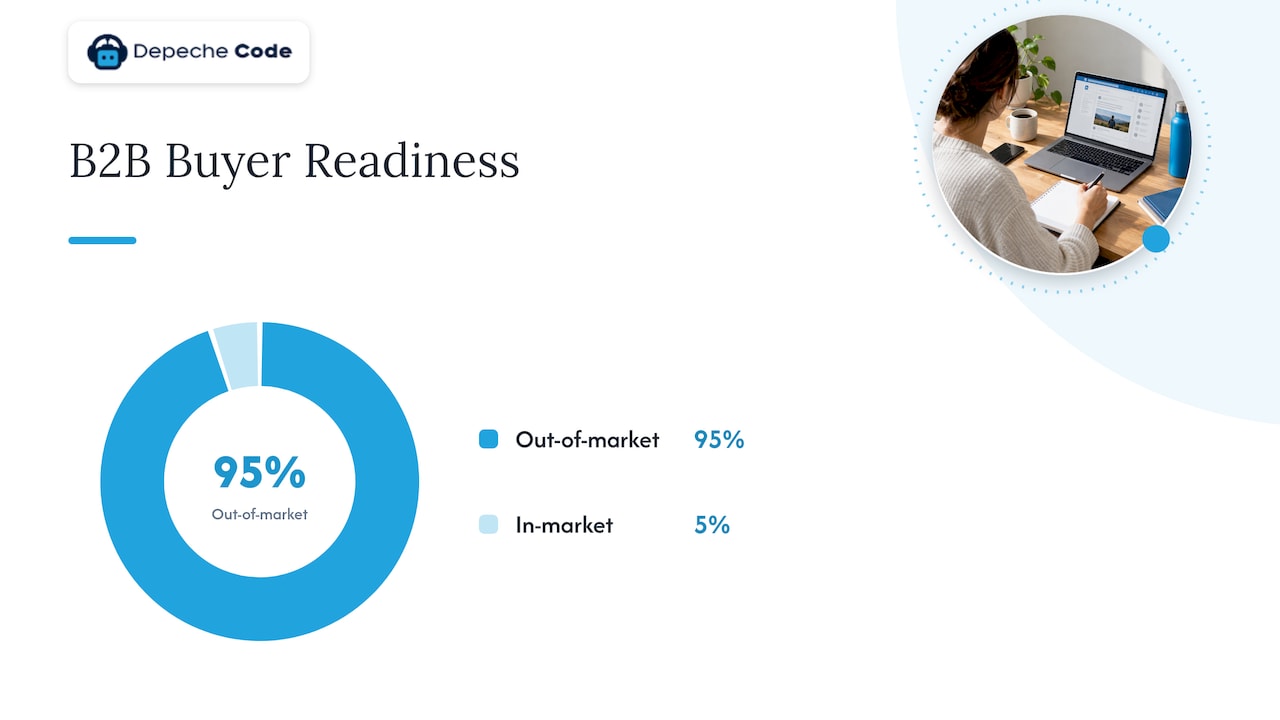
SurveyMonkey’s research on how B2B buyers decide quotes Derek Yueh of LinkedIn’s B2B Institute, who advises marketers to recognize that discovery often happens passively rather than as something buyers actively do all the time. That supports a two-speed plan.
Speed one: always-on, useful and memorable
This is the larger share of your posts. It is not a sales pitch. It is the content a future buyer remembers because it helped them or made them think:
- A plain-language explanation of a decision your customers struggle with.
- A teardown of a common mistake in your category.
- A short story from a real project, with the lesson, not just the result.
- A point of view on a trend, with your reasoning.
LinkedIn-native formats that invite replies, such as open-ended questions and polls, can help conversation, but only when the question is one your audience genuinely has an opinion on.
Speed two: targeted, conversion-focused
This is the smaller share. It speaks to accounts that show a real need: a case study sent to a target account, an ad offering a specific audit, an invitation to a working session. Sales-heavy posts are relevant to the small in-market segment but easy for everyone else to ignore, so keep them targeted rather than broadcast.
How often to post
Consistency beats volume. Choose a rhythm you can sustain for a year with real substance, then hold it. If you need a framework for planning, our social media content planning guide shows how to build a calendar around themes instead of last-minute ideas, and our content marketing examples show what that looks like in practice.
A workable starting rhythm for a small team:
| Surface | Cadence | Purpose |
|---|---|---|
| Company Page | A few posts per week | Consistency and a home for announcements |
| Founder or executive | Weekly | Point of view and credibility |
| Subject-matter experts | One post every two weeks each | Depth and trust with technical evaluators |
| Sales team | Comment and share regularly | Visibility with their own accounts |
These cadences are our suggestion for a small team, not a platform requirement.
Step 5: Add paid promotion on purpose
Hootsuite’s guide separates organic activity, including Page and employee content, from paid promotion such as Sponsored Content and Thought Leader ads. Keep that separation in your planning, because they do different jobs. Organic builds familiarity cheaply. Paid reaches specific accounts you cannot count on reaching organically.
Paid works best when you already know your accounts and roles. Use your named-account list as the audience, promote content that has already earned organic engagement, and send clicks to a page built for that audience. Do not use ads to rescue a weak message. They only make it more expensive to be ignored.
Step 6: Reach out with triggers, not volume
ZoomInfo’s 2026 LinkedIn lead generation playbook states that precise targeting and good timing beat high-volume outreach. It recommends prioritizing by trigger instead of sending generic connection requests to an entire title list. Useful triggers include:
- Recent funding.
- A relevant executive hire.
- Sustained hiring in a department you serve.
- A public post describing a problem you solve.
A good first message references the trigger, offers something specific and asks for nothing large. Compare “I’d love to connect and show you our services” with a note about a post they wrote, one observation that helps them and a light question. The second takes two minutes longer and gets read.
Step 7: Turn engagement into qualified conversations
A LinkedIn lead is not automatically a sales opportunity. ZoomInfo describes a practical funnel: target accounts, relevant buyers, useful content or ads, engagement, identification, enrichment, intent and fit qualification, routing, conversion, follow-up and revenue measurement.
The same playbook notes that most deals close off LinkedIn, so qualified prospects should move to email and phone, where reply rates are higher. Design for that:
- Agree on who responds to engagement, and within what time.
- Record what the person engaged with, so the first call is relevant.
- Qualify on fit (right company, right role) and intent (signals of a real need).
- Route qualified people into the normal sales process.
- Track the opportunity back to the LinkedIn source so you can measure revenue, not clicks.
Step 8: Measure and refine
Review monthly, and look at the whole chain:
- Reach quality: are the right accounts and roles seeing you?
- Engagement depth: how many people per target account have engaged? Remember the multi-threading finding.
- Conversation rate: how many engaged accounts became real conversations?
- Pipeline and revenue: which opportunities started on LinkedIn, and what did they close for?
Retire topics that attract the wrong audience, even if they get likes. Double down on posts that prompt replies from your target roles.
Our perspective: strategy before tactics
We build websites, SEO programs, chatbots and manage social media for businesses, so we see the same pattern often: companies pour effort into a channel while the pages behind it are not ready to convert the attention. LinkedIn is a good example. A strong post that sends a decision-maker to a slow, unclear or outdated page wastes the best part of the work.
Our view is that LinkedIn should be one connected part of your online presence, not an island. The content you write for LinkedIn can be reused and expanded on your site, and the questions prospects ask in comments tell you what your pages and search content should answer. That is why we pair channel work with technical performance, clear ownership of what is delivered and measurable outcomes.
If you do only three things, do these: define your accounts, give your own people a credible voice, and make the handoff from engagement to a real conversation explicit. Everything else is refinement. For the wider context, see our view on the role of marketing strategy in your online presence.
— Donovan Wells – Founder and CEO
Common mistakes to avoid
- Treating followers as the goal. Followers who can never buy are a vanity metric.
- Pitching in every post. Out-of-market buyers ignore it, and in-market buyers can find you through better content.
- Messaging whole title lists. Volume without a trigger reads as spam.
- Relying on one contact per account. Single-threaded deals are fragile.
- Letting sales and marketing work separately. Engagement data helps only if someone follows up with context.
- Ignoring the landing experience. Attention is wasted if the destination does not match the promise.
Where we can help
If your plan needs a stronger website to convert LinkedIn traffic, ongoing search visibility, or someone to run your social presence consistently, we can help. See our digital services overview or learn how our social media management works. If you are still comparing providers, our guide on matching agencies to two or three outcomes will help you decide what to ask.
FAQ
How do I approach B2B on LinkedIn?
Start with named target accounts and the roles that influence the purchase, then build content and outreach around them. Balance useful education for future buyers with targeted offers for accounts showing a need. Hand qualified engagement to sales with context.
How effective is LinkedIn for B2B?
It can be very effective when the audience is precise, because you can target by title, industry, company, seniority and skills. It underperforms when goals are vague or engagement never reaches sales. Judge it by pipeline and revenue, not impressions.
How do I increase my B2B engagement on LinkedIn?
Publish content that helps your specific audience, use questions that people in your field have real opinions on, and have employees and executives share their own perspective. Engage in comments on your target accounts’ posts. Engagement from several people at one account matters more than a high like count.
How should I think about LinkedIn lead generation for B2B?
Treat it as a funnel: identify the right accounts, create familiarity, recognize buying signals, qualify fit and intent, and move qualified prospects into your normal sales process. Most deals close off LinkedIn, so plan the move to email and phone.
Sources
- LinkedIn marketing strategy: How to grow in 2026, Hootsuite
- How to Build a LinkedIn B2B Marketing Strategy for Real Pipeline, Factors.ai
- LinkedIn Lead Generation: The 2026 Playbook for B2B Teams, ZoomInfo
- How B2B Buyers Choose: New Data on the Modern Journey, SurveyMonkey
- The 95:5 Rule briefing