

The best questions to ask a web developer are not about code. They are about what you will own, what is included in the quote, how success gets measured and who answers the phone after launch. Below are 20 questions for 2026, grouped by topic, each with what a strong answer sounds like and what should make you pause. If you are a developer preparing for the other side of the table, there is a short section for you too.
TL;DR
- Ask about ownership first: domain, code, content, hosting and analytics accounts should be in your name or handed over in writing.
- Insist on a written estimate broken into deliverables, milestones, a payment schedule and a change-order process. No honest developer can quote a universal price or timeline without scope.
- Ask for real-user performance targets (Core Web Vitals) and an accessibility target (WCAG 2.2 Level AA), not a vague promise of a “fast, accessible site.”
- Ask what happens after launch: hosting, security, maintenance, training and who edits the site.
- Judge answers by clarity, not jargon. A developer who explains plainly is usually one who works plainly.
Table of Contents
- Why the questions matter more than the portfolio
- Questions about experience and fit
- Questions about scope, price and timeline
- Questions about ownership and contracts
- Questions about technology
- Questions about speed, SEO and accessibility
- Questions about support after launch
- How to read the answers
- Our perspective: what we would ask if we were the client
- If you are the developer being interviewed
- Work with a team that welcomes these questions
- FAQ
- Sources
Why the questions matter more than the portfolio
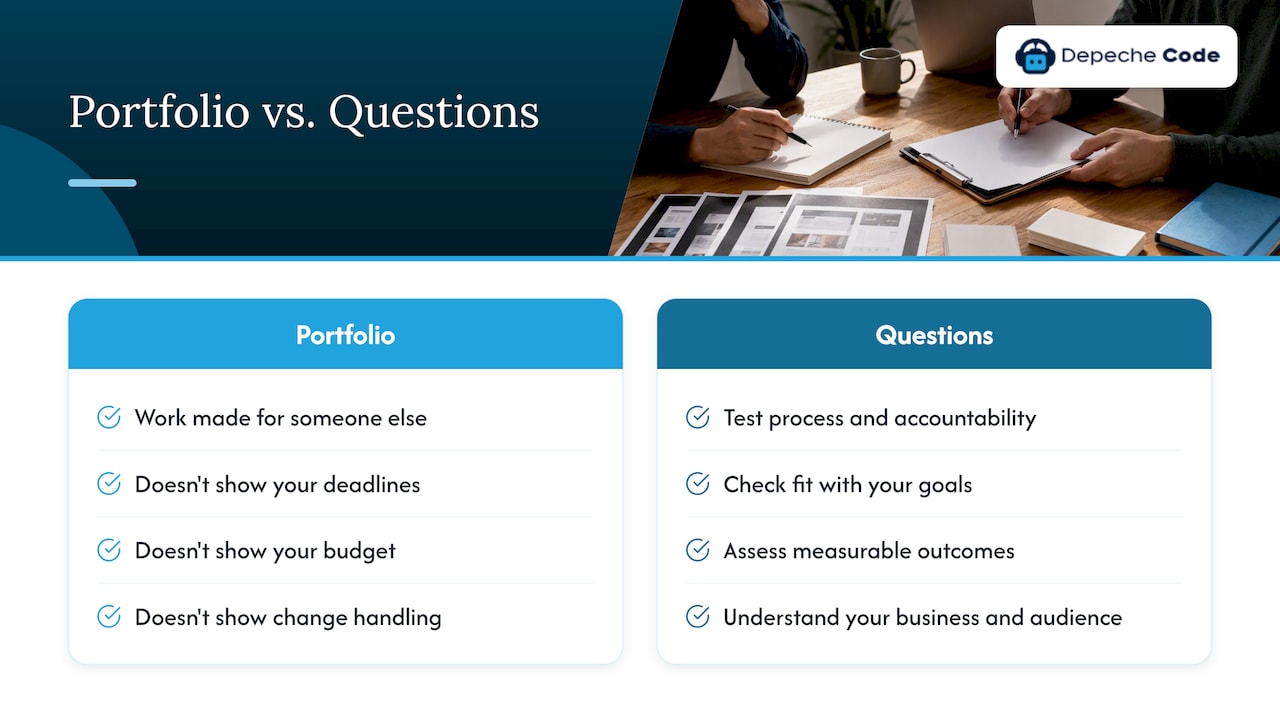
A polished portfolio shows what a developer made for someone else. It does not show how they handle your deadlines, your budget or the moment you want a change halfway through. Business.com’s guidance frames website design as marketing rather than decoration: a developer should understand your business model, audience, brand and the action you want visitors to take before proposing anything.
HubSpot’s agency guidance makes a similar point: the strongest evaluation looks at fit with your goals and measurable outcomes, not a list of technologies. So use the questions below to test process and accountability. The technology will follow.
Questions about experience and fit
1. What comparable sites have you built?
Ask for sites in your industry or with similar needs: bookings, e-commerce, lead generation, a members area. Then ask what the business wanted and what changed after launch. HubSpot’s checklist opens with the types of websites and applications the developer has built for good reason.
Good answer: specific projects, the goal, and a result or lesson. Pause if: you only get screenshots and adjectives.
2. Who will actually work on my project?
Agencies often pitch with senior people and staff with others. Ask who designs, who builds, who manages the project and whether any work is subcontracted.
3. What do you need to know about my business before you propose a design?
This is the most revealing question on the list. A good developer asks about customers, competitors, the actions that make you money and your current analytics. If they quote a design before asking any of that, they are selling a template.
4. Can I speak with two recent clients?
Real references take five minutes and tell you more than any testimonial page. Ask those clients about communication, missed dates and what the developer did when something went wrong.
Questions about scope, price and timeline
5. What exactly is included in the quote?
There is no defensible universal price or duration for a website. Scope, content readiness, integrations, migration, approvals, accessibility work, testing and ongoing services all move both numbers. That is why you should ask for the estimate broken down by deliverable, with assumptions and dependencies written out, rather than one lump sum.
Check the quote for these line items:
- Number and type of pages or templates
- Design rounds included
- Content writing, photography and migration
- Integrations (payments, CRM, booking, email)
- Accessibility and performance testing
- Training and launch support
6. What are the milestones and the launch date, and what could move it?
Business.com recommends asking for a realistic completion date. Then ask what depends on you. Late content and slow feedback are the most common reasons launches slip, and a good developer will say so up front.
7. How are changes handled once the scope is agreed?
You will want changes. Ask for the change-order process: who estimates, who approves, and how it affects cost and date. A written process protects both sides.
8. What is the payment schedule?
Payments should tie to milestones you can see, such as design approval, a working staging site and launch. Be wary of paying everything up front, or of a final payment due before you have tested the site.
9. What costs continue after launch?
Hosting, security updates, maintenance, plugin licenses, domain renewals and any monthly deliverables should all appear in writing. For context, our own WordPress hosting and maintenance plans start at $39 per month for dedicated hosting and $99 per month for maintenance, and we list what each covers so there is no surprise later. Whatever provider you choose, ask for the same clarity.
Questions about ownership and contracts
10. Who owns the domain, code, content and accounts?
This is the question many owners skip and later regret. HubSpot’s guidance stresses putting ownership, handoff, milestones and post-launch responsibilities in the contract rather than relying on verbal assurances.
Ask specifically about:
- The domain registration (it should be in your name)
- Source code and design files
- Hosting and analytics accounts, and their credentials
- Licenses for themes, plugins and stock imagery
- What happens to all of this if you part ways
Good answer: “Everything we deliver is yours on final payment, and here is the clause.” Pause if: the answer is “we host it, so we manage that.”
11. What happens if the relationship ends?
Ask how you get a full copy of the site and how long a handoff takes. A confident developer has a standard answer.
12. How will communication and approvals work?
Get a named contact, a regular check-in, one place for feedback and a response-time expectation. HubSpot’s list includes how involved you will be and how communication works, and a vague reply here predicts friction later.
Questions about technology
13. What technology do you recommend for my site, and why?
The framework matters less than the reasoning. A good answer ties the choice to your needs: who will edit content, how often, what integrations you need and how long the platform will be supported. If you will update pages yourself, a content management system your staff can use beats an impressive stack nobody on your team can touch.
14. Can my staff edit the site after launch, and will you train us?
Editability is on HubSpot’s list of questions for a reason. Ask for a recorded walkthrough or a live training session as part of the project, not as an extra.
15. How will the site work on phones?
The U.S. Bureau of Labor Statistics notes that expanding e-commerce and continued mobile use keep demand for sites that work across many screen sizes. Ask to see the design on real devices before launch, not only in a desktop mockup. Our guide to responsive web design explains what to check.
Questions about speed, SEO and accessibility
16. How will you measure performance?
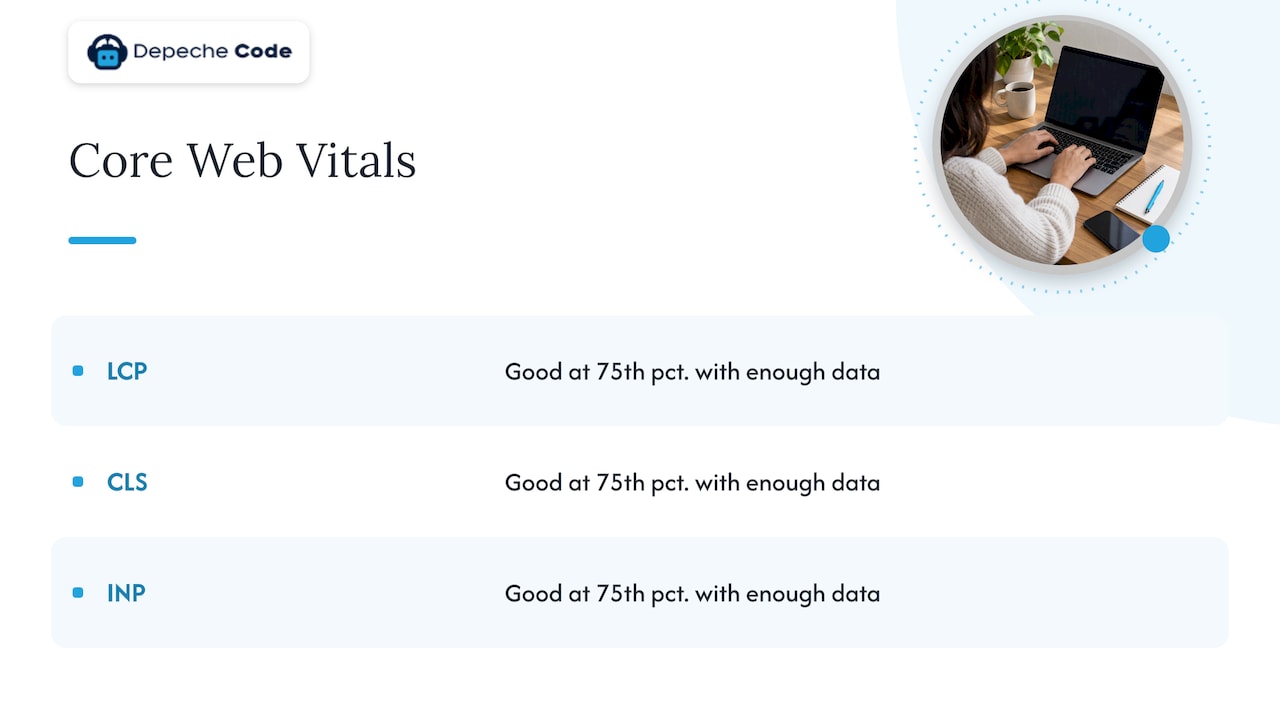
Do not accept “we guarantee a 100 score.” Google explains that PageSpeed Insights combines simulated Lighthouse diagnostics with real-user Chrome data, and that a page passes Core Web Vitals when the 75th percentile of all three metrics is Good where enough data exists. Those three metrics are Largest Contentful Paint, Cumulative Layout Shift and Interaction to Next Paint.
Ask the developer to name the devices and page templates they will test, the target for each metric, and how results will be monitored after launch. Lab scores are useful for diagnosis, but they are not the same as what your visitors experience. Our Core Web Vitals guide goes deeper.
17. What does your launch checklist include for search?
Ask about page titles, redirects from old URLs (critical in a redesign), sitemap, analytics and search console setup. If you are replacing an existing site, a missing redirect plan can undo years of search visibility. Our launch steps guide covers the full sequence.
18. What accessibility standard will you build to, and how will you test it?
The W3C describes WCAG 2.2 as testable, technology-neutral guidance with three conformance levels: A, AA and AAA. Ask whether the target is Level AA, and how keyboard navigation, form labels, focus states, heading structure and screen reader behavior will be checked. Accessibility should be tested during design and development, not bolted on as a final overlay. Read our website accessibility guide for the business side of this.
Questions about support after launch
19. What do hosting, security and maintenance look like?
Ask who applies updates, how often backups run, how fast you can restore a backup, and who responds if the site goes down on a Saturday. Ask for response times in writing.
20. How will we know the website is working?
Agree on two or three business measures before you start, such as form submissions, calls, bookings or sales, and a report schedule. If the developer cannot connect the site to a business result, you will struggle to judge it afterward.
How to read the answers
| Signal | Strong sign | Warning sign |
|---|---|---|
| Quote | Itemized, with assumptions | One number, no detail |
| Ownership | In writing, in your name | “We manage that for you” |
| Performance | Real-user targets by metric | A promised perfect score |
| Timeline | Milestones plus your dependencies | A date with no conditions |
| Support | Named contact, response times | “Just email us” |
| Explanations | Plain language | Jargon used to deflect |
Our perspective: what we would ask if we were the client
We build and maintain websites for a living, so we know which questions make us work harder, and those are the ones we want clients to ask. Our view is simple: you should own what you pay for. Deliverables should be transparent, performance should be measured with the tools Google publishes, and the price should be something you can plan around. We use AI tools directed by our own team to deliver faster, but speed is only worth anything if the result is documented, yours and measurable.
If we had one piece of advice, it is to ask your shortlist question 10 first. How a developer answers who owns what tells you almost everything about how they treat clients. The second is question 3: the developer who wants to understand your business before drawing a single page is the one who will build something that sells.
— Donovan Wells – Founder and CEO
If you are the developer being interviewed
The same topics come up from the employer’s side. Indeed’s list for employers covers reducing page load time, HTTP/2 versus HTTP/1.1, CMS experience, mobile development and client interaction. Prepare short situation, task, action and result stories instead of memorized definitions, and practice explaining your process to a non-technical client in two minutes.
The field is still worth entering. The BLS projects employment of web developers and digital designers to grow 7% from 2024 to 2034, against 3% for all occupations, with a 2024 median pay of $95,380 per year for the combined occupation.
Work with a team that welcomes these questions
We are an Orlando-based digital agency handling website design and redesign, SEO, WordPress hosting and maintenance, AI chat bots, mobile apps and social media management. Bring this list to any call with us. Browse what we offer or start from our home page, and we will answer every question above in writing.
FAQ
What questions should I ask a web developer before hiring?
Start with ownership of the domain, code and accounts, then what the quote includes, the milestones and launch date, how performance and accessibility will be measured, and what support continues after launch. Ask for comparable projects and two references as well. The 20 questions above cover each of these.
How much does a website cost and how long does it take?
No one can give a fair universal figure, because scope, content, integrations, approvals and testing all change the answer. Ask for a written estimate with deliverables, milestones, a payment schedule and a change-order process. Be cautious of any price given before the developer has asked about your goals.
What should I ask a web designer as opposed to a developer?
For a designer, focus on research, brand fit, user flow and how the design supports the action you want visitors to take. Developers should also answer the technical questions about performance, accessibility, hosting and ownership. Many small businesses hire one provider for both, so ask about both.
Is web development in demand?
Yes. The U.S. Bureau of Labor Statistics projects 7% growth for web developers and digital designers from 2024 to 2034, with about 14,500 openings per year on average. For a business, that means good developers are busy, so expect to plan ahead.
Sources
- Essential Questions to Ask Your Web Developer, Business.com
- 12 Questions to Ask a Website Development Agency or Developer, HubSpot
- About PageSpeed Insights, Google for Developers
- Web Content Accessibility Guidelines (WCAG) 2.2, W3C
- Web Developers and Digital Designers, U.S. Bureau of Labor Statistics
- Web Developer Interview Questions, Indeed