

A website proposal is a formal document that outlines your planned approach to a web design or development project, covering the project’s goals, scope, timeline, deliverables, cost, and terms. Think of it as both a roadmap and a pitch: it tells the client exactly what you’ll build and why you’re the right person to build it. Agencies and freelancers typically send one after an initial discovery call or in response to a client’s request for proposal (RFP). The client reviews it, asks questions, and approves it before any work begins.
A strong website proposal covers:
- Project goals and problem statement — what the client needs solved
- Proposed solution — your specific approach to addressing those goals
- Scope and deliverables — exactly what you’ll produce
- Timeline — milestones and expected completion dates
- Pricing and payment terms — total cost, broken into clear phases
- Call to action — what the client does next to move forward
The document serves two purposes at once. It informs the client about what they’re getting, and it persuades them to choose you over everyone else who submitted a proposal.

Why website proposals matter for project success
A well-written proposal sets clear expectations before a single line of code gets written. That upfront clarity is what prevents the most common project disasters: scope creep, budget disputes, and misaligned visions that drag projects out for months.

Proposals also do something less obvious. They demonstrate your expertise and align the client’s vision with your creative approach, which builds the kind of buy-in that makes clients advocate for your work internally. When a project manager has to present your proposal to a CFO or a board, a clear, professional document does the selling for you.
From a business standpoint, a proposal is your best chance to differentiate yourself from every other agency or freelancer the client is considering. A generic, templated pitch signals that you didn’t think deeply about their specific situation. A tailored one signals that you already understand their problem better than the competition does.
Pro Tip: Before writing a single word of your proposal, spend 20 minutes reviewing the client’s current website, their competitors’ sites, and any notes from your discovery call. Proposals that mirror the client’s own language and priorities convert at a noticeably higher rate than generic ones.
What are the key elements of a website proposal?
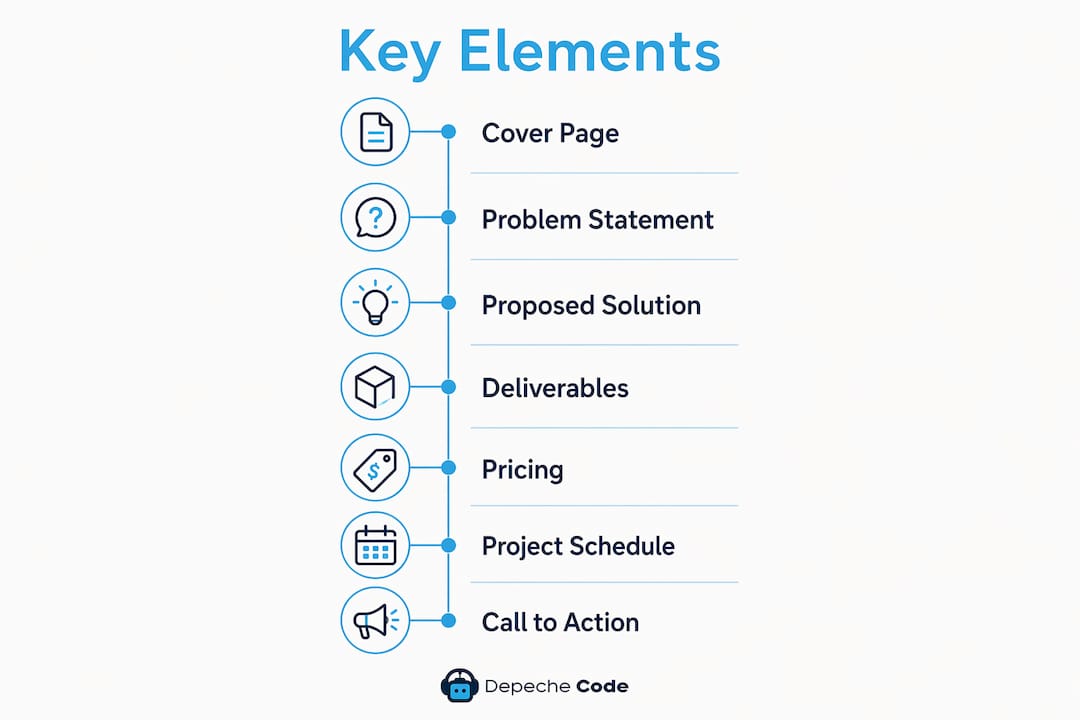
Every strong website proposal follows a recognizable structure. The key elements include a cover page, problem statement, proposed solution, deliverables and scope, pricing, schedule, and a call to action. Here’s what each section actually needs to accomplish.
Cover page
Your cover page is the first thing the client sees, and it sets the tone for everything that follows. Use a bold hero image, your logo, the client’s company name, and the project title. If you’re sending a PDF, the cover page becomes the file thumbnail, so high color contrast and clean design matter more than you’d think.
Problem statement
Restate the client’s challenge in your own words. Don’t copy and paste from their RFP. Restating it shows you genuinely understood what they told you, and it hooks their attention immediately. A client who reads their own problem described back to them accurately feels understood, and that feeling is worth more than any feature list.
Proposed solution
Describe your specific approach to solving the problem. If the client wants a website redesign to improve SEO, explain how updated navigation structure, technical fixes, and new content will increase their search visibility. Keep it outcome-focused, not technical-jargon-heavy.
Deliverables and scope
List every item you’ll produce: specific pages, graphics, contact forms, integrations, and anything else the client will receive. Clarity here protects both sides. Vague scope language is where disputes start.
Pricing and payment schedule
Break the total cost into milestone payments. A common structure is 50% upfront as a deposit, 25% upon approval of a major deliverable, and 25% upon final delivery. Milestone-based payments give clients financial clarity and reduce the friction of a large single invoice.
Project schedule
Map out every milestone with expected completion dates. Build in check-in points so the client can give feedback while the project is still in progress, not after you’ve finished something they don’t like.
Call to action
Tell the client exactly what to do next. Include a section for official authorization, whether that’s a digital signature, a signed contract, or written approval by email. Then tell them how to submit the upfront payment. Clear next steps remove friction from the approval process and get projects started faster.
On design vs. development proposals: A web design proposal focuses on visual deliverables like layout, color choices, and typography. A web development proposal covers the technical side: coding languages, frameworks, and databases. Many projects need both, but knowing which emphasis the client cares about most helps you lead with the right details.
Pro Tip: Add a short case study or two from past projects. A strong proposal that includes relevant client testimonials and past successes builds trust faster than any amount of self-description.
How to format and present your website proposal
Formatting is not decoration. A proposal that’s hard to read loses deals, even when the underlying plan is excellent. The goal is a document the client can scan in two minutes and then read carefully when they’re ready to decide.
Effective formatting practices:
- Use clear headings for every section so clients can navigate directly to pricing or timeline without hunting
- Keep paragraphs short — three to five sentences maximum per block
- Use bullet points for deliverables and scope items, not dense paragraphs
- Include wireframes or low-fidelity prototypes to give the client a visual sense of the direction you’re proposing
- Maintain consistent fonts, colors, and spacing throughout — inconsistency signals carelessness
For delivery format, PDFs work well for most clients because they’re easy to share and preserve your formatting. Slide decks work better for in-person or video presentations where you’re walking the client through the proposal live. Interactive documents, where clients can click through sections or sign digitally, reduce the friction of printing and scanning.
When presenting in person or on a video call, walk the client through the problem statement first and confirm they agree with your framing before moving to the solution. That one step prevents the most common objection: “That’s not quite what we meant.” Encourage questions throughout, and treat the presentation as a collaboration, not a pitch. Clients who feel heard during the proposal stage are far more likely to approve it.
Best practices for writing a winning website proposal in 2026
The proposals that close deals share a few qualities that have nothing to do with length or design. They’re specific, confident, and focused on what the client actually cares about.
Start with deep client research. Before writing anything, understand the client’s business goals, their current website’s weaknesses, and what success looks like to them. Every section of the proposal should connect back to those goals. A proposal that reads like it could have been sent to any client in any industry rarely wins.
Write with confidence. Clients need to trust that you can handle their project. Tentative language (“we might be able to,” “we could potentially”) undercuts that trust. State what you’ll do and how you’ll do it. Confidence in writing reflects confidence in execution.
Focus on outcomes, not features. Proposals framed around client results, such as increased conversion rates, stronger brand awareness, or better mobile engagement, outperform proposals that lead with a list of technical deliverables. The client doesn’t care that you’ll use a specific CSS framework. They care that their site will load faster and convert more visitors.
Handle revisions professionally. Include a clear revision policy in your scope section: how many rounds of revisions are included, what counts as a revision versus a new request, and how additional changes get priced. Clients appreciate the clarity, and it protects you from open-ended feedback loops.
Use data from past projects. If a previous client’s site saw a measurable improvement in search rankings or engagement after your work, include that in the proposal. Concrete past results are more persuasive than any claim about your process. You can also reference project management best practices to show clients you run organized, accountable projects.
Pro Tip: Use a website proposal checklist before you send anything. Confirm you’ve included every section, that pricing matches your internal estimates, and that the client’s name and company are spelled correctly throughout. Small errors in a proposal signal bigger errors in the project.
How effective website proposals drive client conversions
A professionally structured proposal does more than describe a project. It functions as a persuasive sales tool that articulates business outcomes rather than listing technical features. Agencies that treat proposals as sales documents, not just project summaries, consistently win more work.
The numbers back this up. In 2025 alone, one widely used website design proposal template closed over $155 million worth of new business. That figure reflects what happens when a proposal is structured to sell, not just inform.
Proposals that lead with client outcomes, not agency capabilities, close more deals. When a client reads your proposal and immediately sees their own goals reflected back at them, the decision to hire you becomes much easier to make.
The agencies that win consistently share one habit: they treat every proposal as a custom document, not a filled-in template. They reference the client’s specific industry, their competitors, and the measurable results the client wants. That specificity signals expertise and builds the kind of trust that makes a client stop shopping around.
Highlighting business outcomes in proposals also changes the conversation from “how much does this cost?” to “what will this do for my business?” That shift in framing makes pricing feel like an investment rather than an expense, which is exactly where you want the client’s mindset to be when they reach the pricing section.
Ready to launch your next web project?
If you’re planning a new website or redesign and want a team that handles everything from proposal to launch, Depechecode’s website design and development services are built for exactly that. Based in Orlando and serving businesses across the country, Depechecode delivers custom web solutions with clear timelines, transparent pricing, and a track record of client results. Get in touch to start the conversation.
Key Takeaways
A website proposal is the single document that determines whether a client hires you or moves on to the next agency on their list.
| Point | Details |
|---|---|
| Core definition | A website proposal outlines project goals, scope, timeline, deliverables, cost, and terms before work begins. |
| Seven essential sections | Every strong proposal includes a cover page, problem statement, solution, scope, pricing, schedule, and call to action. |
| Outcome-focused framing | Proposals built around client results, like conversion rates or brand awareness, outperform feature-list proposals. |
| Milestone payments | Breaking costs into phases (50% deposit, 25% on approval, 25% on delivery) reduces client friction. |
| Proven business impact | A single website design proposal template closed over $155 million in new business in 2025. |
FAQ
What is a website proposal?
A website proposal is a formal document that outlines a web design or development project’s goals, scope, timeline, deliverables, pricing, and terms. It serves as both a project roadmap and a sales tool to secure client approval before work begins.
What does a website proposal usually include?
A complete proposal typically includes a cover page, problem statement, proposed solution, deliverables and scope, pricing and payment schedule, project timeline, and a call to action with a signature or authorization section.
What does a one-page proposal look like?
A one-page proposal condenses the core elements into a single document: a brief problem statement, a short solution overview, key deliverables, total price, and a clear next step for the client to approve or sign.
What is the difference between a web design and a web development proposal?
A web design proposal focuses on visual deliverables like layout, color, and typography, while a web development proposal covers technical elements like coding languages, frameworks, and databases. Many projects require both.
How do you write a website proposal that wins clients?
Start with deep research into the client’s goals, write with confidence, focus on business outcomes rather than technical features, and include relevant case studies or past results to build credibility.