

TL;DR:
- In 2026, SEO is essential because it determines visibility in both traditional search results and AI-generated summaries. Strong technical SEO, structured data, and topical authority are necessary for inclusion in AI Overviews, which now influence over 48% of informational queries. Investing in ongoing SEO infrastructure remains the most effective way to secure high-quality organic traffic, leads, and long-term ROI.
Search engine optimization (SEO) is the primary mechanism by which businesses secure organic visibility in an increasingly AI-driven search ecosystem. Why SEO is crucial in 2026 comes down to one undeniable shift: AI Overviews now appear on 48% of informational search queries, up from 30% just a year earlier. That figure means the traditional “blue link” result is no longer the only prize worth competing for. Businesses that treat SEO as optional are not just losing rankings. They are becoming invisible to the AI systems that now summarize answers before users ever scroll to organic results.
Why SEO is crucial in 2026: the AI search reality
The arrival of AI Overviews did not replace SEO. It raised the bar for what SEO must accomplish. Google’s AI features pull content directly from indexed, crawlable, well-structured pages. If your site cannot be crawled or lacks clear topical authority, it will not appear in traditional results or AI-generated summaries. SEO is now the prerequisite for both.

Consider what this means practically. A business that publishes thin, generic content may still rank on page two for a low-competition keyword. But that same content will never be extracted by an AI Overview, because AI citation requires structured, high-quality, trustworthy pages. The gap between “technically indexed” and “genuinely visible” has never been wider.
User trust data reinforces this point. Only 6% of users trust AI-generated summaries a lot, and just 21% find them very useful. That skepticism drives users back to organic results for confirmation. Businesses with strong SEO capture that second-look traffic. Businesses without it do not.
Key reasons AI search makes SEO more important, not less:
- AI Overviews cite pages that already rank well, meaning SEO performance directly determines AI inclusion.
- Structured data and FAQ schema increase the probability that your content is extracted verbatim by AI systems.
- Technical SEO acts as a gatekeeper. Pages that fail crawlability checks are invisible to both Google’s index and its AI features.
- Content depth and topical authority signal to AI retrieval systems that a page is the authoritative source on a subject.
Pro Tip: Add FAQ schema to your top-performing pages immediately. AI systems favor clearly structured question-and-answer formats when generating summaries, and this single technical addition can increase your AI Overview inclusion rate without a full content rewrite.
Does traditional SEO still matter alongside AI features?
Google’s answer, published in official May 2026 guidance, is unambiguous: there is no separate optimization method for AI search. The same fundamentals that have always driven rankings, crawlability, indexability, unique content, and quality signals, are exactly what AI features depend on. This directly contradicts the narrative that “GEO” (Generative Engine Optimization) or “AEO” (Answer Engine Optimization) are standalone disciplines replacing SEO. They are extensions of it.
Google’s guidance specifically calls out four non-negotiable foundations:
- Crawl and index eligibility. If Googlebot cannot access your pages, nothing else matters. Robots.txt errors, noindex tags applied incorrectly, and slow server response times all block visibility before any content quality judgment is made.
- Unique, non-commodity content. Pages that restate what dozens of competitors already say provide no incremental value to Google’s index or its AI systems. Original research, first-hand experience, and proprietary data are what earn citation.
- Technical SEO hygiene. HTTPS adoption exceeded 91% among top-performing sites in 2025, and canonical tag usage continues rising. These are now table stakes, not differentiators.
- Structured data implementation. Schema markup for articles, FAQs, products, and local businesses helps Google’s systems categorize and extract content accurately for both traditional results and AI answers.
“SEO is the layer that powers AI visibility, making it essential rather than legacy.” — Search Engine Land, 2026
The implication for business owners is direct: investing in SEO fundamentals is not a hedge against AI disruption. It is the only way to participate in the AI-driven search environment at all.
Classic SEO ranking vs. AI synthesis inclusion: what’s the difference?
These are two distinct visibility goals, and your strategy must address both. Understanding the difference is one of the most underappreciated SEO trends for 2026.
| Visibility type | Goal | Primary signals | Content format |
|---|---|---|---|
| Classic organic ranking | Appear in blue link results | Backlinks, authority, relevance | Long-form, keyword-optimized |
| AI Overview inclusion | Be cited in AI-generated summaries | Structured data, answer clarity, trust | Answer-ready, FAQ schema, concise definitions |
| Both simultaneously | Maximum search real estate | All of the above | Hybrid: depth plus structured answers |
Classic ranking rewards comprehensive content with strong backlink profiles and clear keyword targeting. AI synthesis inclusion rewards something slightly different: pages designed to answer a specific question in a retrievable, structured format. The term for this approach is “answer-ready” page design, and it means organizing content so that a clear definition, a numbered list, or a direct answer appears within the first few paragraphs of a section.
The good news is that these two goals are not in conflict. A page built for topical depth with embedded FAQ schema, clear H2 and H3 structure, and a strong backlink profile performs well in both environments. The step-by-step SEO process for achieving dual visibility starts with technical health, moves to content architecture, and finishes with authority building. Skipping any layer weakens both outcomes.
The business impact of SEO in 2026: ROI, trust, and lead quality
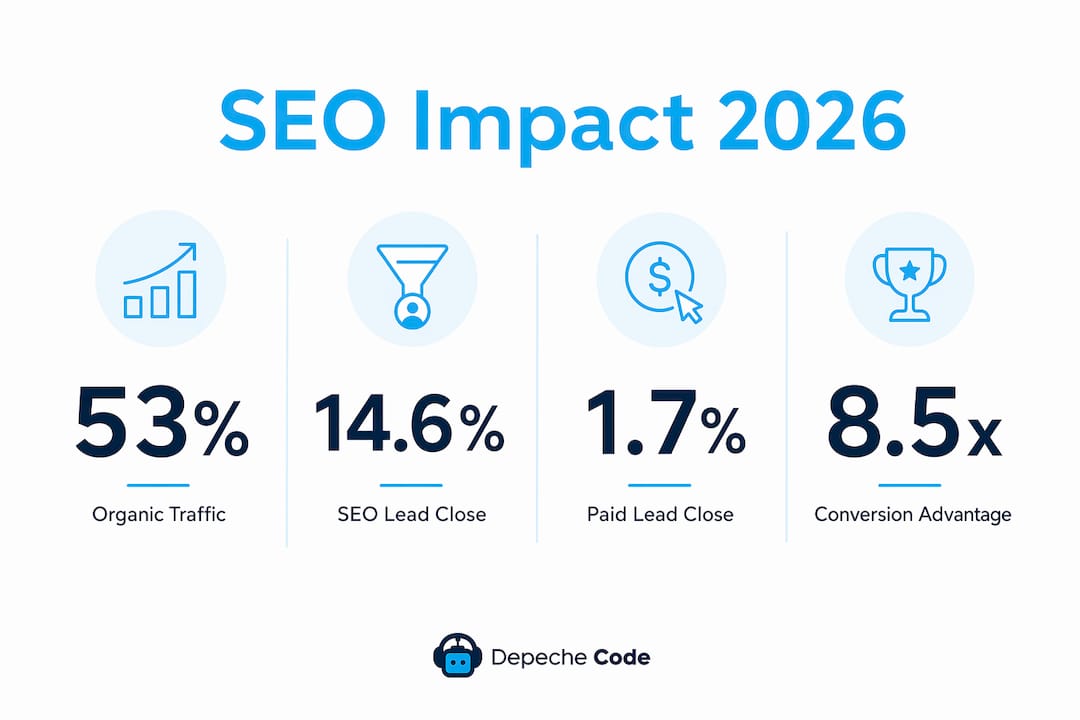
The financial case for SEO investment in 2026 is stronger than at any prior point. Organic search drives 53% of all tracked website traffic, surpassing paid search, social media, email, and direct visits combined. That majority share means organic visibility is not a marketing channel. It is the marketing channel.
Lead quality from organic search compounds this advantage. SEO leads close at 14.6%, compared to 1.7% for paid outbound leads. That is an 8.5x difference in conversion rate, driven by intent. Users who find your business through organic search are actively looking for what you offer. Users who see a paid ad are not necessarily in the same mindset.
The AI era adds a third conversion layer on top of this. AI-referred traffic converts at 23 times the rate of traditional search traffic. Visitors arriving from AI-generated summaries have already received a pre-qualified answer and are clicking through to confirm or act. This makes AI Overview inclusion not just a visibility win but a revenue event.
Consider the trust dimension as well. Consumers consistently rate organic search results as more credible than paid ads. When your business appears in both an AI Overview and the organic results below it, you occupy two trust signals simultaneously. That dual presence is only achievable through strong SEO.
- Organic traffic share: 53% of all tracked visits, making SEO the single largest traffic driver.
- Conversion rate advantage: SEO leads convert at 8.5x the rate of paid outbound efforts.
- AI traffic quality: AI-referred visitors convert at 23x the rate of standard search visitors.
- Long-term ROI: SEO compounds over time. Unlike paid campaigns that stop generating results the moment budgets are cut, SEO-built authority continues driving traffic for years.
Pro Tip: Track your AI Overview appearances using Google Search Console’s “Search type” filter alongside tools like BrightEdge. If your impressions from AI features are low despite strong rankings, your content likely needs better structured data and clearer answer formatting.
Practical SEO strategies for staying competitive in 2026
Knowing why SEO matters is only half the equation. The other half is execution. These are the strategies that separate businesses gaining ground in 2026 from those losing it.
- Audit technical SEO first. Crawlability and indexability are prerequisites for everything else. Use Google Search Console to identify coverage errors, and verify that your robots.txt file is not accidentally blocking key pages. Check your Core Web Vitals scores, since page experience remains a ranking signal.
- Implement structured data across all key page types. FAQ schema, Article schema, and LocalBusiness schema each improve your eligibility for AI extraction. This is one of the highest-leverage technical changes available to most business websites right now.
- Create content with clear topical authority. Publish content clusters around your core service areas rather than isolated blog posts. A cluster of five interlinked pages on a topic signals deeper expertise than five unrelated articles. Review the SEO best practices checklist to audit your current content architecture.
- Build high-quality backlinks from relevant sources. Domain authority still matters. Guest contributions to industry publications, partnerships with complementary businesses, and digital PR campaigns remain the most reliable methods for earning authoritative links.
- Manage your bot policies with llms.txt. A new metadata standard called llms.txt is emerging as a way for webmasters to communicate content permissions to AI crawlers specifically. Adding this file to your site gives you control over which content AI systems can use, a dimension of SEO hygiene that did not exist two years ago.
Additional content priorities worth addressing:
- Write definitions and direct answers at the top of each page section, not buried in paragraph three.
- Use numbered lists and tables for processes and comparisons, since these formats are extracted more reliably by AI systems.
- Refresh older high-traffic pages with updated statistics and current examples. Stale content loses both ranking position and AI citation eligibility over time.
Key takeaways
SEO in 2026 is the foundational layer beneath both traditional search rankings and AI-generated visibility, making it the single most important long-term investment for business owners and digital marketers.
| Point | Details |
|---|---|
| AI search amplifies SEO’s value | AI Overviews cite well-optimized pages, so SEO performance directly determines AI inclusion. |
| Technical SEO is non-negotiable | Crawlability, structured data, and HTTPS are prerequisites before any content quality judgment is made. |
| Organic traffic dominates | Organic search drives 53% of all tracked website traffic, more than paid and social combined. |
| Lead quality advantage | SEO leads convert at 8.5x the rate of paid outbound leads, making organic traffic the highest-intent channel. |
| Answer-ready content wins twice | Pages designed with FAQ schema and clear structure rank in traditional results and appear in AI summaries. |
Why I think most businesses are still underestimating SEO in 2026
After working with businesses across industries on their digital presence, I keep seeing the same mistake: companies treat SEO as a one-time project rather than an ongoing infrastructure investment. They optimize a site, see rankings improve, and then redirect budget to paid ads the moment results plateau. Six months later, they are back to square one, paying for traffic they could have owned.
The AI shift has made this mistake more costly. When AI Overviews dominate the top of search results, the businesses that appear in those summaries are the ones with years of accumulated SEO authority. You cannot buy your way into an AI citation. You earn it through consistent, high-quality content and technical discipline over time.
What I find most interesting about the current moment is that many businesses are paralyzed by the complexity of AI search, waiting to see how things settle before investing. That hesitation is a gift to competitors who are building authority right now. The organic SEO strategies that compound most effectively are the ones started earliest.
SEO is not a legacy tactic being replaced by AI. It is the infrastructure that AI search runs on. Businesses that understand this distinction will own their categories in 2026 and beyond. Businesses that do not will find themselves paying more for paid ads to compensate for the organic visibility they chose not to build.
— Donovan
How Depechecode helps businesses win with SEO in 2026
Depechecode is a full-service digital agency based in Orlando that builds and executes SEO strategies aligned with Google’s 2026 guidance and AI search requirements. From technical audits and structured data implementation to content strategy and authority building, the team handles every layer of organic visibility. Whether you are starting from scratch or scaling an existing presence, Depechecode’s SEO options and plans are built for businesses that want sustainable growth, not short-term traffic spikes. For businesses that also need a technically optimized foundation, the agency’s website design and development service delivers sites built for both user experience and search performance from day one.
FAQ
Why is SEO still relevant in 2026 with AI search growing?
SEO is the foundation that AI search systems depend on. Google’s AI Overviews pull content from crawlable, well-structured, high-authority pages, meaning strong SEO is the prerequisite for AI visibility, not a competitor to it.
How does SEO impact lead quality and conversions?
SEO leads close at a 14.6% rate compared to 1.7% for paid outbound leads, an 8.5x difference driven by search intent. Visitors arriving through organic results are actively seeking what you offer, making them significantly more likely to convert.
What SEO strategies matter most for AI search in 2026?
Structured data implementation, FAQ schema, clear topical authority, and answer-ready content formatting are the highest-leverage tactics for appearing in AI Overviews alongside traditional rankings.
Is there a separate optimization method for AI search engines?
No. Google’s official May 2026 guidance confirms there is no separate AI optimization method. The same crawlability, unique content, and quality signals that drive traditional rankings also determine AI inclusion.
How much of website traffic still comes from organic search?
Organic search drives 53% of all tracked website traffic according to BrightEdge, making it the single largest traffic source and the strongest argument for sustained SEO investment in 2026.