

TL;DR:
- High-quality web design is essential for increasing conversions, building trust, and boosting search rankings. Investing in professional, performance-driven websites yields 2-3 times higher long-term ROI compared to DIY templates. Regular updates and optimization transform a website into a scalable, revenue-generating business asset.
Quality web design is the single most measurable factor separating high-converting websites from digital dead weight. About 75% of consumers judge a company’s credibility based solely on its website design. That judgment happens in seconds, before a visitor reads a word of your copy or sees your pricing. For business owners, this means your website is not a marketing accessory. It is your most active sales asset, working around the clock. Understanding why quality web design pays off starts with recognizing that design decisions directly affect trust, traffic, and revenue, not just aesthetics. Tools like Google Analytics and Core Web Vitals make these impacts measurable from day one.
Why quality web design pays off: conversions and customer trust
The most direct benefit of good web design is a higher conversion rate. User experience (UX) design removes friction from the path to purchase. When navigation is clear, calls to action are visible, and pages load fast, visitors move forward instead of bouncing.
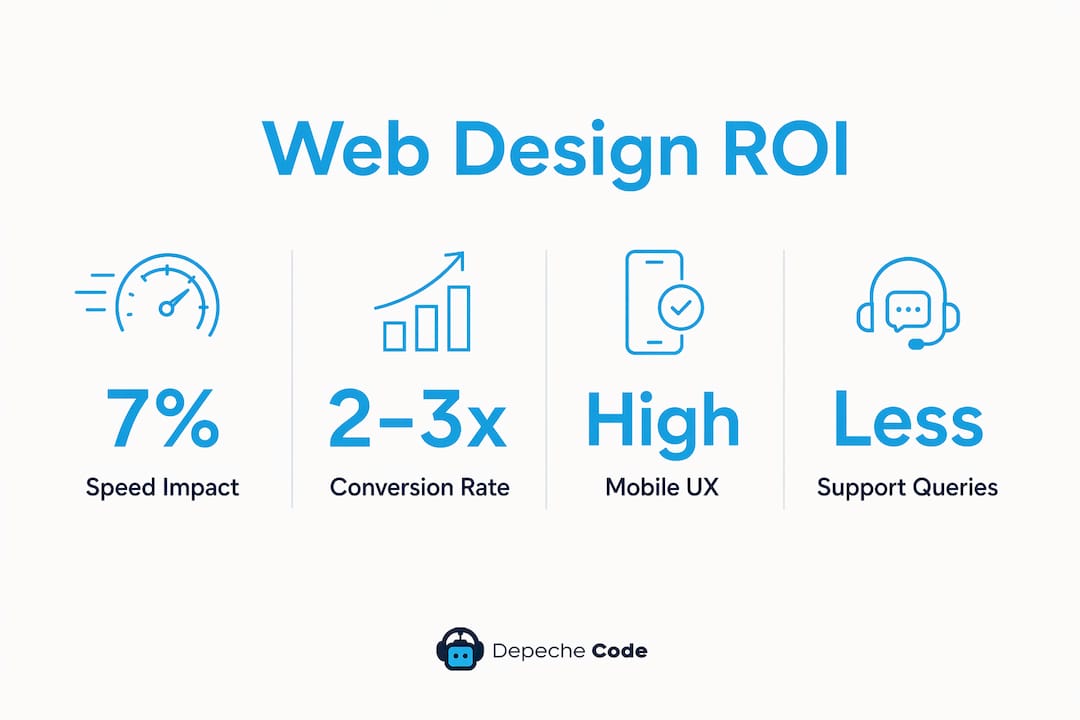
Page speed alone carries serious financial weight. A one-second delay in load time reduces conversions by 7%. Sites that take five or more seconds to load see bounce rates spike by up to 90%. That means a slow site is not just annoying. It is actively costing you customers every single day.
Visual consistency matters just as much as speed. Consistent branding and professional visuals signal business stability and reliability to first-time visitors. A mismatched color scheme or outdated layout communicates the opposite. Consumers associate polished design with trustworthy businesses, and that association drives purchasing decisions.
Here is what separates high-performing sites from average ones:
- Fast load times: Pages under two seconds retain significantly more visitors than slower alternatives.
- Clear navigation: Visitors find what they need without guessing, reducing drop-off at every stage.
- Mobile responsiveness: A site that breaks on a phone loses the majority of modern web traffic.
- Visual hierarchy: Strategic use of typography, color, and spacing guides the eye toward conversion points.
- Trust signals: Professional photography, consistent branding, and visible contact information all reduce purchase hesitation.
Website design and interaction positively and significantly affect electronic customer satisfaction, often more than the informational content itself. That finding reframes the entire design conversation. You are not just building a pretty page. You are engineering a trust experience.
What web design components actually deliver business ROI?
Not every design decision carries equal financial weight. The components that produce the strongest return fall into three categories: visual and interactive features, technical infrastructure, and system integrations.
| Design Component | Direct ROI Impact | Indirect ROI Impact |
|---|---|---|
| Page load speed | Lower bounce rate, higher conversions | Better Google rankings |
| Mobile responsiveness | Retains mobile traffic | Improved SEO performance |
| Intuitive navigation | Reduces support inquiries | Higher repeat visit rate |
| Consistent visual branding | Builds purchase confidence | Stronger brand recall |
| CRM and payment integration | Faster checkout, fewer abandoned carts | Scalable growth without rebuilds |
| SEO-friendly page structure | More organic traffic | Lower customer acquisition cost |
Search engines prioritize technical performance, including speed and mobile responsiveness, when determining rankings. A professionally built site earns better organic visibility, which means lower paid acquisition costs over time. That compounding effect is one of the most undervalued benefits of good web design.
Intuitive navigation reduces customer service burden by letting users find answers themselves. Fewer support tickets mean lower operational costs. For a business running lean, that savings is real and recurring.
Integration with CRMs, payment gateways, and marketing automation tools future-proofs the site. Professional architecture adapts as your business grows, without requiring a full rebuild every two years. That scalability is a direct cost saving that template-based sites rarely offer.
Pro Tip: Before your next design project, audit your current site’s Core Web Vitals in Google Search Console. The report identifies specific speed and layout issues that are suppressing your rankings and conversions right now.
Professional design vs. DIY templates: what is the real cost difference?
The upfront cost of a DIY or template-based website looks attractive. The long-term cost tells a different story.
| Factor | Professional Design | DIY or Template |
|---|---|---|
| Conversion rate | 2–3x higher on average | Baseline or below average |
| SEO performance | Optimized from build | Often requires costly fixes |
| Mobile experience | Fully responsive | Inconsistent across devices |
| Rebuild frequency | Low, scalable architecture | High, every 2–3 years |
| Brand consistency | Controlled and deliberate | Limited by template constraints |
| Support and maintenance | Included or available | Self-managed, time-intensive |
Professional sites typically deliver 2–3x higher conversion rates compared to DIY or template alternatives. If your current site converts at 1%, a professional redesign could push that to 2–3% with the same traffic volume. For a business generating 1,000 monthly visitors, that difference is the gap between 10 and 30 new leads per month.
Poor design causes compounding lost revenue through lost leads, stagnant SEO, and damaged brand perception. Every month you stay on an underperforming site, competitors capture market share and your domain authority falls further behind. The cost of delay is not a one-time loss. It accumulates.
Template sites also create a ceiling. They cannot easily integrate with advanced CRMs, custom checkout flows, or third-party APIs without expensive workarounds. A business that outgrows its template faces a full rebuild anyway, often at a higher cost than starting professionally from the beginning.
Pro Tip: If your site is more than three years old, run it through Google PageSpeed Insights and GTmetrix. If your mobile score is below 70 or your load time exceeds three seconds, a website redesign is likely overdue.
How to maximize your return from a web design investment
Getting the most from a professional web design project requires more than hiring a skilled agency. You need a clear strategy before the first wireframe is drawn.
-
Define measurable business goals first. Decide whether you are optimizing for lead generation, e-commerce sales, appointment bookings, or brand awareness. Each goal requires different design priorities, and vague briefs produce vague results.
-
Choose designers who prioritize technical performance alongside visuals. Ask candidates about their approach to Core Web Vitals, mobile-first design, and on-page SEO structure. A beautiful site that loads slowly or ranks poorly is a missed opportunity.
-
Build SEO into the architecture from day one. Page structure, heading hierarchy, schema markup, and internal linking all affect how search engines index your content. Retrofitting SEO onto a poorly structured site costs more than building it correctly upfront.
-
Set up tracking before launch. Install Google Analytics 4, configure conversion goals, and connect Google Search Console before your site goes live. You cannot improve what you do not measure.
-
Plan for ongoing updates. Good design supports long-term growth by building customer relationships and improving SEO visibility over time. A site that never changes loses relevance. Schedule quarterly content updates and annual performance audits.
User-friendly websites improve customer retention by making engagement easy and repeatable. Positive experiences drive repeat visits, and repeat visitors convert at higher rates than cold traffic. That loyalty loop is one of the strongest long-term returns on a design investment.
For businesses exploring custom web solutions, the architecture decisions made at the start of a project determine how much the site can grow without expensive overhauls later.

Key takeaways
Quality web design is a direct revenue driver, not a cosmetic upgrade, because it simultaneously improves conversion rates, search rankings, customer trust, and long-term scalability.
| Point | Details |
|---|---|
| Speed drives conversions | A one-second load delay cuts conversions by 7%; keep pages under two seconds. |
| Trust is visual | 75% of consumers judge credibility from design alone, making visual quality non-negotiable. |
| Professional beats template | Professional sites convert at 2–3x the rate of DIY alternatives over the long term. |
| Design and SEO are linked | Technical design choices directly affect search rankings and organic traffic volume. |
| Delay compounds losses | Every month on an underperforming site, competitors gain ground and SEO authority erodes. |
The case for treating your website as infrastructure, not decoration
I have worked with enough business owners to recognize a pattern. The ones who treat their website as a one-time expense almost always end up spending more over five years than the ones who invested properly upfront. They rebuild twice, lose leads they never knew they had, and spend months trying to recover SEO ground that a well-built site would have held from the start.
The most common mistake I see is separating design from performance. A business will spend real money on a visually impressive site, then discover six months later that it scores 45 on Google PageSpeed and ranks on page four for every relevant keyword. Visual appeal without technical substance is a liability, not an asset.
The second mistake is treating a launch as a finish line. The sites that generate consistent ROI are the ones with owners who review their analytics monthly, update content regularly, and treat the site as a living business tool. High-quality website design principles are not applied once and forgotten. They require ongoing attention.
My honest recommendation: think of your website the way you think of your best salesperson. You would not hire someone and then stop investing in their development. Your site deserves the same logic.
— Donovan
How Depechecode helps businesses turn design into revenue
Depechecode is a full-service digital agency based in Orlando that builds websites designed to perform, not just impress. Every project starts with your business goals and ends with a site that is fast, mobile-ready, SEO-structured, and built to scale.
The team at Depechecode combines technical depth with real UX expertise, so your site works as hard as you do. From custom architecture to CRM integrations and ongoing maintenance, every engagement is built around measurable outcomes. If you are ready to stop leaving conversions on the table, explore Depechecode’s website design and development services or start with a free website build to see what a performance-first approach looks like for your business.
FAQ
How does web design directly affect sales?
Web design affects sales by controlling how easily visitors navigate to a purchase decision. Faster load times, clear calls to action, and mobile-friendly layouts all reduce friction and increase the percentage of visitors who convert.
What is the ROI of professional web design?
Professional web design typically delivers 2–3x higher conversion rates compared to template-built sites, with additional returns from improved SEO rankings and lower customer support costs over time.
How long does it take to see results from a redesign?
Most businesses see measurable improvements in bounce rate and engagement within the first 30–60 days after a professional redesign. SEO gains from improved technical structure typically appear within three to six months.
Why does page speed matter so much for business websites?
A one-second delay in page load time reduces conversions by 7%, and sites taking five or more seconds to load see bounce rates spike by up to 90%. Speed is a direct revenue variable, not a technical detail.
When should a business invest in a website redesign?
A redesign is worth prioritizing when your site is more than three years old, scores below 70 on Google PageSpeed Insights, or your conversion rate has stagnated despite steady traffic. Delaying a necessary redesign compounds lost revenue every month.