

A website support retainer is a recurring monthly agreement that pays a team to maintain, update and fix your site. You get predictable costs and people who already know your platform. It fits any business that depends on its website for leads or sales and cannot afford downtime, stale plugins or a slow response when something breaks.
TL;DR:
- Treat quick page edits as routine work, but require providers to define when requests become separately priced projects, such as adding a booking system.
- A published WordPress maintenance plan starts at $99 per month; custom platforms, ecommerce, integrations, and tighter response targets raise costs.
- A fast response only promises acknowledgment; require separate resolution targets, severity definitions, monitoring hours, escalation steps, and written rules for unused hours.
- Start with a short initial term, request a sample monthly report, and use actual ticket records to adjust hours or downgrade when usage falls.
Table of Contents
- What a website support retainer typically includes
- How much does a website support retainer cost?
- How retainer hours and SLAs work in practice
- How to choose a website support retainer: questions and a checklist
- What to expect in month one and every month after
- What does a retainer give you in return?
- How we structure retainers at Depeche Code
- How long does a website support retainer last?
- How to scale or adjust a retainer as your business changes
- How a retainer fits with SEO, hosting and chatbot maintenance
- Why the checklist beats the price tag
- Start with a scope review at Depeche Code
- FAQ
What a website support retainer typically includes
Most retainers cover a core set of recurring jobs, and the differences between vendors show up in how those jobs are scoped. When you read a proposal, map every line to one of the groups below so nothing is left vague.
- Core maintenance: CMS, plugin and theme updates, scheduled backups and security patching, tested before they reach your live site.
- Operations: bug fixes, troubleshooting, and monitoring for uptime and errors so problems are caught before customers report them.
- Content edits and small changes: copy updates, image swaps, new team bios, page tweaks and banner changes.
- Proactive work: performance tuning, SEO hygiene such as broken links and metadata checks, and small feature improvements.
- Optional add-ons: 24/7 monitoring, emergency response outside business hours, and custom development quoted separately.
The line between “small change” and “project” matters more than any other clause. A reasonable retainer treats a quick landing page edit as routine work and a new booking system as a scoped project. If the proposal does not say where that line sits, ask before signing.
For a concrete look at how one agency packages these tasks, read our WordPress maintenance plans page, and our guide to what small and midsize businesses need to know about maintenance plans. Our article on technical website support explains how troubleshooting workflows usually run once a request comes in.
Security deserves its own line item, not a mention in the footer. Vendors that publish how they handle access control, audit logging and governance, as Tasking, give you a useful benchmark for the questions to ask any provider who will touch your login credentials.
How much does a website support retainer cost?
Retainers are priced in several common ways, and knowing which one you are looking at is an important part of comparing quotes.
- Hourly bucket: you buy a fixed number of hours per month, and requests draw down from that balance.
- Tiered plans: defined scopes at set prices, usually named something like Starter, Growth and Prime, each adding coverage or faster response.
- Flat-fee retainers: one price for a specific list of deliverables, such as updates, backups and monitoring, with no time tracking.
What pushes the price up is rarely the number of pages. Custom-built platforms cost more to maintain than off-the-shelf ones, e-commerce adds payment and inventory risk, third-party integrations add things that can break, and tighter response targets mean staff must be available when you need them.
As a budgeting frame, think in broad cost bands. A low band covers a simple brochure site with updates, backups and monitoring. A medium band adds regular content edits and a few hours of fixes. A high band covers e-commerce or custom platforms with strict response times and proactive improvements.
For a published reference point, our WordPress maintenance plan is listed from $99 per month, and dedicated WordPress hosting is listed from $39 per month on the same page.
WordPress Maintenance starts from $99 per month. Anything beyond the plan scope, such as custom development, is quoted separately.
How retainer hours and SLAs work in practice
Hours and service levels are where retainers go wrong, because the language sounds precise while meaning very little. Four mechanics decide whether the arrangement works for you:
- Time tracking: a good provider logs every task in a ticketing tool and sends a regular summary, so you see where hours went and why.
- Hour rules: ask whether unused hours roll over, expire at month end, or carry a minimum monthly commitment. Rollover is friendly to you, but it is usually capped.
- Triage: urgent usually means the site is down, checkout is broken or a security issue is active. Everything else is routine and queued in order.
- SLA components: response time (when someone acknowledges the ticket), resolution time (when it is fixed), monitoring windows, and an escalation path when the first person cannot solve it.
Response and resolution are different promises. A rapid response with no resolution target only guarantees an acknowledgment. Our service level agreement checklist covers what to confirm in the written terms.
Add round-the-clock monitoring when your site earns revenue overnight or on weekends. Add separate emergency support when an hour of downtime costs more than the add-on.
Pro Tip: Ask for a sample monthly report before you sign. If the vendor cannot show you one, they probably do not produce one.
How to choose a website support retainer: questions and a checklist
Evaluate proposals on evidence of how a provider works, not on the length of the feature list. Weigh response times, experience with your platform, backup and recovery procedures, ticketing and approval flow, and reporting cadence.
- Scope: are the included tasks listed by name, with exclusions written down?
- Hours: how many, and what happens to unused ones?
- SLAs: response and resolution targets, with severity levels defined.
- Onboarding: what happens in month one, and who owns each step?
- Exit terms: how do you leave, and do you keep your backups, credentials and documentation?
Ask every prospective provider these questions:
- How quickly do you respond to an urgent issue, and how is urgent defined?
- How often do you back up the site, and when did you last restore one?
- What counts as a small change, and what becomes a separate project?
- Do unused hours roll over, and do they expire?
- How do I submit and approve requests?
- What does your monthly report contain?
- Who works on my site, and what happens if they are unavailable?
- What do I keep if I cancel?
Watch the wording of proposals. “Unlimited updates” with no fair-use definition, “priority support” with no stated time, and “as needed” scope all mean the vendor has left room to decide later. A clear provider is happy to put numbers in writing.
What to expect in month one and every month after
Onboarding sets the tone. A good onboarding looks like this:
- Audit: a review of the site’s current health, versions, vulnerabilities and speed.
- Backups: a verified backup taken before any change.
- Credential handoff: secure transfer of access, ideally through a password manager.
- Priority list: an agreed ranking of fixes and improvements.
- Staging setup: a safe copy of the site where updates are tested first.
After onboarding, expect regular reports with a maintenance log, a security and performance snapshot, and recommended work for the next period. Requests flow through a ticket, you approve anything that costs hours, and small edits are typically turned around promptly.
Pro Tip: Name one internal person who approves requests. Slow approvals, not slow vendors, are the most common reason retainer hours go unused.
Our business owner’s guide to technical support covers how to manage this handoff well.
What does a retainer give you in return?
A key benefit is financial: a predictable monthly spend replaces surprise invoices when a plugin conflict or hack lands at the worst moment. Resilience is another benefit. Faster detection and recovery protects revenue and reputation, because customers rarely forgive a checkout that fails during a campaign.
Small improvements also add up. Regular speed and SEO hygiene work keeps a site from slowly decaying. Finally, your team spends less time chasing vendors, and the people on your site already know its history, so they can diagnose problems without relearning the setup each time.
How we structure retainers at Depeche Code
We provide website maintenance and hosting support, so your site can be maintained alongside the environment it runs on. We start with an audit and a verified backup, set up a staging copy, agree a priority list with you, and then provide regular reports on what we did and what we recommend next. Anything urgent follows a defined escalation path, and anything outside the plan is quoted before we start.
We would rather show you a real monthly report and a written scope than ask you to take our word for it.
How long does a website support retainer last?
Most retainers run month to month or on a fixed term, and many renew automatically unless you cancel. Month to month gives you the freedom to leave, and it also tends to cost slightly more per month. A longer term can lower the price and buys the provider time to learn your site, but it locks you in if the service disappoints.
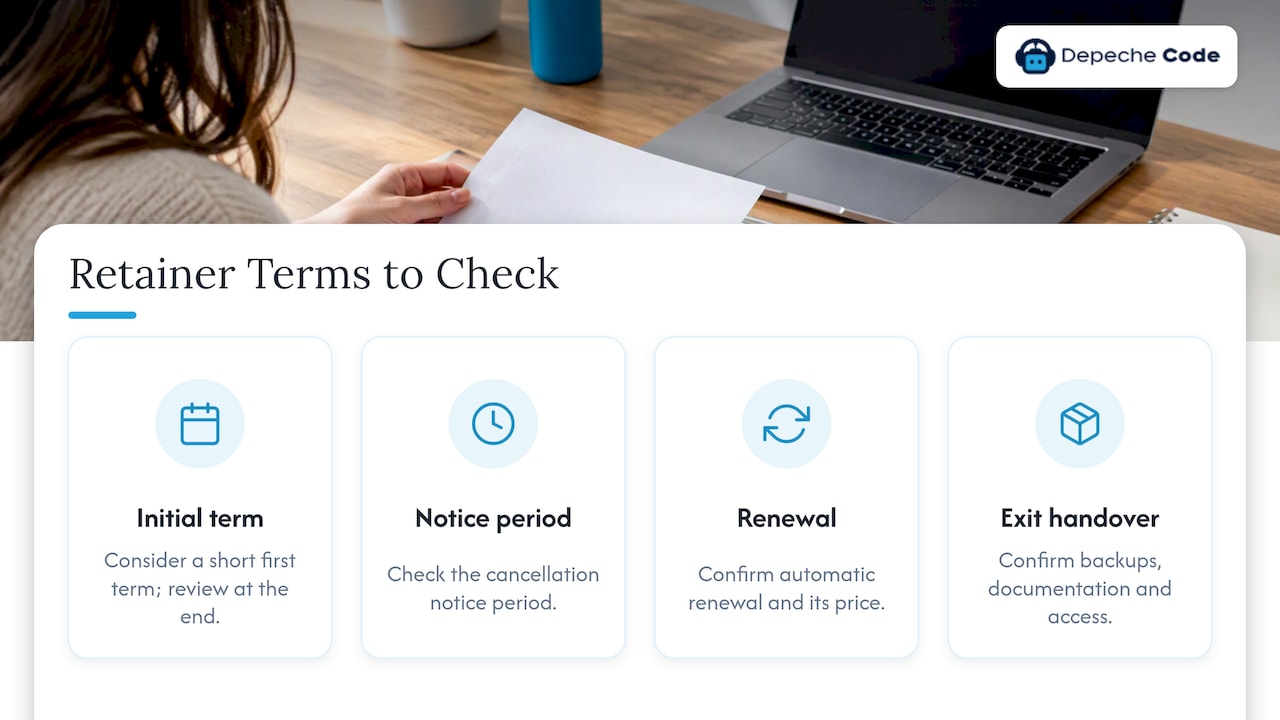
Before you sign, check four things: the length of the initial term, the notice period for cancellation, whether renewal is automatic and at what price, and what you receive on exit, including backups, documentation and access. A sensible approach for a first engagement is a short initial term, with a review at the end. If the reports are clear and issues are being resolved within the stated targets, extend. If not, you have lost little.
Renewal is also a good moment to renegotiate scope. Regular reports show whether you used all your hours, which tasks consumed the most time, and what the site actually needs. Use that evidence to adjust the plan, not just to sign the same contract again.
How to scale or adjust a retainer as your business changes
A retainer should follow your business, not trap it in last year’s needs. Growth usually shows up as one of three signals: you keep running out of hours before month end, you add a store, integration or new site section, or downtime starts to cost more than it did.
When that happens, you can move up a tier, add hours, or add a specific service such as extended monitoring. When the opposite happens and hours go unused for several months, step down or switch to a lighter plan instead of paying for capacity you do not touch.
Ask providers how plan changes work before you need one. Can you upgrade mid-month? Is a downgrade effective immediately or at the next billing date? Are there fees? The best arrangements allow changes with a short notice period and apply them cleanly at the next cycle.
Use the monthly reports to decide. If the same category of work keeps appearing, such as repeated content edits or recurring performance fixes, that is a signal to reshape the plan around it, or to move that work into a scoped project.
How a retainer fits with SEO, hosting and chatbot maintenance
A website rarely stands alone. Hosting, search optimization and chatbots all depend on the site staying healthy, and they work better when one team coordinates them.
Hosting: the host controls server speed, uptime and backup storage. A retainer provider who also understands your hosting can fix problems at both levels, instead of passing blame between two vendors.
SEO: technical SEO depends on clean, fast, error-free pages. Retainer work such as fixing broken links, maintaining metadata and keeping pages fast supports your search plan directly. Automated auditing tools, like those from BabyLoveGrowth, show how technical checks can feed a regular maintenance routine. You can see how our own SEO options and plans work alongside site upkeep.
Chatbots: an AI chat bot is a website feature, so it needs the same care as any other: compatibility after updates, content updates when your offers change, and monitoring when it stops responding.
Bundling does not mean buying everything. It means asking whether each service has a named owner, so a speed problem, a ranking drop or a broken chat widget never falls between vendors.
Why the checklist beats the price tag
Most buyers compare retainers by monthly price, and that is the weakest comparison available. Price tells you what you pay, not what you get. A cheap plan with vague scope, no stated response time and no reporting costs far more the first time something breaks and nobody owns it.
My view: judge a retainer by its written promises. A response time, a definition of urgent, a rule for unused hours, a sample report and clear exit terms tell you more than any feature list. The reverse is also true: “unlimited” and “priority” with no numbers should lower your trust, not raise it.
Conventional advice says to buy the most hours you can afford. I would start smaller. Run a short first term, read the reports, and learn what your site actually consumes. Most sites need steady, boring maintenance and a few quick edits, not a large block of hours. Put your first effort into scope and response time, then into hours, and last into price.
— Donovan Wells – Founder and CEO
Start with a scope review at Depeche Code

If you want a team that already knows how to run this, we offer WordPress maintenance and hosting. Here are three ways to begin:
- Request a scope review of your current site and support needs.
- Schedule a consultation to talk through tiers, hours and response targets.
- Start with a basic maintenance plan, then adjust it as the reports come in.
See our WordPress hosting and maintenance services to get started today.
FAQ
How much does it cost to hire someone to maintain a website?
Cost depends on platform complexity, scope and response targets. A basic maintenance plan is a small monthly fee, while e-commerce and custom sites cost more. Our WordPress Maintenance plan is listed from $99 per month.
What does retainer mean in business?
A retainer is a recurring payment that reserves a provider’s time or services for a defined scope. You pay on a regular schedule so help is available when you need it. The arrangement trades a predictable cost for priority access.
What is a retainer in freelance work?
In freelance work, a retainer is an ongoing monthly agreement where a client pays for a set amount of work or availability. It gives the freelancer steady income and gives the client faster turnaround. The scope and hours are written into the agreement.
What does a website support retainer include?
It usually covers updates, backups, security patching, monitoring, bug fixes and small content edits. Larger builds and new features are normally quoted separately. Always confirm the exclusions in writing.