

TL;DR:
- Prioritizing user experience leads to higher revenue, better customer loyalty, and reduced operational costs. Ethical UX builds trust and encourages long-term engagement by respecting user autonomy and transparency. Implementing continuous testing and aligning UX metrics with business goals drives measurable improvements and competitive advantage.
User experience (UX) is defined as every interaction a person has with a digital product or service, from the moment they land on a page to the final step of a transaction. Businesses that treat UX as a strategic priority see measurable gains in conversions, customer loyalty, and operational efficiency. 47% of users expect a page to load in 2 seconds or less, and retail loses $2.6 billion annually to slow load times alone. That single data point reframes UX from a design preference into a direct revenue driver. Understanding what UX design actually means in 2026 is the first step toward making it work for your bottom line.
Why prioritize user experience over other business investments?
The core argument for UX investment is straightforward: friction costs money. Every extra click, confusing label, or slow-loading page pushes users toward a competitor. Adobe frames UX as every digital interaction across platforms, which means a poor experience on one channel contaminates the perception of your entire brand.
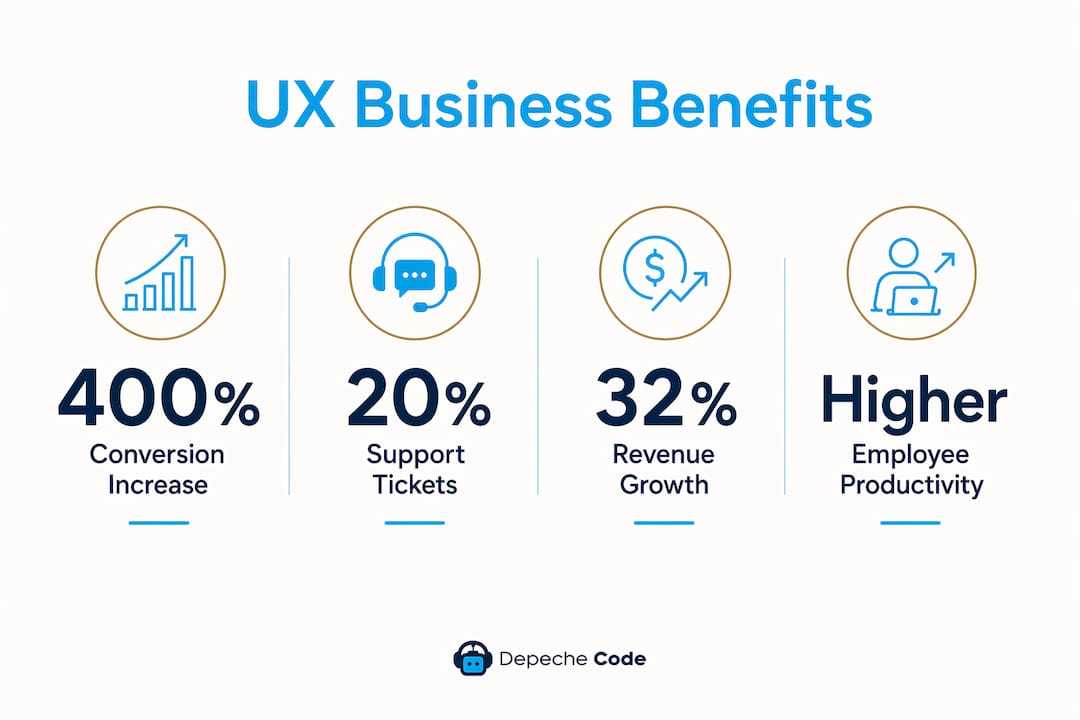
The business case becomes even clearer when you look at retention. Companies with mature UX practices see 32% higher revenue growth and 56% higher shareholder returns compared to those that treat design as an afterthought. That gap exists because UX reduces the wasted effort users experience, which directly lowers churn and increases lifetime value.

Decision-makers often ask whether UX competes with product development or marketing for budget. The answer is that it multiplies the return on both. A well-designed product needs less paid acquisition to convert, and a clear interface reduces the volume of support tickets your team handles every week.
How does prioritizing UX improve customer satisfaction and loyalty?
Customer satisfaction and UX are not separate metrics. They are the same measurement taken from different angles. When users complete tasks without confusion or delay, satisfaction scores rise automatically.
Forrester identifies emotional resonance and trust as the two factors that convert satisfied users into loyal advocates. A user who trusts your interface returns without needing a promotional nudge. That trust is built through consistency, clarity, and the absence of deceptive patterns.
The PwC data on this point is striking. 73% of global consumers say a positive experience is the primary driver of brand loyalty, and customers are willing to pay a 16% premium for quality experiences. This means UX is not just a retention tool. It is a pricing lever.
“Bad experiences drive 60% of consumers to abandon brands entirely, regardless of product quality or price.” — PwC Global Consumer Insights Survey
The loyalty equation breaks down like this:
- Reduced friction keeps users from abandoning tasks mid-session, which directly improves completion rates and repeat visits.
- Consistent design patterns across web, mobile, and email lower the cognitive effort required to interact with your brand.
- Transparent communication at every touchpoint, from error messages to checkout flows, builds the trust that converts one-time buyers into repeat customers.
- Responsive performance signals that your business respects the user’s time, which is one of the strongest emotional drivers of brand preference.
Each of these factors compounds over time. A user who completes a frictionless purchase once is statistically more likely to return, refer others, and resist competitor offers.
What are the measurable business benefits of good UX design?
The ROI of UX is no longer theoretical. Fully optimized UX design can produce up to a 400% increase in conversion rates. That figure comes from comparing poorly structured interfaces against redesigned versions with clear hierarchy, reduced steps, and faster load times. The improvement is not incremental. It is transformational.
Beyond conversions, the cost savings in development are equally significant. Fixing a UX problem during the design phase costs up to 100 times less than correcting the same issue after a product has launched. Engineering hours, QA cycles, and customer complaints all compound when UX is treated as a post-launch concern rather than a pre-launch discipline.
The table below summarizes the primary business outcomes tied to UX investment:
| Business outcome | Impact |
|---|---|
| Conversion rate improvement | Up to 400% with fully optimized UX design |
| Development cost savings | Issues fixed in design phase cost up to 100x less |
| Revenue growth | Companies with mature UX see 32% higher revenue growth |
| Customer retention | 73% of consumers cite positive experience as loyalty driver |
| Support cost reduction | Intuitive design enables self-service and lowers ticket volume |
Employee productivity is another underreported benefit. When internal tools and customer-facing platforms share clear design standards, employees complete tasks faster and make fewer errors. Adobe’s research confirms that UX improvements reduce support costs by enabling self-service, which applies equally to internal users navigating enterprise software.
Pro Tip: Track UX ROI by measuring support ticket volume before and after a redesign. A 20% reduction in tickets is a direct cost saving you can present to any CFO.
How does ethical UX design build long-term user trust?
Usability is the floor, not the ceiling, of good UX. The ceiling is ethical design: experiences that are transparent, respectful of user autonomy, and free from manipulative patterns. Forrester warns that coercive design patterns, such as hidden unsubscribe links, forced account creation, or misleading default settings, frustrate customers and erode the trust that took years to build.
Aligning your brand promise with your actual customer experience is where the biggest revenue opportunity lives. Forrester’s Total Experience framework shows that companies achieving this alignment see up to 8x revenue uplift in certain industries. The gap between what a brand promises in its marketing and what users actually experience on the website is one of the most expensive misalignments in business.
Ethical UX design rests on four principles:
- Clarity over cleverness. Every label, button, and instruction should communicate its purpose without requiring interpretation.
- Respect for user data. Consent flows and privacy settings should be easy to find and genuinely controllable by the user.
- Honest feedback loops. Error messages should explain what went wrong and how to fix it, not just display a code.
- Inclusive design. Accessibility features like screen reader compatibility and sufficient color contrast serve users with disabilities and improve usability for everyone.
When users feel respected by a digital experience, they extend that trust to the brand behind it. That emotional connection is what separates companies with loyal communities from those constantly fighting churn.
What practical steps can businesses take to prioritize UX strategically?
Embedding UX as a strategic priority requires structural changes, not just design updates. The following steps give business leaders a clear path forward.
-
Align UX metrics with business KPIs. Conversion rate, session duration, task completion rate, and Net Promoter Score should all appear on the same dashboard. When UX data sits in a separate design tool that executives never open, it gets deprioritized. Connecting UX to conversion outcomes makes the business case visible at every level.
-
Run continuous, small-scale user testing. Testing with as few as 5 users per round identifies the majority of usability problems. Smaller, frequent tests outperform large annual studies because they catch issues before they compound. Schedule monthly sessions rather than quarterly audits.
-
Reduce cognitive load across every interface. UX design that reduces visual noise improves content comprehension by up to 20%. White space, legible typography, and clear visual hierarchy are not aesthetic preferences. They are performance variables that affect how quickly users reach decisions.
-
Build cross-functional UX ownership. Product, marketing, customer service, and engineering teams each touch the user experience at different points. When these teams share UX data and collaborate on improvements, the result is a consistent experience across channels rather than a patchwork of disconnected touchpoints. Practical website redesign guidance can help teams align on shared UX goals from the start.
-
Prioritize page speed as a UX variable, not a technical afterthought. A 3-second mobile load time increases bounce rate by 32%. Speed is the first impression your UX makes, and it determines whether any other design decision gets the chance to matter.
Pro Tip: Set a quarterly UX review cadence where one cross-functional team presents a single friction point and a proposed fix. Small, consistent improvements outperform large redesigns in both cost and adoption speed.
Key takeaways
Prioritizing user experience drives measurable revenue growth, reduces operational costs, and builds the customer loyalty that no advertising budget can manufacture.
| Point | Details |
|---|---|
| UX is a revenue driver | Companies with mature UX practices see 32% higher revenue growth and 56% higher shareholder returns. |
| Speed is a UX metric | A 1-second load delay reduces conversions by 20%; retail loses $2.6B annually to slow load times. |
| Ethical design builds trust | Transparent, respectful UX converts satisfied users into loyal advocates who resist competitor offers. |
| Fix issues early | Resolving UX problems in the design phase costs up to 100x less than post-launch corrections. |
| Test small and often | Testing with just 5 users per round identifies most usability issues faster than large-scale studies. |
UX belongs in the boardroom, not just the design studio
I have worked with enough business leaders to know that UX gets misclassified as a visual concern. Executives approve budgets for features, infrastructure, and paid media, then wonder why conversion rates stagnate. The answer is almost always friction that no one measured because no one was looking.
The shift I have seen in companies that get this right is not a design overhaul. It is a mindset change at the leadership level. When a CMO asks “what is the user’s experience at this step?” in a product meeting, the entire team starts thinking differently. UX stops being a deliverable and becomes a lens.
What frustrates me most is the capability gap argument. I hear it often: “We have great technology, but users aren’t adopting it.” That is a UX failure, not a technology failure. The tool’s value is irrelevant if users cannot access it without effort. Reducing that effort is the entire job.
The companies winning in 2026 are not the ones with the most features. They are the ones whose users never have to think about how to use what they built. That is the standard worth funding.
— Donovan
How Depeche Code helps businesses build UX that converts
Depeche Code is a full-service digital agency based in Orlando that builds websites and digital experiences designed around user behavior, not assumptions. Every project starts with a clear understanding of how your customers interact with your brand online, and every design decision is tied to a measurable outcome.
From professional website design and development to AI chatbot integration and SEO strategy, Depeche Code gives businesses the tools to close the gap between what they offer and what users actually experience. If your current site is losing conversions to friction, slow load times, or unclear navigation, the team at Depeche Code can identify exactly where users drop off and build a solution that keeps them moving forward.
FAQ
Why does user experience matter more than product features?
Users abandon products that are difficult to use regardless of feature quality. Reducing friction and simplifying workflows drives adoption faster than adding capabilities.
What is the ROI of investing in UX design?
Fully optimized UX can increase conversion rates by up to 400%, and fixing UX issues during the design phase costs up to 100 times less than post-launch corrections.
How does UX affect customer retention?
73% of global consumers identify positive experience as the primary driver of brand loyalty, meaning UX directly determines whether customers return or switch to a competitor.
How often should businesses test their UX?
Monthly small-scale tests with as few as 5 users per session identify most usability problems faster and more cost-effectively than large annual studies.
What makes UX design ethical?
Ethical UX avoids manipulative patterns like hidden unsubscribe links or forced account creation, and instead prioritizes clarity, honest feedback, and genuine user control over data and settings.